With the Affordable Health Care Act health insurance is being extended to the uncovered American public in two primary ways.  And the cost is levied in two ways as well.

The first is through employers; employees are covered through group health plans provided by employers. They bear the expense, except that there are incentives that flow to them from the federal level. The way that the insurance is provided is not through a centralized system, such as in Great Britain or Sweden, but rather through health insurance exchanges. These are competitive private sector networks from which people select their plans. The insurance companies lobbied hard for this and succeeded. It is a private sector solution.

The second is through the extension of government subsidized insurance like Medicaid. This will cover the unemployed, poor and disabled. In Missouri the expansion of Medicaid would cover another 300,000 people and add some 20,000 jobs to staff it. It is paid for with taxes, federal taxes.

Though extending Medicaid through state structures is far more efficient and keeps management control with the states, our Missouri House just blocked the attempt to add that funding for the coming year. It would have amounted to 900,000 and would be paid for by the federal government to the state.

Opposition stated that the state should not position itself in such a way that in coming years, if federal money dries up, the state would be left holding the bag. In addition, running up the federal deficit is not good policy either. Those are interesting arguments. In fact, they are familiar arguments. I have just finished reading the recent biography of FDR by H.W. Brands entitled, Traitor to his Class (Doubleday, 2008). The arguments against the establishment of unemployment insurance and social security ran exactly the same way. By today, however, social security is seen as an important part of our security fabric, right along with Medicare. At the time and much like the Affordable Health Care Act today, it was hotly disputed and barely came into law.

The second reason the Missouri House did not vote to extend Medicaid benefits to uninsured Missourians was much more ideological. They may not have been able to block the Affordable Care Act but they can attempt to block it from happening on the state level. The thing is, this is coming to the state one way or another. Ideological resistance may play well politically (I’ll do everything in my power to block this socialized Obamacare…), but reality is that Missourians can choose to determine the form this takes on the state level or not. It is much more efficient and effective to utilize our existing structures and extend them with federal money and more Missouri jobs than to make room for a free-standing federal program to do the same thing.

As we have discovered, however, practicality and efficiency have much less to do with this than political ideology. We are losing a great opportunity, not only to do the best with the situation in which we find ourselves, but to make sure that the most people possible get the health care they need. Other strategies have not succeeded to date. If they had the solutions they propose would already be in place. Our strategy up unto the present has been to ignore the problem and let the poor keep showing up in emergency rooms – the most expensive and inefficient way to deliver care.

What the Missouri House has demonstrated for all the world to see is the vast capacity of human beings to do the wrong thing for supposedly the right reasons. It’s a travesty and embarrassment.

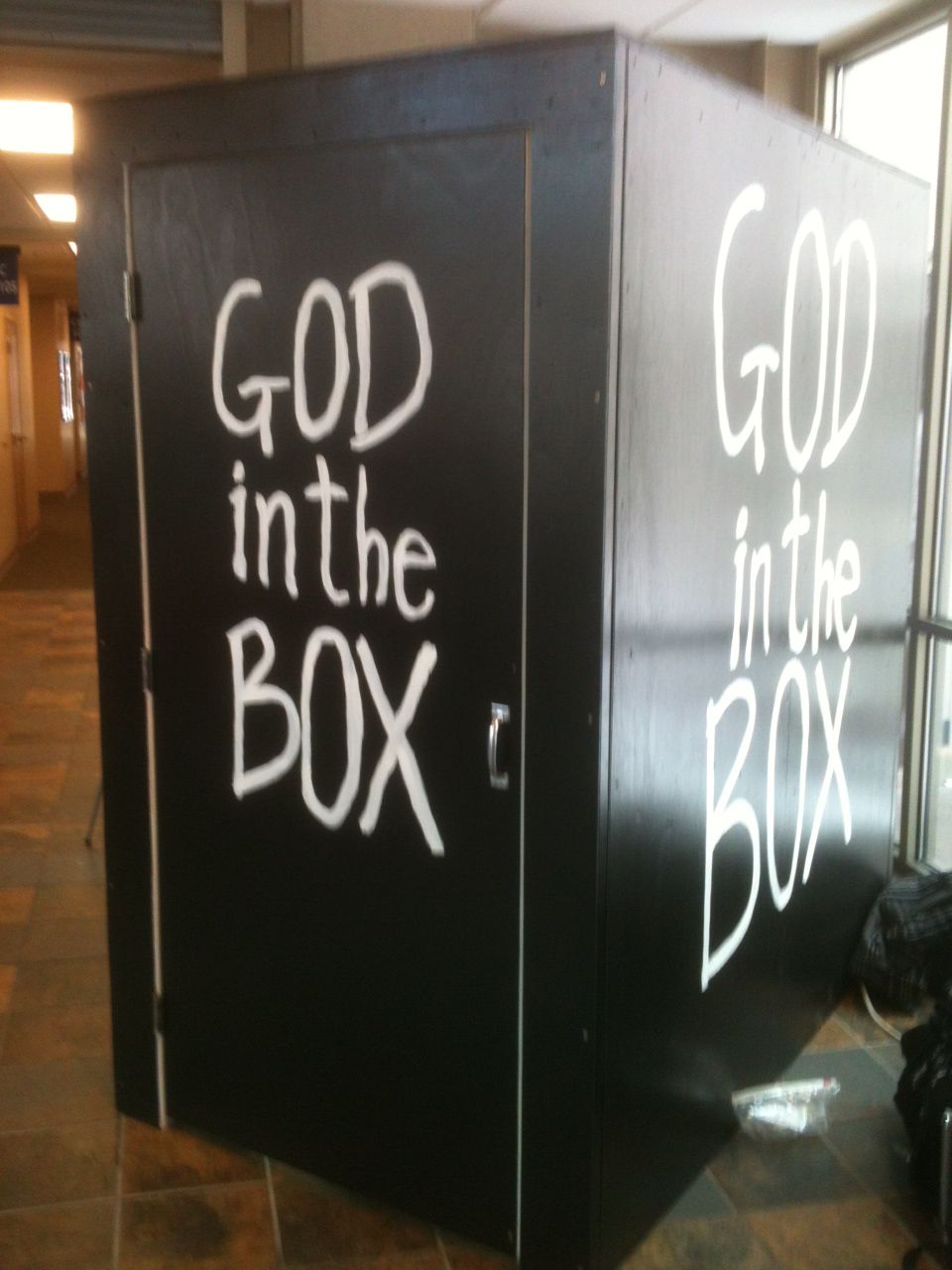
God BoxOn March 21 the community of Columbia, Missouri gathered to witness the premier of the documentary, God in the Box. Director Nathan Lang was in attendance for Q&A. And as a great surprise we trucked out our own short-short version created with our own God Box. In the weeks preceding our event we had been videoing people around the city. Director and editor Caitlin DeSpain put together this charming video. I’m struck by its honesty and the way universal questions are posed. How would you answer the question, “What does God mean to you?” Watch the documentary here for yourself:

This weekend a number of us who had participated in mission trips to Ecuador over the years gathered for a reunion. The impetus for our gathering was the death of friend Victor Vaca, who passed only a couple of years after his wife and our friend, Violet. We gathered to remember them and what we we shared together. All of that reminded me of a story out of Victor’s life.

Victor was a native Ecuadorian married to a true Minnesotan. They served for decades together among the poorest of Ecuador’s people. But early on they were appointed by our Division of Overseas Ministry to Paraguay. This was in the 1970s in a particularly volatile time. A right wing military government was in power, much like in Chile, and the death squads were rampant. Victor and Violet had the opportunity to get out but they decided to stay – for the sake of those they served.

In the midst of that political environment anyone who worked for and with the poor – to advocate for their rights and better conditions, challenging the oppressive system that kept the powerful in power – were seen as seditionists. The last thing that fascists want is the poor to be empowered enough to speak and organize. And so those working with the poor automatically became targets of the military government.

One night there was a knock at the door. They knew it come anytime and it finally did. They hauled Victor away and while Violet was guarded they ransacked the house. She was informed that if she wanted to see her husband again she would keep her mouth shut. But Violet called the head of DOM at the time, Bill Nottingham, and before you know it, he traveled to Paraguay to attempt to secure Victor’s release. Mostly he wanted the government officials to know that people knew Victor was detained. Many were simply disappearing during that time so that step was crucial.

In detention and interrogation they attempted to intimidate Victor with many accusations and threats. But he held firm through the entire ordeal. Eventually his release was secured, but no one really knew until it finally happened.

The moment of truth for Victor and Violet was their decision to stay, not leave. They could have done so and no one would have blamed them, not at all. And with that decision unknown consequences came, though they knew the risks.

Perhaps you and I have not or will not face that kind of dramatic decision that requires that kind of courage. But each one will make fundamental decisions and decisive turns in the road. These decisions will require courage, grace, forgiveness, and trust. The gauntlet through Jerusalem was precarious, as Jesus knew. And such are the passages we make, day by day and year by year. Faith, hope and love go a long way. In the end our moment of truth calls for a decision, one for which we are rarely prepared until it arrives. God bless you as you stare it down during its next visit.

Surplus

Posted: March 19, 2013 in Uncategorized
Tags:

It’s not often that a city, school, family, or church has a surplus. Maybe it came as the result of a windfall. Or maybe just careful management. But there it is – extra. At first there is a sigh of relief: “Could be the opposite!” And it could have been. But soon the tune changes.”Well, what to do with it?” And a line begins to form. The line holds a spectrum of values and ideas, not all bad. But competition ensues. Who carts off the spoils of  war?

This has been the recent story of Columbia, Missouri. Many admirable causes have been suggested. I have not heard a bad one yet. Some more important than others, but not especially bad.

What is lacking, however, are urgent need and investment in the future.

If I were writing the checks I would fund an initiative to address homelessness in Columbia. Not solve it, but begin to address it. Secondly I would start the Columbia Incubator Project. This would be a center that would resource the best and brightest initiatives and creative thinking for the future. The answer is out there and we have to reach toward it. Why not provide an environment and incentives to do so? On many levels. May the most creative and brilliant win.

Urgent present need and future possibility. Surplus. Making a difference.

Francis

Posted: March 14, 2013 in Uncategorized
Tags:

It’s not just the name, but a cluster of things. Of course, taking a papal name from St. Francis of Assisi can mean plenty, symbolically speaking. Basing your spiritual leadership on the humble friar who embraced poverty and harmony with all creation is a great start. But add to that the fact that this new pope is from Argentina and a Jesuit to boot and you’ve got something. Here is one who assumed a simplicity and pastoral role with the people, especially those on the lower tier of the social ladder. I like that fact that the chair of St. Peter will be occupied by one who rides the bus and knows less of the curia than political insiders might like.

What this may reflect is a whole new visage of spiritual leadership. It won’t be that easy, of course, what with scandals to the left and right and the difficulty of leading a giant and tradition-bound institution. Nevertheless, I am glad.

Don’t go expecting some new progressive theology flowing out of the Vatican because I don’t believe we will see that. Women will not be ordained as priests and doctrines will be reinforced rather than loosened. In the same way that John Paul II was very conservative and very pastoral I imagine we will encounter Francis as more of a people’s pope. And that will be embraced joyfully. It could spell another ecumenical moment for the universal church.

So let us pray for our brother Francis. Let him aspire to his name. And we with him.

Goodenough: not lacking a space between the two words good and enough, but rather a proper name, Ursula Goodenough. She is one of the world’s finest cell biologists and teaches at Washington University in St. Louis. One of her passions is the intersection between religion and science, hence her past presidency of the Institute on Religion in an Age of Science.

I’ve just finished her power-packed volume, The Sacred Depths of Nature (Oxford University Press, 1998). A self described “religious naturalist” she finds the universe – its origin and beautiful complexity – brimming with enough sacred presence to tease out songs of praise, awe and wonder. The universe is finely tuned for life, its building blocks for biological unfolding cemented into the foundation of all that is.

Her descriptions and, yes, testimony, will thrill those who want a faith that makes sense alongside the insights of modern science. They may be less gratifying for those holding classical theistic formulations. But the hymn of praise she sings before the intricate function of every enzyme and protein of every cell is worth learning. From the evolution of all species to the emergence of consciousness she speaks with conviction and elegance.

I think of her as a scientific Emerson, a cell biology transcendentalist. In her own words:

“The religious naturalist is provisioned with tales of natural emergence that are, to my mind, far more magical than traditional miracles. Emergence is inherent in everything that is alive, allowing our yearning for supernatural miracles to be subsumed by our joy in the countless miracles that surround us.”(30)


coffee cup and laptopI ate my eggs and potatoes with a glad and generous heart. The waitress kept coming by and topping off the coffee. They even had WiFi, a bit unusual for a small town cafe where the sight of laptops was on the rare side. It’s the kind of cafe that still has the individual stools up at the counter across from the grill. Some people prefer to sit there even when tables are available. One gentleman did for sure.

If someone is a bit hard of hearing they occasionally speak a bit louder, not knowing that their stage whisper can rattle the windows. Add some emotional agitation to that and you might as well give them a megaphone: Now hear this! That’s how it was for the older gentleman in the brown work shirt with the twin front pockets.

“Did you hear why Rand Paul was filibustering?” It really wasn’t a question. “Because Obama wants to use drones to assassinate American citizens, right here at home!” Everyone within ear shot, which would be everyone within a square mile, paused and looked up. “Yep, it came right from the Attorney General. The government will just kill its own citizens as it sees fit. They are just dumping our constitution. Just like that!”

In a setting like this the waitress behind the counter assumes a kind of facilitator role, before anyone else chimes in, if they do. “Really?” she said. “Now where did you hear that?”

“Well right on the news,” he said with confidence. And with that everyone around went back to buttering their toast.

“Right on the news” is an interesting phrase. It’s especially of concern today because it matters a great deal what “news” program one happens to be following. It may not be “news” at all but rather commentary, extended op-ed speech draped in news-like surroundings. That is one of the challenges of today – discerning truth from fiction in a multi-source environment.

For instance, I actually listened to the statement of the Attorney General as regards the use of drones. His statement was exactly opposite that of the loud man at the counter. The fact that any statement may be twisted and manipulated by a “news” program for its own political purposes is familiar to us now. In addition, any citizen may listen to that “news,” turn it another 90 degrees, repackage it with absolute authority, and spew it to Liza Mae at the coffee bar. It might be patently untrue, but that doesn’t stop anybody. The lie has assumed legitimacy. Say it often enough and it becomes “true.” And that’s how politics roll today.

I didn’t comment from across the room. To tell the truth I might not have even if I were sitting on one of the revolving round seats at the counter beside him. Some things ring as untrue even to the uninformed. I suppose that’s why the collective group around him just changed the subject to the weather. That’s one of the endearing things about a small town. They know that opinions come and go but the sun always comes up.

While they are talking I check out the hearings for Brennan as new CIA chief on CNN. The waitress comes by again and checks on my coffee. “Top that off, honey?”

Shuffleboard

Posted: March 5, 2013 in Uncategorized
Tags:

Alongside the basketball court in our Christian life center is a shuffleboard. We never use it. Granted, churches and organizations often have, especially in the past. Our course usually stands lonely. Until recently, that is.

It seems that the shuffleboard is the most popular attraction at our Broadway style Room in the Inn, our program to shelter the homeless. Why?

I’m not sure, really, except that it is a game full of clear rules and boundaries. When everything else in your life is hazy, those lines are marked in the same place. The disc either does or does not land on a point. And I can push it down the length of the floor toward a hopeful end. My effort makes a difference, here and now. Maybe that is it. Maybe it is about hope when hope is scarce. And the movement of my mind and body changes something.

Push. Slide. Land.

Seville in Summer

Posted: March 4, 2013 in Uncategorized
Tags: ,

Just recently, a reporter for the Missourian interviewed me. He was studying at the Journalism School at the University on a year abroad. His homeland is Spain. And as we talked I couldn’t help remembering a visit to Spain not so long ago.

If it is summertime and you find yourself on the southern coast of Spain, perched on the edge of the Mediterranean, the sea breezes stave off the heat of the day and provide deliciously cool nights. If you make the decision to leave this rarified geography and travel north toward the plains and its multitude of olive trees, you are in for an entirely different experience. The sun bears down on that parched ground in such a way that the song, “The rain in Spain falls mainly in the plain” is forever called into question. What rain?

The magnificent city of Seville is baked in this summer oven, and after walking around its alleys and plazas for an hour or two in mid-day, you begin to question your sanity. Just why did I decide to visit this place in the midst of summer? This is made for fall touring, or winter. It’s no wonder that so many tourists, alone or part of a tour group, duck into large, cooler public spaces and stay longer than their normal interest might usually hold them.

When I walked into the cathedral in Seville, one of the very largest Gothic style edifices in Europe, I was first struck by its sheer immensity. The huge apse of the cathedral houses a series of devotional chapels dedicated to this saint and that. An impressive monument to Christopher Columbus is located near the south transept and four stately figures carry the stone bier of the explorer off into statue eternity.

Seville is distinguished not only by the personage of Columbus and his commissioning and provisioning by Ferdinand and Isabella for his new world adventures, but also by the monarchs’ pursuit of a purely Catholic Spain which included the expulsion of both Jews and Muslims.

As regards the Moors, they had occupied Spain for eight centuries, a slowly shrinking empire attempting to stave off the steady re-conquest by Christian rulers who moved southward down the Iberian peninsula taking back territory as they went. Granada was the last Moorish stronghold to fall.

Seville witnessed its long-standing Jewish quarter decimated as Jewry scattered in all directions into the Diaspora, Sephardic Jews who are still found throughout the world carrying their many Spanish names.

Still delirious from the heat, I plunked down before the high altar for a rest. After composing myself I beheld the huge, gold-encrusted altar piece and waited for inspiration. I generally find spiritual depth and transcendence in ancient sacred spaces. Put me in the Cathedral at Chartres or the monastic church at Iona and leave me alone. I’m in communion with the saints of the ages.

But here I sit in one of the wonders of the church world, beholding this spectacle in gold, and … nothing. I feel nothing. Perhaps it was the heat, I told myself. Or too many tourists milling about. Or my heart was somehow not in the right place. It could have been any or all of those things. But I think not. All I could focus on was the source of all that gold. It was plundered by the empire, taken from the weaker and carried back to the source of the power. Columbus got a nice burial place in the Cathedral because of it. In fact, his burial vault inclined in my direction as I sat in front of the altar. Here was gold upon gold and the legacy of Jews and Muslims stamped out when in some communities several faiths had harmoniously coexisted for centuries. My heart did not go pitter-pat.

There was nothing inside me that was stirred to awe and wonder. And I confessed this to the God for whom this house of stone and gold was supposedly built. The only answer I received was no answer. So I gave up for the time being and just sat, waiting. Some things can’t be forced.

I watched a group of Japanese tourists looking over the altar as they would any other of the world’s religious shrines. How beautiful. Time for photos. What time, artistry and resources must have been required to create such a piece. More photos. Imagine the history and religious perspective that brought it into being. Time to move on. Turn in the audio headset.

Somewhere between Columbus and his stony pall bearers and the Japanese and their clicking cameras my attention was drawn to the great vaulted ceiling directly overhead. At least a hundred feet above me the cap of the cathedral arched over everything beneath, a symbolic representation of the heavens touching the earth. And there, lazily circling the circumference of the highest interior point of this voluminous space was a lone bird in flight.

It looked like a Swallow, though I couldn’t be sure. It was a winged interloper, a cathedral squatter who threw up a shanty on the ceiling over the high altar. Did this vagrant buzz the cathedral for recreation and loiter among pillars as though they were trees? The routine was always the same – the falling into open space, circling three times and then returning to the point of departure. What about those intervals between flights, the brief layovers in this bird nest terminal? Was he reflecting on the last ride, assessing his performance, tuning up the trajectory, or just waiting for a new tour group to stroll by?

By contrast the cathedral was not nearly so nimble. It was heavy, bulky and chained to every noble and less than noble history recorded on its walls, its floors, and its statues. It could never take flight, but instead stood flat footed, coveting every aeronautical maneuver of its envied guest.

Did the cathedral secretly wish to trade places and exchange its never ending assignment for another? It’s tough work being a cathedral. Keeping up appearances for 800 years can begin to wear on you. The bird, on the other hand, aloft and in play, was perfectly free.

It is no wonder, I think, that a bird – the dove – has been chosen as a universal symbol of the spirit, the active presence of God. We are told that at our Lord’s baptism, the spirit descended upon him in the form or the appearance of a dove. Somewhere over the waters and the son in whom the creator was well pleased the bird circled and circled, calling out through the empty spaces in holy tones.

It is no small consolation that the same bird often descends on the piles of stones we have cobbled together. Its arrival reminds us of what we should know anyway; that there are sacred underpinnings to the planet and the eternal nest in which it rests. The winged messenger moves into every temple, every building, knowing that no stone will be left standing upon another. It calls out that all flesh is grass, that every human enterprise, large or small, has its day. It dances around the spoils of every conquest and consigns them to the whispers of history.

Ever so often these long-dead artifacts of stone and gold are awakened by the arrival of a holy guest, and then, every voice silent, even the stones begin to cry out. And what will they say to the soaring phantom that haunts her arches and gables? Does the old girl clear her long-ruined voice and creak out a paeon of gratitude because the spirit still comes long after the altar piece has forgotten what to do?

Where’s the God Box?

Posted: March 2, 2013 in Uncategorized
Tags:

DSC00163Yes, the God Box is on the move! As our local extension of the nationally touring God in the Box documentary, our home-made God Box is showing up here, there, everywhere in Columbia. Special thanks to our construction crew, painters, video crew, and box attenders. Here’s how it works.

We station ourselves in a public place and and ask passers by to participate in a documentary. If they are willing they are invited into the box where they may answer a couple of questions about their understanding of God. We have drawing materials if they would like to sketch something, too. We compile and edit all these first person videos into a short documentary. And then we share that with the same public that offered it, completing the loop. The goal is to introduce a safe, non-threatening conversation about sacred things, transcendence, into the culture.

This weekend we are stationed at a prime venue during the True/False Documentary Film Festival. Over DSC0017025,000 people descend on Columbia every year for this event. We’ve had astounding response. In coming weeks we will locate the box elsewhere, trying to reach different crowds.

DSC00172All this will culminate in the viewing of the national documentary God in the Box on March 21 at 7pm at the Ragtag theater. We are flying the director, Nathan Lang, in for the event. At this same event we will premier our own “short-short” God in the Box – our Columbia version.

Watch for a box coming near you!