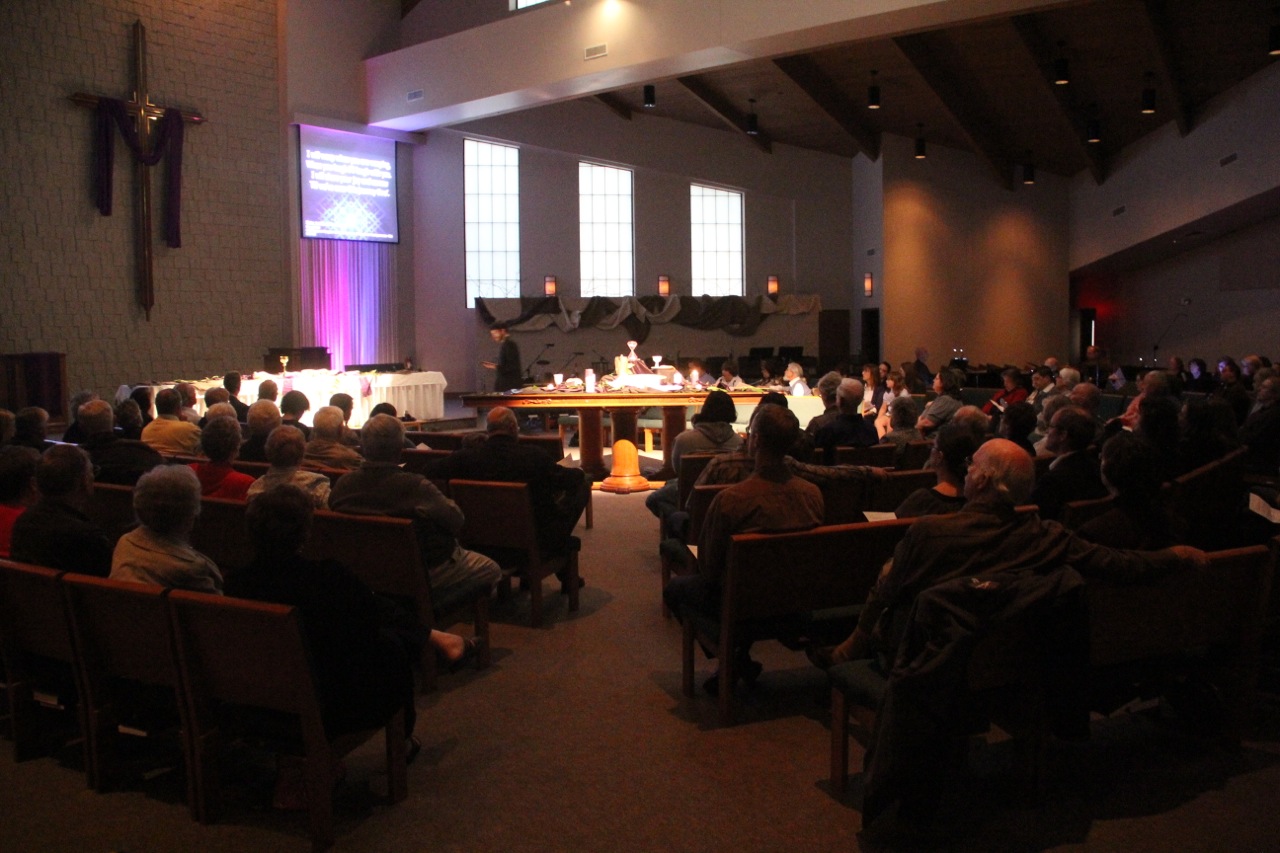
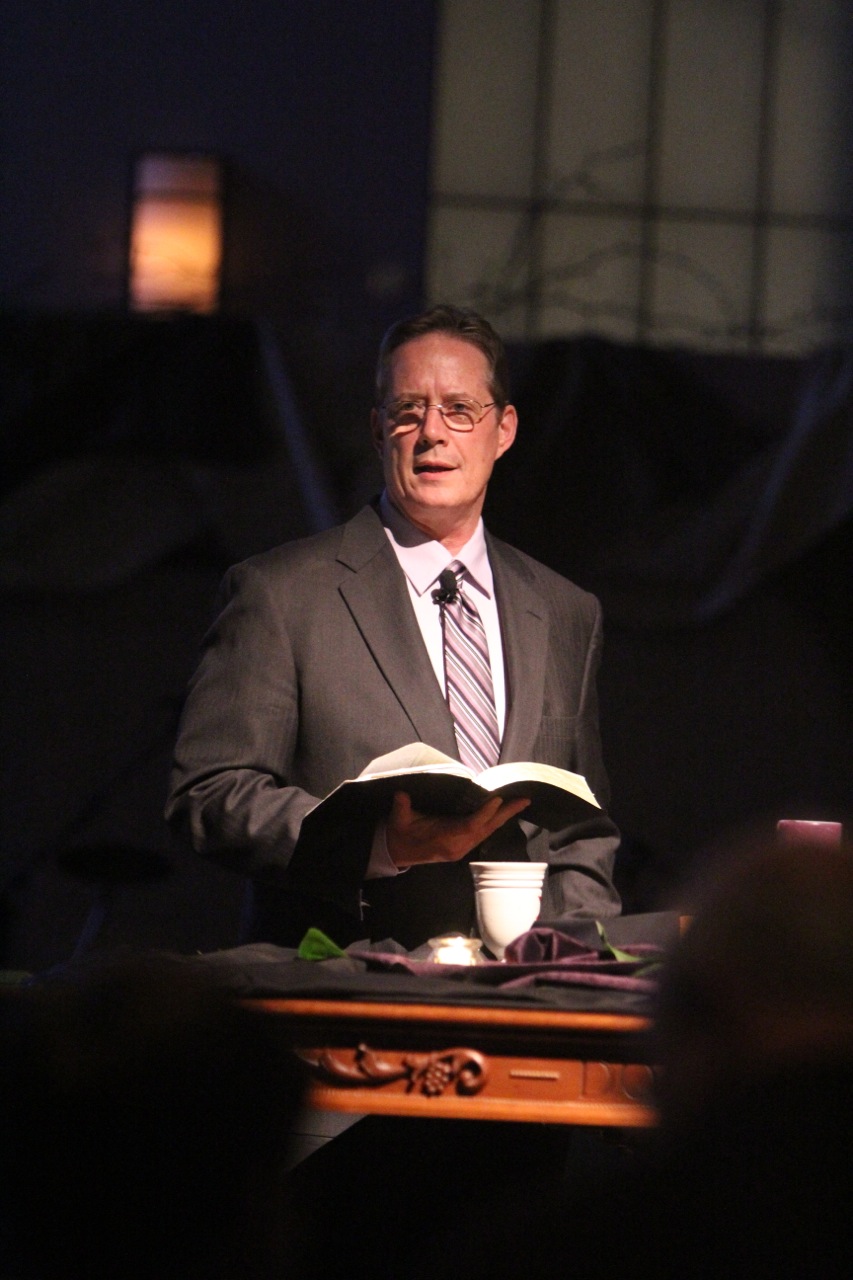
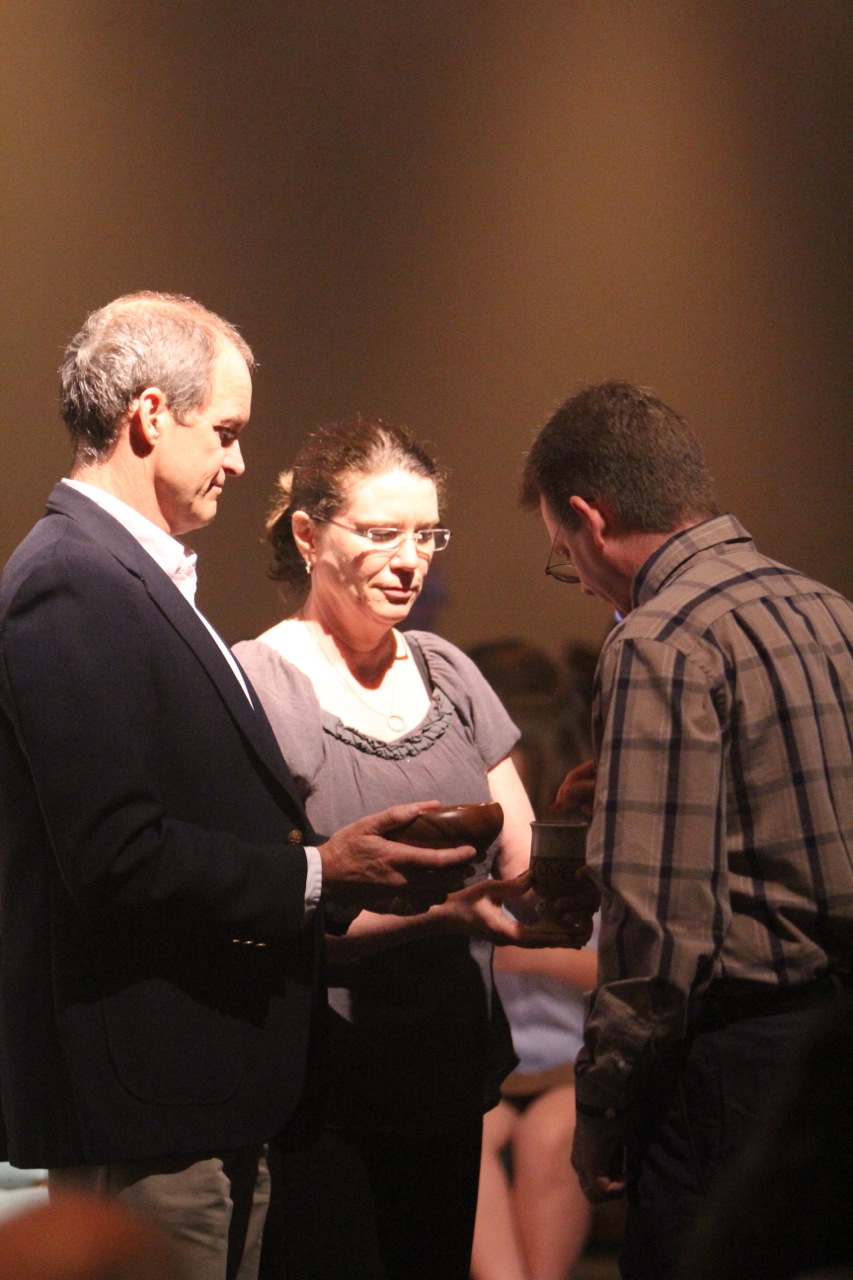
When three-year-old Cooper asked about the trays with bread and juice being passed around in “big church,” his mother, Hallie Rainwater, tried to explain as much as she could in terms he might understand. She shared that we take it to remember God and Jesus and everything they’ve done for us, the love we all have.

That night at bedtime he said, “Mom, if we put our hand over our heart like this, will we remember God and Jesus?” She said she thought that was a very nice idea and that they should try that. So they put their hands over their hearts and he said, “Oh, I wish I could remember God and Jesus.” Then he said, “Maybe next time I go to big church I can eat that little white thing and drink that juice – that will help me remember them.”

When I talked to his mother later she said that it was if he was trying to remember God and Jesus as those he used to know but couldn’t any more.

“You must become like a child to enter the Kingdom of God, ” said Jesus. I know he was right. For children – close to the origins of the spirit – it is like remembering something they already know. And that, I think, is a key to spiritual formation. It is not that we, family and church, are sharing something that is foreign to our little ones. No, it is simply reacquainting them with something already there. And they can reacquaint us. The Biblical stories remind everyone, of all ages, who have open hearts.

It is silly to believe that young children can’t “get” the liturgy of the church, its storytelling, and rituals that bridge head and heart. They get them on their own level more easily and faster than we entrenched adults do. Our job as mentors and trusted guides is to keep them close to the action, engage in faithful and loving conversations, and allow the flower to bloom.

Thank you, Cooper. Next time I take communion my hand is going over my heart. I hope I can remember, too.

As I’ve shared before we have a dynamic special needs ministry for children at Broadway called All God’s Children. The program meets simultaneously during one of our worship services and employs adapted learning strategies and a very low student-teacher ratio with trained volunteers. Several of our All God’s Children participants, mostly on the autistic spectrum, made their confessions of faith during Holy Week.

One of our All God’s Children parents, Christina Crawford, told the story of her son, Gavin, on Easter. I share it with you here:

We heard Gavin stirring early on Sunday and when we finally got up, we saw him at the dining table waiting for breakfast with the iPad. He was already dressed and he looked up at me and said, “Broadway Christian Church on
Sunday.  Happy Easter, Mom!” I almost cried my eyes out.

1. He never gets dressed without prompts.
2. He knew he had to be dressed and ready to go because church was at 11am
3. He knew it was Easter and used it appropriately to greet me.
4. He added, “mom” at the end of that sentence to make it personal and
directed at me, which meant he was socially aware of someone else other
than himself.

It was by far the most memorable Easter we’ve ever had!
Hope yours was just as wonderful!

Christina

In the Gospels there’s a lot written about Jesus’ last days, his entry into Jerusalem, the Last Supper, Gethsemane, the trial, crucifixion and entombment. And of course, there is resurrection, the empty tomb, appearances, a doubting Thomas putting his finger in the marks in His side. But here we are on Saturday, the great “inbetween” day, somewhere between Good Friday and Easter.

If you said to yourself, “I don’t remember much of anything that happened on Saturday,” you would be right. After all, Jesus is in the tomb and it’s the Sabbath; no one is doing anything. Well, almost no one.

There is one and only story from the Gospels that takes place on the Saturday between tomb and rising (Matthew 27:62-66). The Chief priests and Pharisees have an audience with Pilate and ask that special security be put on Jesus’ tomb.

It’s ironic, to begin with, because they are doing this on the Sabbath, one of the criticisms they always leveled at Jesus. But other than that, why the big deal?

Some scholars have noted that the secretive removal of Jesus’ body was one of the claims made by detractors attempting to refute his resurrection; he was just moved. And so this story shows up to make the point that the tomb was carefully watched and nothing like that could have ever happened.

Perhaps that’s one of the reasons the story is included. But I think the real truth runs deeper than that.

Matthew makes it clear that Jesus has been labeled an imposter by his antagonists, a pretender messiah.  They wanted to make sure that nothing validated his claims. That would be terrible, to have him justified in death. Imagine what might happen if they couldn’t silence him, eliminate him, or erase him.

And they will go to extreme measures to do just that, even going so far as to violate the Sabbath and collaborate with a pagan governor! They will do anything to make sure that the cover-up is held tightly in place. And that’s the extent to which the powers and principalities of this world will go repress the truth.

The answer, of course, is that no amount of force can ever repress the power of God. No soldiers stationed at a tomb, no gag order, no propaganda campaign, no silencing of the revolutionary voice can stop it. And that’s the terror that people carry when they have attempted to thwart God’s purposes and plans; that eventually they will be revealed as the imposters. And that happens all the time.

One of the strategies of the human evil inclination is to invert the truth; to turn a virtuous belief or action on its head and present it as sinister. Innocent people are slandered all the time. Great spiritual leaders are attacked because they threaten the status quo or challenge cherished assumptions.

We have ways of silencing their kind, of stationing soldiers at the tomb.

Nelson Mandela speaks against apartheid in South Africa and we send him off to Robben Island to rot for years. Sir Thomas More is sent to the Tower of London and his eventual death for not agreeing that King Henry is head of the church. Martin Luther King, Jr., tells the truth about race in America and we kill him for it. It’s an old, old story that repeats itself over and over. Soldiers are stationed at the tomb to silence the truth. But the truth won’t be silenced; it never is.

And that’s what we find on the Saturday between Friday and Sunday, that even after the terror of crucifixion it’s not enough and they’re not done, because they are just as fearful after he’s been killed as when he was living. What we fear most is that which is out of our control. And whenever we encounter something or someone that is out of our control we turn to force, lock down the lid on the pressure cooker, and silence all dissent. That’s what happens.

The saving grace is that people don’t get what they want. The efforts and designs of Jesus’ detractors will come to naught because you can’t repress the things of God. In the end they will triumph. And though it sometimes looks like the battle is lost, it never really is.

Later in Matthew’s story we are going to meet these soldiers that Pilate dispatched to guard the tomb again. They are the ones who, when the angel appears to roll away the stone, are so shocked and scared that they become like dead men, immobile, frozen in place. The stone is rolled away and the soldiers become like stones. Those who attempted to silence Jesus are silenced themselves. The ones who called him an imposter are shown to be imposters.

Vindication is often a long time coming. It frequently doesn’t come in our lifetime, while we’re still living to know it. But it does come in God’s time. And when it does every stone of falsehood is rolled away from the tomb of truth so that it may see the light of day, the tomb setting free its captives.

We gathered like usual on Maundy Thursday, remembering how he washed their feet, shared a supper that was infused with new meaning, and trogged out to sweat blood in a garden called Gethsemane. It’s a somber meal with words about bread and body, wine and blood. There is covenant-making in the works. And dipping bread in the same bowl as one who will betray.

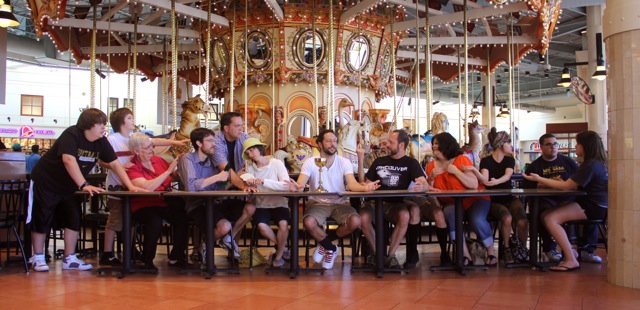
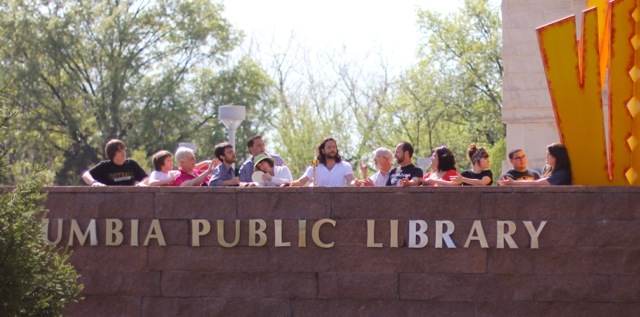
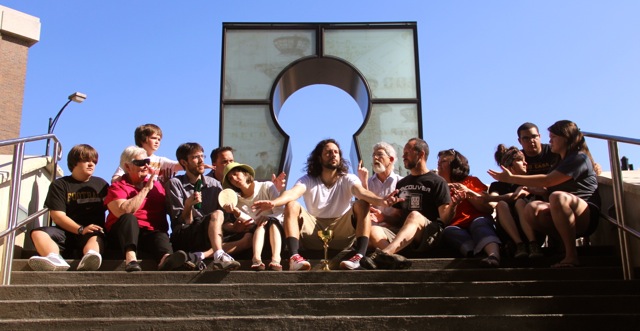
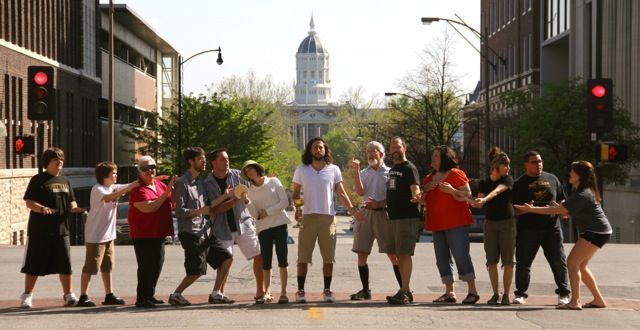
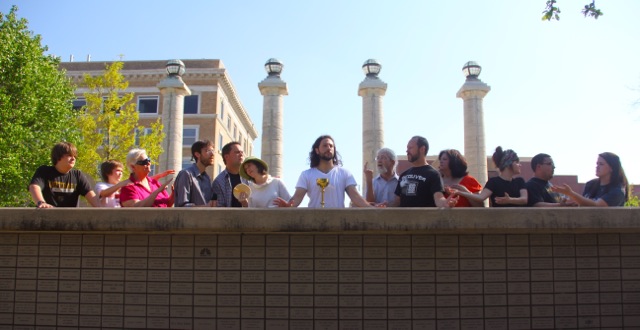
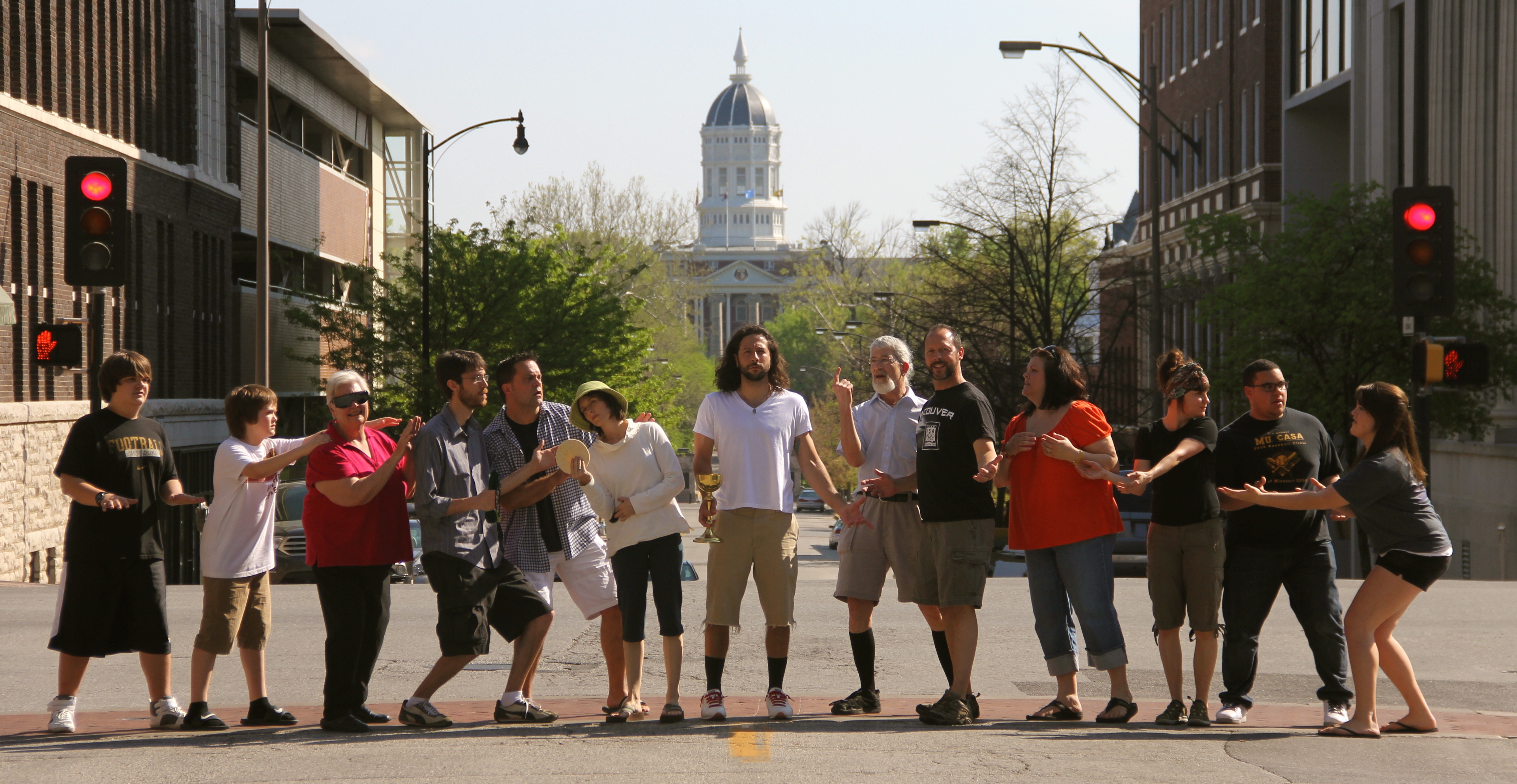
Our supper had already traveled out to the city, making appearances in public places: Same supper, different contexts. And some people wondered what in the world is going on. Others knew, recognizing the familiar DaVinci pose. But now those images came crashing back home, back to the place where we always break bread. This time, though, the portable supper took on new meaning, the lines between sacred and secular air brushed away.

When you leave Maundy Thursday its only a short hop to Good Friday, the dark day, the day of trials, denial, torture, death, entombment. We want to avert our eyes. And avert eyes for more than one reason. It’s gruesome, of course. But more than that the sacred mirror has been held up before us and we don’t like what we see. It was I who crucified you, Lord. My humanity did it.

And then in a passing, fleeting moment, there out in the darkness of crosses, we see it: A young man, one of his followers, almost caught because he’s hovering near the cross, looses his clothes as he runs naked into the night. The nameless naked.

We don’t know who he is, but we can guess he is one of his now scattered followers. He’s terrified and impotent. He’s running for his life, stripped of everything he thought he had, all the protections peeled away. And of all the characters in the story maybe he is most our stand in because we find ourselves fleeing without anything, at least before all this we do.

Somewhere in the darkness where the nakedness intersects with flight, there is a veiled grace that is about to catch him, enfold him, clothe him, and bring warmth and light. But not now. Soon, but not now. Weeping tarries with the night but joy comes with the morning. And it surely does.

I remember an interview with the phenomenal jazz maven, Lena Horn, as she talked about the seasons of her life. She especially spent time talking about the long expanse of mid-life that contained a persistent state of depression. She called those years “the dead years” because that’s how she felt. She said, “I was dead for several years of my life, and then I came back to life in the second half.”

I think crucifixion, in part, is about exactly that, the dead years. And I think that resurrection, in part, is about coming back to life. There is running naked into the dark and there is awakening to the morning light. We talk about it over and over without naming that Christ’s crucifixion and resurrection is shared by us, when we share in it. It names us and gives us hope at the same time.

Behold, the old is gone and the new is come. Thanks be to God, it’s so.

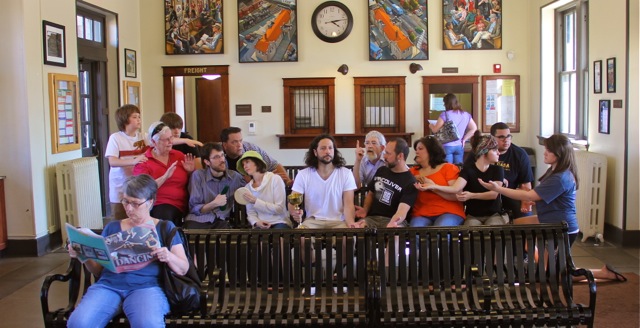
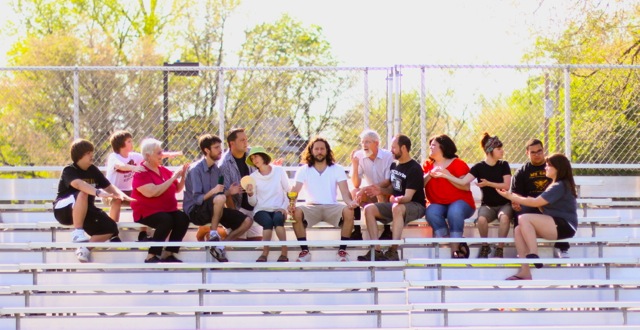
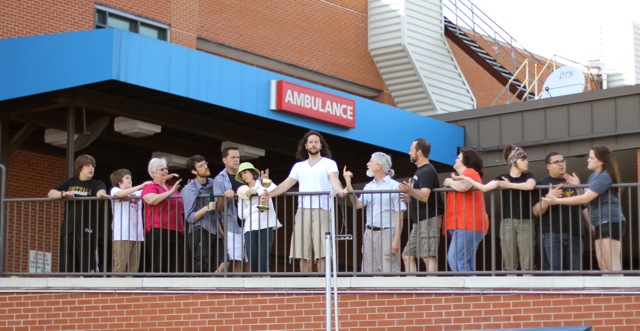
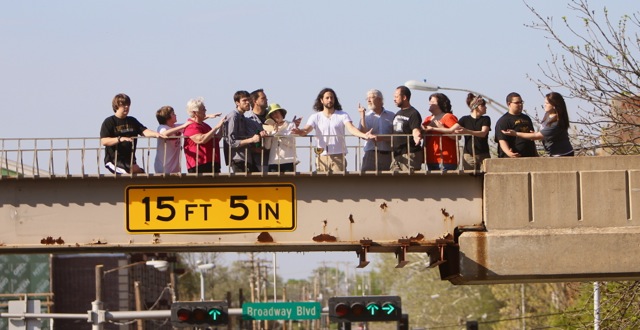
On Saturday, April 19, a moveable Last Supper based on DaVinci’s iconic portrayal moved about Columbia, Missouri. Erasing the arbitrary lines between the sacred and secular, we took the supper to the city, and on Maundy Thursday evening will be bringing the city back into the supper. Thanks belong to Dave McGee for the great photography and here are a few:

Carousel in the Mall Food Court

Shelter Gazebo

Columbia Library

Top of Parking Garage

City Hall

Crosswalk at Broadway and 8th

The Columns

Wabash Bus Depot

Columbia College Bleachers

Boone Hospital

Bridge at College and Broadway

Sure, take it to the Streets:

The Last Supper at Broadway and 8th

So today is World Autism Awareness Day. You’ll be seeing lots of blue here and there, a reminder that we’re on to this condition and dealing with it. That doesn’t make it easier if you’re a parent of a child on the autistic spectrum, but you also know you’re not alone. That counts for something.

At church we’ve been doing some educating around the whole issue, raising awareness especially with youth. But the most important thing took place tangentially, as a part of our typical spiritual formation and worship.

Every year we have a class for baptismal candidates that continues for about twelve weeks. During that time the young people meet with pastors, mentors and attend a special retreat. Most usually they make their “confession of faith” – own that faith that has been carried for them by the church and family to date – and it is public, in the context of worship. This year, since we now have a special program that includes children with disabilities called All God’s Children, the question presented itself: How do we include our children with special needs, often autism, in this communal formation and ritual?

The answer to that question is two-fold. First, we created an adapted confirmation class, one session to cover main ideas. Secondly, and most importantly I think, we decided to include them in the public profession of faith in worship right along with all the other children. And we did. Yesterday, on Palm Sunday, at the close of the service, all of our children and their mentors lined up to receive a single question and provide an answer. The question, in its doctrinal form is that of the so called good confession: “Do you believe that Jesus is the Christ, the son of the living God?” But the way we posed it to each child varied, depending on how they were able to understand it.

When we came to some of our kiddos on the autistic spectrum, we essentialized it: “Do you love Jesus?” Well, yes they do and said so. And if there was ever a more whole celebration of the community’s embrace of Christ in the many ways we receive him than this,  I don’t know of it. There was not a dry eye in the house, including my own.

There was a time when the sacred canopy of the church so enfolded the reality of a culture that its rituals and dramatic enactments appeared part of the given fabric of life. Like keeping a season such as Lent, or walking through Holy Week. It was perceived as an actual entity that existed, in and of itself, in time and space. That was the reach of that symbolic universe.

Even with a reticence to state the obvious I will say it anyway: those times are over. There are no longer any “meta-narratives” in which winner takes all, the culture bows, curtsies, and says, “Of course, it’s Holy Week. We’ll be keeping that in mind.” Nope.

What we have, rather, are the particular sacred stories and symbols of particular communities of faith. And whether or not Holy Week or anything else has meaning derives from one’s willingness to fully enter into that story. The reason, today, that the ecumenical church has a “church year” in which the story of our faith is parsed out in chapters over twelve months, is to get the truths seeping into the bones of those who are observant. There is nothing objectively more sacred about the forty days before Easter we call Lent than any other time. But setting aside a particular time to tell and re-tell the stories insures that we visit it often enough, which we usually don’t without it.

My thinking has changed about all this, and it’s probably the product of age. Or I should say the perspective age brings.

I used to think that these arbitrary observances, cooked up by Popes and councils and Bishops, were quite beside the point. Right along with my radical reform ancestors each Sunday is just like any other Sunday. Each day is like any other day. Now is the time so get to it.

All of that is fine and well, especially if you’re a super Christian who just lives and breathes the Spirit 24/7. I mean, why tarry around church seasons? Except that we really aren’t super Christians, not in the long haul. We are weak, flawed people who forget a lot. We get lost and wander around, looking for our moorings. Our knowledge of our guiding stories becomes blurry. And that’s why I view all that differently now.

We basically need the structure of seasons that recount the sacred story over and over again. Our children need that exposure. With each run at it we are given the chance to go deeper, depending on where we are in life. And now I realize I don’t have that many runs at it left, not really. Time like an ever-flowing stream bears all its sons away …

I don’t absolutize church holy days like I used to in my spiritual storm trooper days. And I really don’t expect the culture to get it at all. I mean, really, most people couldn’t care less. They’ll make time for anything but those things. And to tell the truth they only make sense if you participate in the symbol system that provides the sacred drama in the first place.

What I do embrace and find helpful for individual Christians and Christian communities is the way we focus on seasons of spiritual story telling. Advent, Lent, Pentecost – they all give us permission to tell those aspects of the Christian story again, to hear them again, digest them one more time. And that’s good because we’re not so smart when it comes to doing that on our own. In fact, because we are so naturally oriented to what we already believe, we screen out most of what we don’t want to hear. Having it programmed so we have to consider it anyway is a good thing.

At the entree to Holy Week this year we gathered a group of people who were willing to pose – in street clothes – DaVinci’s iconic Last Supper out in public. We chose about seventeen locations around Columbia, Missouri, showed up, struck the pose, and moved on. The impact on the culture around us may have been minimal. Perhaps it provoked thought, unearthed forgotten memories. I don’t know. But one thing I do know is that the people who were in that drama became that story for several hours. They took it to where it’s meant to really live, in the world, beyond the illusion that sacred and secular are separate. And when, on Maundy Thursday, we bring those images of that Supper-gone-to-the-world back into our worship, we will remember why it’s so important to tell and re-tell the story. I mean, really, once is not enough.

Happy Holy Week.

Yes, I made the obligatory pilgrimage to the cine du jour, The Hunger Games. It is an “edge of your seat” kind of movie, but not one that will ring the originality bell; we’ve seen the plot and the themes too many times before. It’s based on a trilogy by Suzanne Collins (watch out sequels!).  One of the finest aspects of the film was the leading actress, the heroine, none other than Jennifer Lawrence, the young woman who surprised us in Winter’s Bone.

The plot is simple: A force has taken over our country, divided the conquered into twelve districts. The occupiers live decadent lives of excess. And as a punishment for a past revolution, the districts are forced into a combat to the death once each year. Two representatives, one male and one female, are chosen from each district. In gladiatorial fashion they are touted, paraded and bet upon. One shall survive at the end. Only the hope of getting to that last survivor position keeps the games intact.

As a form of “survivor,” last person standing, the story pits wits and brawn against the designs of the contrived and controlled system. It is not simply a matter of competition, Darwinian style, but the machinations of those directing the show – which is televised everywhere, much like the Truman Show – adding and adjusting limits and obstacles along the way.

Much like other narratives of occupation and resistance The Hunger Games holds a tension between the regulation of those in power and the innovation of those who would shake free of it. In the end those in power are left with the awareness of an ominous fissure in the armor, a vulnerability that unsettles presidents and brings hope to the oppressed.

More than anything, Hunger Games plays with the themes of determinism and free will. There is much in the lives of our characters that is circumscribed. But within that imposed design are spaces for free thought and action, novelty and creation, that is beyond what oppressors could have predicted. Handlers will not be able to control outcomes as they thought, not as long as freedom, hope and courage are at work.

You can’t help but root for them, the citizens of the districts. And that’s the point, I suppose, that we wonder how we contend, survive, and stay human in our own hunger games, in the many ways they come to us. And they most surely do.