The parable is an old one. Once upon a time a man noticed leaks in his basement and so he went about patching them. He tried everything, but to no avail. And then one day he looked out the window and realized that the whole neighborhood was flooded.

Forces larger than me often determine my personal situation. No matter how well I waterproof the interior walls when the neighborhood is flooded everybody gets wet.

As the visioning task force of our congregation considered current research around the current decline of many churches we gazed out of the window and looked at the flooded neighborhood. Though the 80s and 90s realized some membership and worship attendance growth in the mainline churches, the first decade of this century experienced a dramatic decrease, especially in worship attendance. It was a sharper decline than anyone imagined and no one is quite sure why. The only churches that seemed immune to the drop were those averaging well above 1000 in worship every Sunday. They seemed to have the capacity and critical mass to sustain and thrive when others did not. Winner take all. The Walmart phenomenon.

Sidebar: The mainline churches, having been around for a long time, have already experienced much of that slow decline. The newer “big box” Bible churches – of which every community has at least two – have finally begun to experience the same decline experienced by their mainline brothers and sisters. In our community two of those churches rose, peaked and now have started to decline. The third one, popular darling of the moment, is still in its ascendancy. But keep watching. Ten years from now you’ll see the same bell shaped pattern emerging. Every congregation, regardless of size and age, has to negotiate its life cycle. I know we do.

So why has this trend materialized during the past decade? Some point to demographics; a greying church and church models that don’t reach out to new generations. There is pertinent research that indicates people just worship less often – much less than every week – and consider that “regular.” But I have my own deeper suspicions.

I believe that the crux of it has to do with the growing irreligious proportion of our citizenry. More and more people check “unaffiliated” or “none” when it comes to religious preferences on various surveys or questionnaires.

The long and short of it is that these trends do exist and they are largely cultural, bigger than any one congregation. Sure, there is a lot we can do to make it either worse or better. And we need to keep that in mind and work on it. But the neighborhood is flooded after all.  The leaks shouldn’t surprise us as much as when we didn’t know that.

I’ve known churches that crucified pastors for this trend as though it was necessarily a deficit in ministry or leadership. They blamed him or her for the flood outside, pointed to the leaks and shouted, “Do something!” They defined one person as responsible for forces larger than any one person. When that leader drew their attention to the neighborhood flood outside the window, they said to him or her, “Quit making excuses!”

Roy Oswald, senior Alban Institute consultant, has reminded church leaders that the tough work of congregational renewal requires change, the kind of change few congregations are willing to make. They want to grow, to thrive, but without having to do anything differently to bring it about. The other thing is that almost every congregation that has transitioned to a new phase of fruitful life encountered conflict as a result. The shifts were not painless. And the congregations that, on the edge of making the big turn, lose nerve,  send ministers packing or shelve their ambitious vision, bounce off that granite wall and slide back down the long slope of decline – because they are not willing to go the distance.

In the end this is not about numbers, though quantitative assessment is important. The real challenge is a qualitative one. Are we being faithful? Are we being true to our sense of calling? Are we pursuing selfless service and loving care of the neighbor? Are we cultivating lives of prayer? Are we striving to worship with passion? Are we embracing the young and caring for the old? Are we challenging one another to be what God has called us to be? Are we discerning God’s voice – and not the drone of the culture – to determine where and what we do next?

If we are true to these things God will bring the right people to our doors and we to theirs. If we worship in spirit and truth then the truth shall appear. When the flood recedes the ground will flourish for having been so quenched. And the earth will sing a song of praise.

What call this untimely splendor

Posted: February 26, 2013 in Uncategorized

What call this untimely splendor
expected ’round the birth
delayed but not forestalled
arriving on the edge of the thaw?

It is called holiday and break
by children with their sleds
and parents armed with mugs
of steeping hot chocolate

It is called work by those who clear
the white crystals from the ground
or clear it to serve in ways
hidden to us, the happily homebound

It is called strange by those
who walk on sands warmed by the sun
or those who live a state away
and wipe sweat from their brows

But I call it a reminder
that the world does not spin
on my timetable of weather
convenience or circumstance

The splendor appears when it will
and what we call it
neither hastens nor delays
its perfectly timed arrival

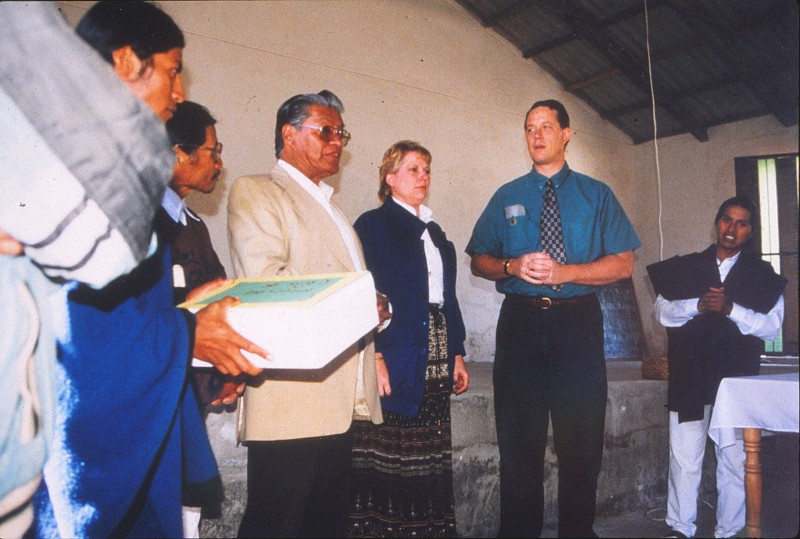
From left to right - Victor Vaca, Kathy Carson, Tim Carson, Segundo Morales

From left to right – Victor Vaca, Kathy Carson, Tim Carson, Segundo Morales

I first met Victor over twenty-five years ago while serving in Camdenton, Missouri. He and his wife Violet had served for years as our Global Mission staff in Ecuador. Victor was native Ecuadoran and Violet was a northerner from Minnesota. They met in Imbabura as Violet taught in a religious school. Talking to Violet about that heady time in her life she said, “Oh, you’ve got to watch out for those Latins. He hired a band and came and serenaded me beneath my window!” Victor and Violet served for years in Ecuador, primarily investing their time and energies with the indigenous peoples.

When Victor and Violet were on furlough and visiting congregations I spent time with them. Before you know it I was visiting Ecuador, representing our region as the moderator. Kathy often went with me. It was the first of many, many trips made to that impoverished and enchanted land. Numerous congregational mission trips and additional furloughs in the states made for a long-term friendship.

The Vacas were my first real mentors and teachers in the developing world and its concerns. They gently educated me about indigenous communities, the history that those in the north do not reference, and the ways to avoid the worst of paternalism and colonialism. And they demonstrated time after time what real hospitality looks like.

Victor taught me that the Gospel is holistic – that God cares about the whole person in all dimensions. He demonstrated how liberation theology grew from the people and their faith and how the social circumstance of a person shapes and limits their world. And he created an approach to church and missional life in which there was no distance between singing to Jesus from the heart and striving after justice.

Not too long ago Victor laid his beloved Violet – Violetta – to rest. Understandably, he was never quite the same after that. His grief was so heavy and loneliness for her so deep. And now he goes to his rest to be with her. We hear that in that kingdom they will come from the north and south, east and west and all sit at table with the Lord. They already had a foretaste of that in life. Now it’s a feast.

OMG! Yep, we’re adding another distinctive service to our palette of worship experiences at Rocheport. Beginning this Saturday, February 16, 5:00 p.m., we will begin a 3rd Saturday of each month Jazz Service at Rocheport Christian Church. In terms of form, this follows suit with our Bluegrass service – simple, lots of music, a message, communion, followed with a hospitality hour.

We are so pleased to have the phenomenal musical leadership of Tom Andes for our maiden voyage. Everyone around the area knows of Tom’s great jazz artistry. He will be joined by his long-time bassist, Dave Johnson and our own Terry Overfelt on vocals. Pass the word to all your friends who are jazz buffs or those who just want to worship differently.

An exciting heads up: Tom can’t take the every month gig, but we have seized a very, very exciting opportunity! Beginning in March our Jazz services will enjoy the musical handiwork of no less than the Lily Tan Jazz Trio. What a coup! Lily, a graduate student in jazz studies is originally from Malaysia. And she is a woman of exceedingly strong religious conviction – a self-avowed “believer,” in her words. We so look forward to that.

So join us for the next iteration of the Rocheport journey. Yeah, this time it’s jazz.

So the latest attempt at urban renewal has hit the rolling hills of Columbia and environs. The winter encampment of the homeless has become the source of irritation. Though parks and recreation handled it in a respectful, civil kind of way, the end result was the same: Run out the homeless from their winter camp. There, we feel better. No more tents in the woods.

What is lacking is any consideration of why they are there in the first place or where they might go next. Remember: You and I are returning to our heated abodes. They have none. So why do we deny them a place to camp? They have no homes and we are telling them they can’t even form a community of survival outside. For God’s sake!

Let them have their campsite. Put up some porta-potties to boot. Drive a patrol car by ever so often. But unless there is a problem leave them alone.

Why not create a campground for the homeless, anyway? Other than the already full shelters, where would you go? Wouldn’t you rather stay in a tent in the woods than crouched in a doorway?

In the most recent issue of Time Magazine (Feb 18, 2013, 34-37) a feature ran on expert military sniper and shooting victim Chris Kyle. The veteran of Iraq fell not to the enemy, but from one of his own, a troubled veteran back home in Texas.

As I read the article I noticed a quote by Kyle. It is indicative of the emotional distancing one assumes in combat in order to kill lots of people. Putting aside the debate as to justifications to engage in violence in the first place, there are the fundamental mental gymnastics that rationalize what is being done:

“You just view these guys as the terrorists that they are. So you’re not really viewing them as a person. They’re out there, they’re bad people, and you just take them out and you don’t think twice about it.”

That mental view of the enemy is called objectification. You make enemies, who are actually persons, into non-persons in order to kill them with a clear conscience. You also label them bad in order to to justify it even more cleanly. They are non-persons and they are bad non-persons.

That is the same parallel thinking that is used to justify genocides: The victims are not persons but rather vermin, cockroaches, filthy leeches, and don’t really feel the pain. They have no families who grieve their death, they have no mothers who gave them birth.

Though such thinking is assumed when facing a hostile adversary it persists in the other ways we label the neighbor as less than human. When they are non-human we may rape them, deport them, cheat them, take their possessions and land. They are morally inferior therefore deserve what they get even as we deserve the benefit of moral superiority. They are Catholic or Muslim or Palestinian or Jewish or some race that isn’t a part of my tribe. That’s it, they are a thing, an object, not really human.

I’m sure that if my assignment were to take out the opposition in order to achieve what I or my tribe believed was a noble cause, I would assume this end-justifies-the-means morality, too.

But it is dangerous. And that thinking goes all the way back to our Cain and Abel primal nature. We have a mark on our foreheads, the mark of some of the most dangerous creatures on the planet because we feel entitled to kill those who are not as human as we are.

The phone call came from the pastor of my youth, my home church pastor, the man who first posed the whole ministry question to me over a barbeque sandwich. Bob Gartman believed that barbeque could seal almost any deal, a Texan’s assessment if ever there was one. “I just came from Art Digby’s funeral and wanted to call you.” I knew that if someone called me about Art’s death and funeral it would be Bob. He had first introduced us those many years ago.

When I first arrived at seminary at Brite Divinity School Bob Gartman was down in Fort Worth working on a doctorate. He made sure I had something to eat. I also met plenty of his minister friends. One of those was Art Digby, then Senior Minister at First Christian Church, Arlington, Texas. What I didn’t know is that the two friends were hatching a plot.

I needed a part time church job, one that could serve as my seminary internship. First Christian needed a part-time youth/music director. The timing was perfect and would serve intern and church well. But how do you make such a decision, other than trusting the biased opinion of your friend. I was surprised to learn how Art would do it.

Bob had told Art that I liked to play tennis. I did like it, however mediocre my game. So Art suggested we go play. Was he sure? The man had thirty years on me. In short order I would discover why that didn’t matter. I picked up Art in my old 1970 Ford Maverick, the one I filled with STP oil treatment rather than oil itself. We head to the nearest courts and began our play. He bested me match after match. Defeated but not bowed I took Art home, but only after making a quick stop at the bank to withdraw some money. They accidentally overpaid me and I sent the overage back in to them.

As I dropped Art off he said, “Ok, let’s plan an interview with the committee.” Really? How did we move to that so soon? Only later would I discover why, compliments of Bob Gartman. “Your tennis game was the first part of your interview,” he said. “Art wanted to see how you would handle yourself under pressure, deal with your own mistakes and losses, and how you would treat your partner.” I nodded. Unbeknownst to me he was sizing up not only my abilities but my character, my personality. Art Digby knew that if he had the right kind of people on his team he would have the right team. Later Art relayed another part of the tennis day. “Remember when we drove through the bank?” he asked. Well, I vaguely did. “They overpaid you and you returned the five dollars.” Yes, I remembered that. “It was then I knew I could trust you.”

So why did Art Digby size up people in that way? Because the qualities he valued in others were the same ones exemplified in his own life. He was a man of character, integrity, wisdom, charity, self-control and devotion. I, on the other hand, was a snotty nosed kid who only partially knew it at the time. Passing years, experience and struggle would cause me to value those remarkable attributes differently.

The last time I met with Art he had already lost his beloved wife, Joy, partner for so many years. Life was hard but Art carried himself with a sad and hopeful kind of dignity. I will never attain to either the piety or level of leadership that Art possessed. But I am thankful that he suggested we play tennis on that hot summer day. In the years following he taught me much, often without knowing it. And we will miss him.

Lo! some we loved, the loveliest and best
That Time and Fate of all their Vintage prest,
Have drunk their Cup a Round or two before,
And one by one crept silently to Rest.

The Rubáiyát of Omar Khayyám

I wish, I wish, I wish I could say that the apology for praying was because the prayer was offensive, heartless or hasty. But it was not. When Lutheran pastor Rob Morris apologized for praying with other Christians in a prayer service following the Sandy Hook Elementary School in Newtown, Connecticut, it was because he wasn’t supposed to. How can that be?

It is because Missouri Synod Lutherans are not supposed to co-mingle themselves with the worship of other faiths or even other Christians. Somehow it is thought to defile the one true faith. The real defilement, in my mind, comes from an arrogance that believes prayer is somehow wrong with others because we are different. I hate to say it, but this isn’t the first time.

Throughout my ministry I’ve been in situations following national calamities or local tragedies in which Missouri Lutheran pastors could not participate in ecumenical gatherings for this same reason. I’ve always felt it reprehensible. I still do.

With Lent just around the corner our minds turn to confession, repentance and sin. There is much we need to turn from and turn to. But one thing stands for sure. If we’re going to give up one thing for Lent this year maybe it should be arrogance. I think Jesus would like that.

Just today I answered a hand-written letter from a member in a church I served a long time ago. He is well into his eighties now. He moved south for the good weather and is glad for that. But what he shared was about the closing of his church there in paradise. Everything is not perfect even in paradise.

My friend could never understand why this little church couldn’t make it, couldn’t thrive, seemed destined for such an end as this. His memory of churches earlier in his life included the boom times of the 50s when you opened the church door and people flooded in. It was the social thing to do, whether you had a heart warming experience or not. Not anymore.

I felt for him. And I tried to explain some of the many factors that have contributed to this strange new world. We’re never going back, I said. It’s first century Christian faith for all of us. We’re no longer a part of empire. That’s not such a bad thing if you can get over it.

He will never read this blog. Nor will he see the tweet that reminds people the blog was posted. He doesn’t even have email. My communication with him included a smooth envelope that I addressed by hand, licked a stamp and placed it in the upper right hand corner. It’s been a long time since I licked a stamp.

This is indeed a strange new world with remnants of the old one holding on like stowaways in the hold of our plane. We tweet and Skype and monitor our stock transactions online anytime. The 24/7 vapid news channels bleat on. And yet, a man in Florida writes me a letter after his church closes and I send one back to him. We sometimes call the friend by phone instead of flashing an email. A few even stop to chat in the grocery store aisle. It’s all of this wrapped into one ball of twine. But just try to find a loose end so you can unroll it. Can you even find one?

Tonight we resumed our practice of gathering on the first Tuesday of each month for the healing strains of Harp music interspersed with readings and prayers. Maria Trevor, harpist exceptionale, plays the most meditative and soulful music. Tonight we wove in a story of healing from the great healing tradition of relocation; moving one spiritually from one place to another. The traditional sweat lodge rituals of the North American first peoples did this so well; the trance/visions always transported the participants beyond the mountains to the places where spiritual healing is found.

We did this via a story of the great path – from forest to meadow, meadow to lake, lake to cabin, and the wise woman inside …

In the beginning was movement … of the spirit to the spirit. And story is the vehicle. That and the golden strains of the harp.