I believe God is

Posted: July 12, 2023 in Uncategorized

In 2014, Columbia Faith and Values awarded me first place in their “I Believe” poetry contest. Here it is:

I believe

God is

regardless of what I believe

I believe

what I believe

changes year by year

I believe

God comes

whether I call or not

I believe

but trust more

and that has made the difference

Hello Liminality Friends!

I have been invited to be a TEDx speaker on the stage of the University of Guanajuato, Mexico, on June 15! I am excited to take the big idea of liminality to this powerful stage of popular culture.

Right now I’m building a launch team. I am asking a team of people, once the video goes live on the TED YouTube site in several months, to do three things:

  1. Watch the video to the end.
  2. Like the video
  3. Comment on the video

Would you be on my team? If so, you can let me know by commenting directly to this post or email me directly: timothylcarson@yahoo.com.

Thanks for considering!

Tim

One of my privileges is to volunteer with an organization whose mission is to train Ukrainian mental health workers. That work is doubly hard in a time of war. In addition to everything else that a counselor must routinely address, there are war-related trauma, stress, grief and fear. But that is in no way limited to clients.

The counselors themselves are not insulated from the devastation of war. Like military chaplains, they share the same context as those whom they serve. To do this, they must find ways to keep heart and soul together. Unless they do, how else can they be of help to others?

One of my Ukrainian friends told the story of sharing in a Ukrainian celebration of the New Year, full of merriment, only to have it followed by the bombing of the apartment complex that killed scores of men, women and children. That shock, that sense of destruction, hovers over everything they do.

After a long Zoom call, interpreted from Ukrainian to English, my Ukrainian friend said, “Думаю, я ще раз прочитаю Книгу Йова.” (I think I will read the Book of Job again.)

Indeed. What better? This parabolic Biblical classic wrestles with universal questions of suffering, supposed causes, and the role, if discernable, of the Source of all that is. And that’s what we talked about.

The first, most native reading probably speaks most directly: People suffer. They suffer a lot. At the worst, everything that matters can be taken from them. Most surely, this.

And then come questions of causation. In the story, well-meaning friends show up to bring counsel and consolation. Their observations are predictable: You must have done something to deserve this. Fess up, Job, and repent. But as the story lays out from the beginning, Job was a righteous person, a good person who suffered greatly. Job knows this and informs his friends of the same. What the Book of Job is doing through this dialogue between Job and his friends is to make an argument. Actually an argument with other parts of the Bible that state or imply that all suffering is the result of punishment for sin. Not so, says Job. Not by a long shot. In fact, the story itself is a refutation of that understanding. Good people suffer. Our suffering is not correlated to our moral lives, except as consequences flow from intentions and behavior. We are not punished for our sins, though perhaps by them.

After addressing that little misconception of suffering, the story shifts to Job’s anguish before God. In the same way that his friends accused Job of moral failings, now Job begins to accuse God. After all, if God is all-powerful and this has happened, isn’t God culpable? Job puts God on the witness stand. Job the prosecutor shakes his indignant fist. Why? An accounting, please!

Anyone who has shared in suffering to any degree knows this bitter taste in the mouth. Someone deserves my bile. How about appealing my case to a higher court? But wait, do I have a God who is a master puppeteer, arranging this event and that, the cause of all things good and bad? To what degree is God actually involved in historical life? Other than being the creative source of all things? What do we mean when we say God “acts” in the world?

Before those little theological questions are resolved, the story shifts again. This time the silent Presence roars out of the spinning whirlwind, throwing Job into the witness stand. Now Job shall give an accounting. And the Prosecutor asks one question in many iterations: “Where were you when I created the foundations of the world?”

Well, nowhere. That’s where I was. I was nowhere, a no-thing.

Job shuts up.

And that’s where the story ends, even though later generations tried to repair it by adding a happy ending. It ends with muted Job standing before a mystery he cannot begin to understand or explain. And the many dimensions of suffering are left spinning in that whirlwind.

My Ukrainian friends know suffering. It comes not as a punishment for sins committed. However much we may analyze causes and solutions from a geopolitical perspective, there are no ultimate, eternal explanations available. None except a ponderous silence before suffering and the awareness that we are too tiny and short-lived to venture answers in the midst of infinite time and space.

Martin Seligman, professor at the University of Pennsylvania, writes in the most issue of Time (Jan 16, 53) about the nature of catastrophizing – the mind’s concocting of the most terrible outcomes. It is a habitual way of thinking, often shaped very early and deeply engrained in the neural functions of the brain. The impacts and outcomes of catastrophic thinking are not only descriptive but predictive; that kind of thinking presages outcomes.

Their research involved tracking every single one of the 79,438 U.S. Army Soldiers deployed to Iraq or Afghanistan from 2009 to 2013. On their first day in the Army they all took a psychological questionnaire which delved into exactly these questions. The results profiled extreme pessimistic thinking in such statements as “When bad things happen to me, I expect more bad things to happen” and “When I fail at something, I give up all hope.”

Unsurprisingly, the results of that one questionnaire provided the most accurate predictor of who would and would not develop PTSD and to what degree. The psychological state of the service member before entering zones of great stress was the most impactful metric of all metrics. “Catastrophizers who faced severe combat stress were almost four times as likely as non-catastrophizers to get PTSD over the course of their service.”

If combat is one of the most extreme forms of stress facing a human being, other stressors function in the same way, to a lesser degree. And the attitudes, beliefs and subconscious assumptions we carry most determine the level of resilience we will have in facing the most difficult challenges of our lives.

Though stress, conflict, and trauma will never be eliminated from life, the ways in which we move away from catastrophizing to different beliefs and expectations will have a one-to-one influence on how we handle those stressors. Beliefs matter. Assumptions matter. Unresolved emotional legacies matter. And above all, hope – dynamic and positive hope – matters above all else.

I was knee-deep in presenting a class on the life and teachings of Dietrich Bonhoeffer when I read the article: “War and the Church in Ukraine: A Pastor Describes Ministering in Wartime Bucha and Kyiv” (Plough Quarterly, Summer 2022, 12-14) The parallels were striking, even if they were not exact. Bonhoeffer addressed the fascism and heresy of his own country in the rise of the 3rd Reich during WW II and Ukraine is suffering from an attack by a neighboring adversary. In Bonhoeffer’s case, he dared critique the evil of the Nazi regime, confront its theological heresy, form alternative underground church structures, and engage in a plot to assassinate Adolf Hitler. In the case of Ivan Rusyn, president of the Ukrainian Evangelical Theological Seminary in Kyiv, he had to decide whether to flee over the border to safety or stay and minister to his people. On that score, Bonhoeffer and Rusyn are exactly on par: Rather than flee, they both stayed.

Bonhoeffer, of course, paid the ultimate price for his return to Germany, almost certain imprisonment, and possible execution. Ivan Rusyn returned with the knowledge that extreme danger awaited him. They both went anyway.

Another parallel between the two became perfectly clear: The way in which “ethics” are transformed, or seen differently, against the backdrop of the extreme chaos of war, especially a war born of an evil adversary. Bonhoeffer came to the conclusion that the weight of the concrete moment places a moral demand on the person of faith, a demand that might be seen differently in in different times. For Dietrich, the decision to participate in a plot to eliminate Hitler was hard, but clear: One must die so that the many might live. Ethics, then, cannot be constructed in an ivory tower outside of the struggle of history. They must emerge in the thick of living in the world.

In the same way, Rusyn described the Ukrainian struggle of peacemaking in terms of overcoming evil in order to create peace. In his own words:

“I used to be a pacifist. When I was called up, I chose alternative national service. Now I believe that only the nation that has known the horror of war has the right to speak about pacifism. My theology has been changed. For me, peace-making is not a passive thing anymore, an ability to absorb and embrace everything. No, it is very active – action in order to stop violence…When you compare the size of Russia and Ukraine, you will see that we are fighting a giant. The only hope we have is God. So, yes, I do pray. I don’t pray about peace, I pray about victory. Peace will be an outcome of victory. Unfortunately, with Russia, there will be no peace without victory.”

Then there was the Barmen Declaration, penned primarily by Karl Barth and embraced by Bonhoeffer and others of the Confessing Church. Dietrich’s objections to Barmen had to do with the omission of statements condemning the persecution of the Jews. But otherwise, especially as regards the Christian’s ultimate loyalty and worship of God as opposed to political or national idols, Bonhoeffer was in complete solidarity. We have but one Lord. The church is not a functionary of the state.

In Rusyn we also have a parallel to Barmen: “This is about our ultimate loyalty. Worship has political resonance. Whom do we worship? The gospel is so powerful that it transforms every area of our life. We are not just waiting for evacuation to heaven. If we are Christians, we have to have an impact. Yes, we are not of this world, but we are in this world for the sake of this world. We have to be engaged if we want to be a true church. For me it was very important that I remain here with my people. If I evacuate before everybody else, what kind of pastor am I?”

Bonhoeffer couldn’t have said it any better. Though he did say it in so many words. They both have. And their witness lives on in the debris, through the suffering, and by faithful striving in the world.

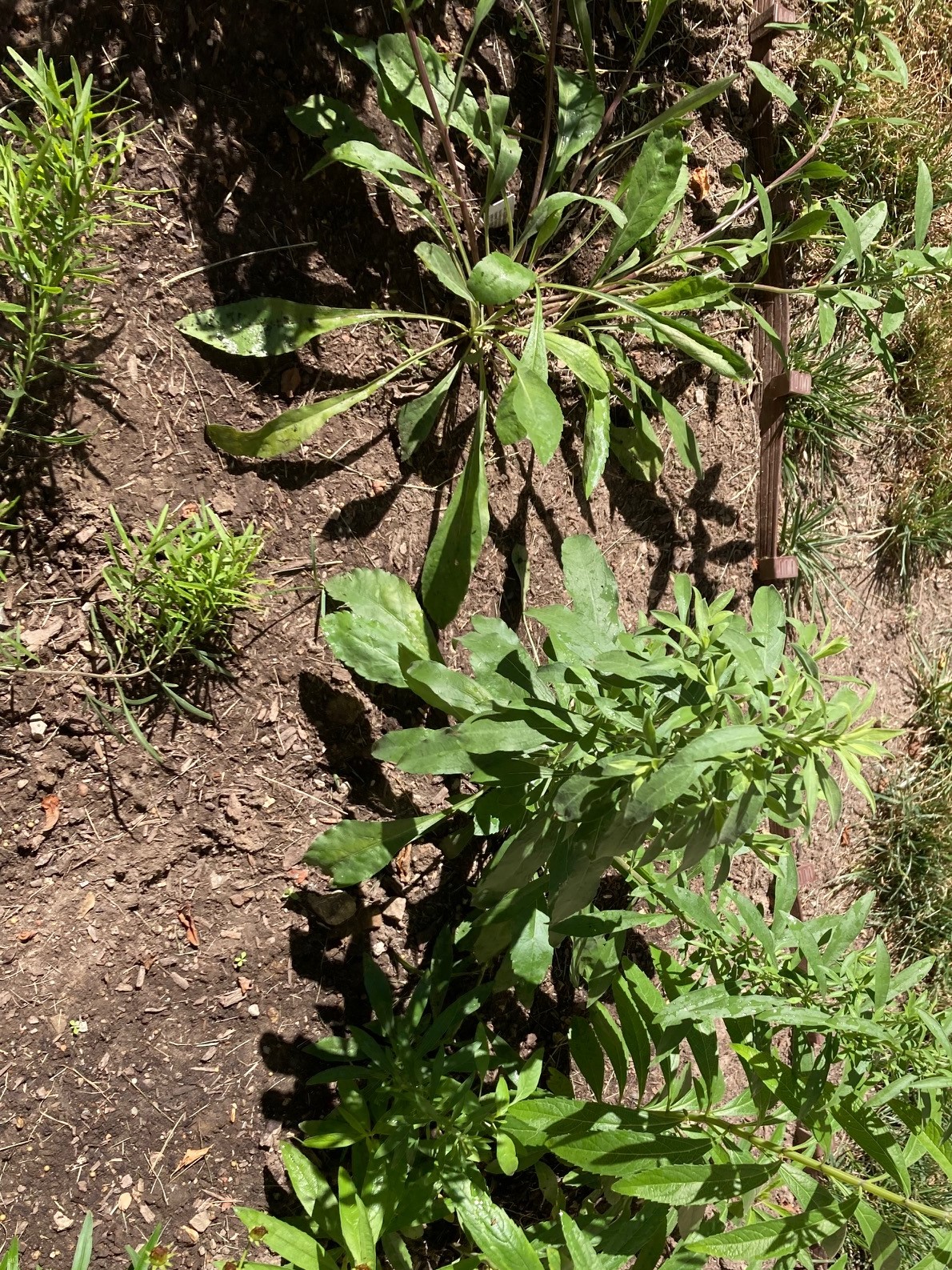
I’m not a horticulturalist. I can barely spell that word. It’s not that I can’t mow a lawn, water the flowers, or put down mulch when it’s time. I can. But I just don’t know much about plants. Like what they are, what soil they thrive in, and what degree of direct sun they need or can’t stand. I know people like that, but I’m not one. I have a friend in that category and he is amazed how much I don’t know about the plant kingdom. When I rant about weeds he gently reminds me that a weed is just a good plant out of place, depending on who is doing the defining. I suppose that gets to the root of it.

This year we decided to plant Missouri wildflowers in several gardens, especially one that ended up being the wildflower showcase. I think we got motivated after watching some documentary about which wildflowers attract what butterflies and bees and why that is so important. Off we traveled to a nursery that specializes in just that, wildflowers. After finding the area of the nursery dedicated to our geographic region and our kind of soil, we made our selections, imagining where they might be planted after we returned home. We filled up our cart, checked out, and after unloading them into our yard, began assigning this plant and that to different locations.

As it ends up, turning over the soil, planting and watering the fledgling wildflowers was not the greatest challenge. That would come later. In one particular bed out back, a bed we watered but neglected in every other way, the weeks passed without weeding that garden bed. Though we had planted wildflowers, even wilder plants than those joined the party. Even though I had left the little plastic identifier tabs in the ground so that we would know one flower from the next, that soon became superfluous. The wild had blended with the wilder into swath of green, growing things.

One of the problems with my kind of ignorance is that I can’t differentiate between the obvious and very subtle. For example, I might know the difference between a hosta and a dandelion, but not between one leafy thing and a thousand others nearly the same. Much of the time the non-garden of my yard is growing much prettier than the identified garden, nature popping up in some unexpected rivalry. It always wins.

When I leaned down with the intent of weeding the bed I was faced with a terrible truth; I could recognize some indigenous Missouri wildflowers, but not nearly enough. I could recognize the Shasta Daisy, but not the Gray Goldenrod, the Prairie Aster, but not the Butterfly Milkweed, most usually the Garden Phlox, but hardly ever the Bottlebrush Blazing Star. But that wasn’t the worst. I could barely tell the difference between any of those and all the uproarious volunteers. Which leaf had the jagged edge and which a straight line? How many buds graced the tippy top? How many strands crawled the ground like a wanton snake?

I was woefully inadequate to be making any decisions about who lives and who dies, who gets watered and who gets tossed on the compost pile, who gets a soothing touch and who gets pulled out by the roots. The reason I found myself making general confession to the garden bed in advance was that I was not qualified to be making any of these life and death decisions. I had neither the knowledge or perspective to be doing that. I am no master gardener. I am not a horticulturist. I don’t even remember much of what the horticulturist told me. I am a bull in a flora closet.

That reminds me of a story. One time Jesus and his friends were wandering through a wheat field and Jesus threw a parable their way, as he was want to do. He told how a farmer had sown his wheat, but during the night a adversary had sown the weed darnel into the field. That’s really mean because darnel is a wheat imposter, appearing very much like the wheat it imitates. The servants of the master were irate. Who would do such a thing! They asked the master if they should wade out into the field and root out all the imposter plants. To that the master replied that no, don’t do that, don’t try to yank the weeds out of the wheat. Because, he said, if you do, most surely the wheat will be damaged in the process. Instead, let them grow alongside together and it will all be sorted out at harvest time.

The parable was, of course, about more than horticulture. It was about living in the world, an imperfect world, a world where the good grows alongside the bad, the really bad, and the kind of bad. The servants were not qualified to make such decisions, to be the arbiters of virtue, to determine with certainty what needs to stay and what gets tossed out. The collateral damage is too great for such a sorting. The sorters are not qualified, don’t know how much or how far to go, and don’t know the difference between darnel and wheat.

Like my wildflowers and their uninvited guests, I don’t know enough, can’t see the fine distinctions, am not aware of where what came from and why, to assume the role of judge and jury. Too many weeds are good plants out of place. Too many good plants grow alongside other good plants. Some plants are deemed legitimate because somebody, somewhere, decided they were so.

But we do set ourselves up that way, set ourselves up as the ones who make judgements for what we find in the garden. We make judgements for people we scarcely know. We make judgements based on the tiniest of knowledge and greatest biases of giants tromping through the garden bed in ignorance. And then, as the gardeners in charge for a moment, we define the boundaries of the garden, what shall be included and what not, based on the tiniest grain of consciousness from the beaches of the universe. The arrogance.

I will help some plants grow. I will harm others. The outcome of all that effort will be based on the most subjective assumptions. And if I am a gardener who has caught a whiff of power, then I’m really dangerous. I may attempt to enforce my little gardenview as the only one, the only way to garden in the wide world of the many plants I do not know, do not understand, and do not care to understand.

Then I build a fence around my garden. To keep all competing information at bay. I create a world of the imagination where I actually believe that my kingdom of the ground is the best, the very best, the only, the universal one. The edicts begin: You will act this way. You will see the world this way. You will regulate your behavior this way. Or we will yank you out by the roots, toss you aside, and revel in what we have made, the triumph, the glory of the work of our hands.

Don’t do it, Jesus said.

It’s a fearsome thing to be stalked by an armed man with homicidal intent. It surely is. Which is why I’m sending up my thoughts and prayers for the Kavanaugh family. An armed man was recently apprehended as he stalked their residence.

The response by the Senate minority leader, Mitch McConnell, was swift. He took to the Senate floor calling for laws that prevent and punish such malevolence. Special protections for Supreme Court Justices.

As serious as this issue is, this response seems rather rash. Because in the end this doesn’t have anything to do with guns. This is all a symptom of a deeper problem. This doesn’t have anything to do with the ease with which guns fall into the hands of those who would do devious things. It certainly doesn’t have to do with domestic terrorism or the plague of gun violence in our society. There are other steps we can and should take, just as so many politicians and their allies suggest following every slaughter of school children, people shopping in a mall, worshipping in a church, synagogue or mosque, attending a concert, or a nightclub. Before we overreact, we should implement some commonsense measures.

First of all, this is a mental health issue. Balanced people don’t go around assassinating political figures because they happen to disagree with them. Were there warning signs? Did this man have a history of mental illness? How about the availability of mental health services in his community? Let’s get to the root of this thing.

Second, this is a question of evil. There is evil in the world and there always has been and will be. It’s part of the human condition. And evil always finds a way. Evil doesn’t need a gun to be evil. It’s a matter of the darkened human heart. What we need is a religious revival to put hearts right.

Third, there are practical measures the Kavanaughs can take, just like other people can take. Obviously, a good person with a gun can neutralize a bad person with a gun. Are the Kavanaughs well armed? Does their family engage in regular shooter drills? Have they designated a safe room? Have they purchased some bullet proof vests for the family? Have they sealed off all doors in the house so that there is only one secure entrance? As regards children, do they have bullet proof backpacks to use as shields? Remember: Hide, Run, Resist, Play Dead.

Fourth, in the same way that arming teachers in schools is one of our front-line defenses, have the Kavanaughs armed their yard man, the pool guy, the cleaning service people, the butler? These people, with just a little training, can get out in front and stand between the Kavanaughs and a shooter wielding an assault weapon with a high capacity magazine. Never underestimate a well-trained maid with a pump shotgun. At the very least they can serve as distractions until the SWAT team arrives.

Fifth, legislation coming down the pike may insure that no one under 21 will be able to purchase the kind of weapons that could do the Kavanaughs in. To be sure, if the hypothetical assailant is 22 then they can. In fact anyone over 21 can purchase all the weapons they like to assault the Kavanaughs. But at least no one under 21 will. Unless they sneak their parents’ guns out. That thought alone should be a great consolation.

So, Mitch McConnell, before we rush to judgement and overreact, I would counsel you to be more circumspect: Guns won’t kill the Kavanaughs, people will. If a person was so motivated, they could accomplish the dastardly deed with a pocket knife. Or a boomerang. Or an old broken DVD player.

There are so many other ways you can give the appearance of doing something without really doing anything. That way we won’t engage in one more government overreach that may really do more harm than good by limiting people’s freedom. And you know how much we treasure our freedom. Think about the freedom of all those who want to obtain firearms without real background checks, no waiting periods, red flags for felons, or screens for people with a history of violence. Think of how you may inadvertently infringe upon the freedom of those on the FBI’s terrorist watch list. It’s a slippery slope for freedom if you start limiting access to guns in any way. I know that in the short term that may be bad news for the Kavanaughs and anyone else in their shoes, but that’s the price of freedom.

So take it slow, Mitch. What’s the rush? This is just an isolated incident. Isn’t it?

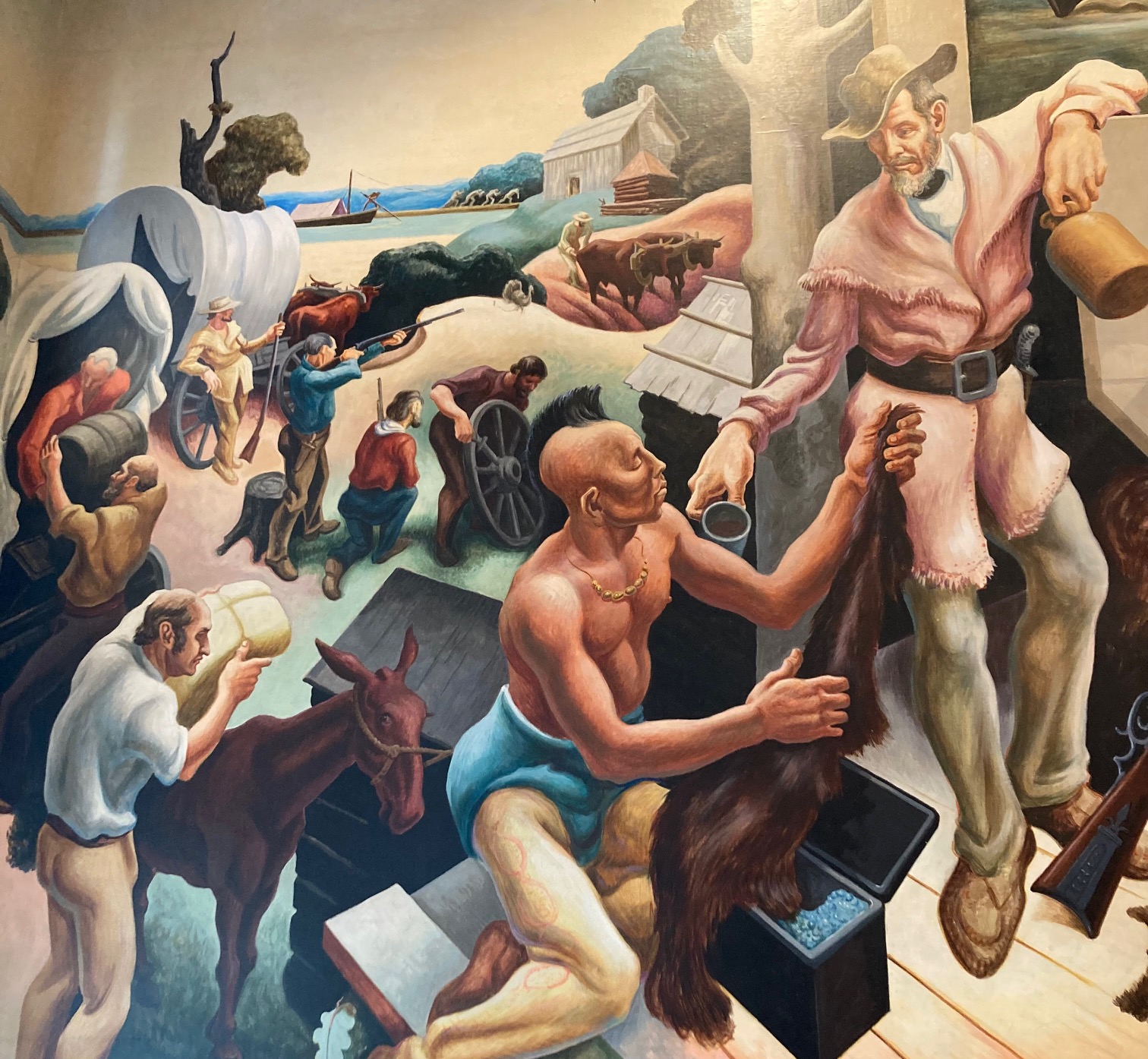
When the artist Thomas Hart Benton climbed the ladder in the House Lounge of the Missouri Capital in 1936 and began painting the mural that would become one of his most famous, it was during a record-setting blazing hot summer that he did so. Though he had been given two years to complete the commissioned piece, he finished it in six months. But perhaps it wasn’t just the heat that prompted him to complete the project in record time; It might have been the fact that he had just spent the last eighteen months traveling Missouri and preparing his sketches for its creation. By the time his feet walked up those Capital steps he had most of the mural already in his mind, custom fit to the only room left in the Capital that had enough available space for a project of its magnitude.

As I toured the Missouri Capital today, I made sure and visited the Benton mural. I had seen it numerous times in print or online. But this was the first time that I walked the actual room and cast my eyes on the wonder of it all.

The mural begins with the statehood of Missouri in 1821 and wraps around to the mid 20th century. What is conspicuous is the subject matter. Benton wanted the mural to represent the common life of Missourians in that time and place, not only a grandiose presentation of famous people. He did just that. Actually, more than that. He made sure to include typical rural life, families at work and play, and the development of commerce along the river and in the cities. But he also included the unsavory – slavery, slave auctions, and lynchings; the subjugation of native Americans in the pioneer/settler movement; raw scenes from upended domestic life; the fires of the Civil War and Industrialization. He told it all, the whole unvarnished story.

When the artistic work was at last unveiled, many of the legislators were not pleased. They wondered why he would tell a story that featured such ordinary people and a history that was so often brutal, a history some would rather not remember. If it weren’t for the cost incurred upon the taxpayers, a goodly number of politicians would have painted right over the mural with white paint. Thankfully for us, they didn’t. The masterpiece endures. And we are the recipients of this larger-than-life truth telling.

As I strolled around the room and viewed the mural, a fourth grade class was doing the same, guided by a docent. I listened in. The students asked questions about what they saw. The guide was honest. They were seeing, hearing history, all of history. Nothing was held back. And the roof didn’t cave in.

Time doesn’t change some things, like the response of legislators to telling the whole story of history. There is a movement afoot now to whitewash our history to omit the painful parts we don’t want to think about, to know about, the parts that do not cast a flattering light on how we got here. According to them, textbooks are supposed to omit subject matter that makes students (and most likely parents) uncomfortable. A theory called Critical Race Theory is used as a straw man to batter anyone – including educators – from dealing seriously with everything from Indian genocides to the Atlantic slave trade to the ultimate cause of the Civil War. They believe we should delete these portions, not speak of them, pretend they never happened, act like they do not exist.

In the face of this denial, in the presence of this attempt to cancel history and paint over it, we need a next generation of Thomas Hart Bentons willing to chronicle the whole story. We will learn from this story, be sobered by it. We may change because of the narrative that is told and avoid repeating some of the travesties of our own history. Without including the whole story, good and bad, we will continue to paint ourselves as heroic figures and project our lesser selves onto scapegoats, consigning them to the dark side.

And so, the best response to a modern equivalent of those legislators in 1936 who wanted to cancel Benton’s work, is to refuse to allow people to paint over the story today. We must not collude in a partial telling of the story. We should not be silent in the attempt to censure books, permitting only those we agree with to sit on our library shelves. We should resist attempts to support only the art that presents us in the most brilliant and appealing light. Those attempts will not help us and will most surely continue the damage that has always occurred. Only the truth can help and heal, and one can only hope that members of the Missouri House of Representatives will walk their constituents into that mural-filled room, pause, and talk with one another about the history we share. Only then, with a courageous painting of the whole story, can a way forward become possible.

Feet, yes, but not only

Posted: April 16, 2022 in Uncategorized

I don’t come from a foot-washing religious tradition. It’s not that I don’t appreciate the ritual of foot-washing on Maundy Thursday, I do. And in my time I’ve participated in my share. It’s just not something native to my experience, however aware I am of the narrative of the upper room and last supper of Jesus with his disciples.

It is jarring imagery: the rabbi washes the feet of his disciples. In first century Middle-Eastern culture the washing of the feet of guests, providing for their refreshment after dusty journeys, was not unusual. It was generally done by house servants or slaves. And that’s the twist. Jesus takes on the role of servant to make a point, namely, that true leaders are servants. He demonstrated it by taking up a towel, bending over, and washing.

I would have been as shocked as those first ones when it happened. In fact, Peter was so taken aback that he refused to receive the profound gesture of humility. For the story, of course, this was all part of the suffering servant theme, one that would extend far beyond foot washing; the feet of Jesus would not be washed, but rather scarred by Roman nails.

In my world foot washing is not a thing, not really, and certainly not for dinner guests, house guests, and visitors. They are welcome to wash their hands or shower up like everyone else. I have discovered that there are other ways to demonstrate servanthood and express humility.

With my daughter’s diagnosis of colon cancer, we travelled with her through the valley of diagnostic testing, chemotherapy, radiation, and finally surgery. It was major surgery, and the end result was the removal of a tumor. The prognosis is good. But the hospitalization and then recovery in our home has been difficult. It has been difficult in particular because phase one of the surgery necessitated an ileostomy. That will remain until the second surgery some months off when the surgery will put her back together with a bowel resection, a reversal. After that, we hope for total remission.

In the meantime, she is living with what over 100,000 American a year experience – the necessity of using, maintaining, mastering, and living with an ostomy appliance. It is not easy. Skills are required and acquired. The correct supplies are critical. And in addition to travail for the patient, much is required of caregivers.

As one who has been in and around illness and hospitals all my adult life, I was not shocked, either by the surgery or its aftermath. But I have never served in the role of support for a patient with an ostomy, and never served in that role for a member of my own family. It has been challenging. The learning curve alone is steep. Many aspects of life are put on hold. But with the right kind of support, like gifted and devoted ostomy nurses, it becomes possible.

In the early weeks, nothing takes place according to schedule, no matter how well you prepare. Accidents occur and emergency response is needed at any hour, like, for example, 1am in the morning. Addressing the problems when they happen are very important, so that the area surrounding the stoma may heal properly.

It was there one time, in the depths of the night, removing a failed appliance, cleansing the area, attempting another application, changing clothing and washing what needs to be washed, sitting afterwards to make sure all is well, that I came to understand what foot washing means for me in this very particular season of life. It means tending to those who are helpless for whatever reason, humbling ourselves to do so, without resentment or a sense of being bothered. It is honoring, washing and tending the body of the beloved for no other reason than it is needful and you are one who needs to do it.

I was surprised that after a while the ritual of giving and receiving became strangely normal, even giving way to levity, simple songs, puns, and stories from other times. There is a very helpful adhesive ring that seats the devise against the skin immediately around the stoma, and for us that became “The Lord of the Rings.” We who work to put it in place have became “The Fellowship of the Ring.” And so forth.

Mostly, I became aware of the love that is exchanged in those moments. There is a surrendering to the time and place, experiencing the holiness at the intersection of human weakness and help. I was surprised by how much changing an ostomy appliance feels like prayer, and perhaps at its heart it is exactly that, a form of prayer in the midst of ritual and loving.

I suppose each one of us finds different forms of foot washing along the way. When Peter refused to accept the gift of washing, Jesus reminded him that he could have no part in the realm of god without receiving such grace. That is true for us. We need to receive the grace that presents itself before us. With dawning acceptance, Peter retorted that, yes, he would surrender to the foot washing after all, and by the way, Jesus could wash anything else he cared to, like his head and hands as well. For us, it is the anything else that we find along the way, especially in those moments, whether giving or receiving, when we become mindful of the bending, washing, loving and submitting. It is then that we are transported to the upper rooms where loved ones wash one another in preparation for the feast of life.

In the Christian calendar, the days between Palm Sunday and Easter hold a sacred story, the journey of Jesus into the city that kills the prophets, a city that eventually kills him. The entrance on Palm Sunday was much less the portrayal we have customarily received through cinema or Sunday school art, namely, a rock concert entrance with Jesus on stage, fawned over by the swooning crowds, and more like street theater in which he and his beleaguered community acted out a story of entrance of a new sort of reign of God, led, by all things, by a man riding a donkey. Coinciding with the Jesus people demonstration coming in from the east, was a Roman military parade approaching from the west. The contrast couldn’t be more dramatic or illuminating. 

The arc of the story includes crossing a threshold into the crucible of inevitable persecution by authorities in temple and government. The temple could not suffer religious rivals. The Romans would quell any hint of insurrection, living as they did on top of a powder keg of social unrest and backstreet insurrectionists. When Jesus turned over tables on the temple mount, acting out a biblical tradition of cleansing, his fate was essentially sealed; from then on he would be a marked man, regardless of what teaching or truth-telling came out of his mouth. After a farewell covenant-making meal with disciples, an anguishing wait in a nearby garden to be arrested, he was taken, tried, and passed between religious and civil authorities until Roman verdict was passed. He was tortured and then crucified, the common practice of the Romans to enforce their power. It was a technique of terror. And when the Gospels say that Jesus was crucified by Golgotha – a strip pit turned town dump – it was outside the walls, in the margins where other outcasts and trouble makers were dispatched. He was not, as is portrayed on Hallmark cards and popular movies, crucified with two others alone on top of the dump. Rather, he was most certainly in a long line of crosses outside the gates, on the road leading in and out of the city, one of many, a man on his left and man on his right. They were crucified low to the ground, for maximum effect, and vulnerable to dogs. 

He received a burial in a borrowed tomb. In the Christian story the tomb served as a sort of portal, a transitional space for three days, out of which the spirit which can never be killed endured, arose, transformed. The passage through liminal space was not nothing; it was something, and that something had to do with the cost of faithfulness and love, the self-sacrifice undertaken by the best within us, and what lasts on the other side of the empty space of loss. Much must die on the way to rebirth. And the world is made new in much the same way. 

Like many others, I have been to Jerusalem and visited all the traditional sites such as the Via Dolorosa and the garden tomb. When I visited the Church of the Holy Sepulchre, the shrine where Jesus was supposedly crucified, presided over by several different religious orders, I came away with a very particular sense of what it was and why it was there, a sense that clarified, in a negative shadow, why I don’t view or understand the death of Jesus in that way. What it has evolved into is a cult of the dead that is understood to have sacral power by virtue of the spilling of blood, and by extension, sacrifice of a savior that appeased a deity that the death somehow sated. Short of that, one could say that the human fascination with death is a shroud that covers the entire story. 

Certainly, death is a particular and shattering aspect of the entire story. But it is not the death that is the final meaning. Death is the end of passage in order that something else is born. It is the passage, the transition, the movement through the valley of the shadow of death, that brings transformational power. To linger forever at the shrine of death is to minimize the impact and power of the great journey and the sacrifices necessary to do so.

It is as though we spent all of our time building altars at Ford’s Theatre to remember the assassination of Abraham Lincoln, but never read the Gettysburg Address, or told the story of what was required to overturn slavery, or explained the impact of the 13th Amendment. It is as though we never moved beyond the balcony of the Lorraine Motel to reflect on the meaning of Martin Luther King’s legacy, never recited stories of the Pettis bridge, his opposition to systemic racism, and the hard-won legislation that overturned the segregation that kept America in chains. 

In the same way that Jesus sojourned in the wilderness before his public ministry, contending with his demons, overcoming temptations to power and enshrining the self, so he sojourned at the end of his seemingly short, meteoric life, in the place where he felt compelled to go, a place where he had no choice but to slay dragons with his words, expose the hypocrisy of empty religious practice and the powers of this world that would eventually fall like rows of corn in harvest. He sojourned in a place and time that required risk, courage, and his life. Like others in history who gave their all in a martyr’s death, he submitted. He also demonstrated in his own flesh the transcendent vision he carried in life, becoming, for a time, the intensity of the reign of God within, until others saw it, too.

The power is in the passage and what comes of that passage. And so we do not linger long in the Church of the Holy Sepulchre. We pass through, exit, and go out into the world where truths worth dying for take root and give birth to new realities, a new humanity, a transcendent view, a view that takes one’s breath away.