The United Nation’s most recent commission on Climate Change just issued their voluminous report. It verifies what most already know, that rapid climate change is being enabled by the continued introduction of greenhouse gases into the atmosphere. Over the past ten years more CO2 has been emitted than that past three decades combined.

What to do? If a combined effort of all nations included taking drastic steps to reduce carbon emissions beginning now we could limit the overall increase of temperature – and its impact – by two degrees F. If those steps were taken, and that’s a big if.

What does it require? Enormous changes in carbon emissions – manufacturing, vehicle emissions, carbon based industries such as coal and oil.

How to get there? Really there is only one way – public policies that enact limits.

What’s the problem? Money. Big money. Corporations stand to lose money in the process of making the changes required. Regulations reduce sheer profit. And the corporations, lobbyists and big money own and control the politicians. As the Supreme Court is dismantling any legislation that could stop the deluge of money into elections and the coffers of politicians it is only going to get worse.

The political tactic that is used is denial – a foolish, almost unbelievable denial of the preponderance of scientific evidence. Nobody with half a brain believes that stonewalling. But not everyone has half a brain. The public is easily duped. Say it enough on talk radio and TV with an air of authority and it becomes “the truth.”

To put a finer edge on it people who are really, really smart with almost unlimited resources are putting their intelligence to work in the effort to protect those who would damage our environment most for their own financial gain. The people who deny climate change and human agency in it are the same people who would roll back reasonable regulations that protect our air, water and land from heinous pollution.

Years ago the tobacco industry denied that there was any health hazards that came as the result of smoking. Even in the face of dramatic evidence to the contrary they continued to deny the facts. They denied the facts in order to continue to sell their product in the same way and make the same profits. And this continued until denial turned into out and out lying. Eventually they were caught in their own web and the society forced them to change. And that, in the end, is what will happen with emissions regulations and climate change.

Unfortunately, many people died from lung and respiratory disease before the truth came out. We can only hope that the same does not happen with climate change and what is required to abate its momentum. Will we need to suffer mass devastation before awakening? Or will we have to endure climate cancer because the industries with the clout were unwilling to fess up – right until the very end?

The scientists have their role. The political process has its – legislation, regulation, policies. And people of faith are charged with making the moral case, to state our core convictions about being stewards of the earth, tending God’s garden, and loving our neighbor with compassion and justice. Naming the sin is a good place to start. And then, because of who we are, we paint a portrait of redemption and liberation, a way out if the people will but turn around.


At the regular meeting of my civic club our guest was the new exec of our local Chamber of Commerce. He’s a fine, intelligent, communicative, focused leader. I believe he is a real asset to our community. As a part of his presentation he shared the core values and mission of the Chamber, one similar to other chambers around the country. This unsurprisingly included a commitment to creating a pro-business environment in which local commerce may flourish. That makes sense. I mean, that’s why they exist.

One of the questions that Chamber execs often field is that of the Chamber making political endorsements of candidates or taking political stands on certain issues. This can become controversial. It is not a practice shared by all chambers in all parts of the country. Some chambers may focus on politics rather than politicians, for instance. But in Columbia we have a tradition of endorsements.

When the board of a Chamber of Commerce endorses a particular candidate it is ostensibly to further the mission and goals of the organization, i.e., to create that pro-business environment. Again, that would be anticipated, to choose politicians or support legislation that further the goals. The problem enters when you attempt to define just what creates a pro-business environment.

The way that is defined by most chambers is generally through a fairly narrow lens. It usually has to do with regulation, taxes, incentives, and supportive infrastructure. What I want to say (and they aren’t asking!) is that a pro-business environment requires much, much more than that.

What a truly pro-business environment includes is the stability and flourishing of the entire community and social system. Instability, failing systems, inadequate health care and social services, low wages, lack of investment in education, and any sense of disenfranchisement of the public undermines the goals of a pro-business environment.

For instance, lowering taxes cannot be the only focus of creating a pro-business environment. Enlightened entrepreneurs know that investment in education, infrastructure, municipal services, and cutting edge programs to strengthen families and children create the work force and tax base that makes the pro-business engine hum. That’s why the most progressive pro-business leaders make sure that they invest in just those things and they make sure the local, state and national government do too.

One of the most dramatic things leaders can do to create a pro-business environment is to invest in people, in workers, and strengthen their lives and families. In a time of extreme gaps between mega-wealth and the eroding wages and benefits of the middle class, a real and vast inequality that is creating instability and an anti-business environment, we could right-size the enormous gap between excess at the top (that opposed to popular mythology does not create jobs) and the repressed middle and lower class. This will take courageous people who dare look at the whole picture of our society and economy.

The endorsement of candidates or taking of political positions by a chamber is not dangerous because they do it. No, it is dangerous because those who make those decisions are peering through too small a lens. The whole, bigger story is required reading for anyone who truly wants a thriving, continuing, sustainable pro-business environment that benefits all. That requires a multidimensional approach, one usually not brought forward by the candidates who are most often endorsed.

In the end the most fruitful pro-business environment can only be obtained by pursuing the most just, righteous and compassionate course. That, in the long run, will be rewarded, and I don’t mean just with heaven. I mean it will be rewarded with the loyalty, commitment, long tenure, sacrifice and true affection of fellow citizens. And that, as the commercials say, is priceless.


Last night the convening convention of Columbia Faith Voices took place in Second Baptist Church of Columbia, Missouri. Those who have worked to form this community of communities were joined by others seeking seeking justice and dignity for all. The keynote speaker at the high energy service was the Rev. Dr. William Barber, the convener of the now famous Moral Mondays in North Carolina. We asked him to come and bring Monday to our Tuesday.

In addition to a calling for a moral voice in the present political atmosphere Dr. Barber gave us a little Oppression and Liberation in America 101. You put things in context and they begin to make sense, things like historic movements for freedom and dignity for all and how they have been resisted and repressed by those with great power.

Columbia Faith Voices identified an agenda that included safeguarding voting for all citizens and making health care available to all. The challenge extended to all to lift up their voices and put their faith to work.

There was a prophet in the land in Columbia, Missouri. And Monday moved to Tuesday.


No one walks the same Camino

Posted: March 28, 2014 in Uncategorized
Tags:

I just watched a feature on The Camino, or The Way of St. James – the ancient pilgrimage route that crosses the north of Spain. It has been walked for over a thousand years. If you want to walk the entire five hundred mile trek, you begin on the east at the French border and the Pyrenees and continue to Santiago on the west. I have a friend who walked a portion of it, about one hundred miles, last summer. Along the way your official document, the credencial, is stamped to certify your pilgrimage. At the end the pilgrims enter the cathedral for the noonday mass that gives thanks for safe passage and the gifts of the journey.

People walk the Camino for many reasons. I watched an interview with some of the Peregrinos, Pilgrims, and their answers were often quite different.

For some, the trek came about as the result of talking with or going with friends – another untried adventure. They might be outdoors people and next year it will be hiking the Appalachian trail or the Spine of England or Pan American Highway through Latin America.

Others were escaping. Mostly they were trying to escape the frenetic pace of the wired, work world in which they felt they had been sucked dry. Reconnection with nature, finding ancient pathways released them.

A few were walking for some thinly veiled reach for redemption or liberation from the debris left in their own wake. Some wanted to start over and they really didn’t know where they were headed, except that they were going and waiting and hoping.

Then there were the pilgrims walking the Camino in the spirit of the original purpose, a spiritual trek in the company of the faithful, seeking the grail of the soul, touching the ancient, rehearsing the story, and walking in repentance and a humble spirit, waiting for the Spirit to speak. These were the self-identified religious pilgrims.

The interesting thing, I thought, is how all of these were mixed together, heading the same direction, albeit for different purposes. That is, in my mind, a metaphor for how it is wherever our feet are. Some walk to get away, some to find, some as a spiritual practice, and some need the exercise or the change of pace. My confidence is that whatever the motivation God is going to snag us where we are on the trail. The Camino will be full of surprises even if we are not looking for them.

I think I want to walk it some day, if my bad knee holds out, that is!

I pulled the book of poetry off the shelf, part of a search for just the right word to speak where I was not speaking well, not well at all. I liked the poems –  fresh, creative, insightful – and had borrowed from this well before.

Just as the cover fell open my eyes fell on an inscription, one etched with ink on yellow page from more than twenty years ago. To me from her. Written in longhand, with crafted handwriting, the kind that is learned, practiced, made more than readable, made graceful, unlike my scrawl.

My fingertips touched her name. She was old when I was young, younger than now. The book was a gift, the poems of one of her friends. She knew I would like them. I remember the time she told me that this writer, this wordsmith, reminded her of me, something I didn’t see at the time, but do now.

She had been married to one of my kind, that strange, archaic, quaint vocation of minister, pastor, priest, shaman, metallurgist. The least she could do is give the younger ones a fighting chance, she thought. She thought right. We liked it that she loved on us. If she could of she would have passed out peanut butter sandwiches and apples on the way to our work.

And now, these many years later, I cannot locate a single poem that assists me in this task at hand. In fact, I cannot even remember the poet’s name. But I do highlight her inky name with the fleshy ends of my fingers. And that, now that she is long gone, is all the inspiration I need.

“One day I walked into a store in Cincinnati and discovered the mountain dulcimer. I had no idea what it was, how it sounded, or how to play it. Though not musically talented, I bought it. Within months I chanced upon local dulcimer lessons. That eventually led me to learn from an Irish harper who also taught dulcimer, leading to my love of Irish music, which eventually led to trying my hand (or foot) at Irish dance, where I met my wife. I can safely say that my initial leap of faith in buying the mountain dulcimer changed my life.”

Peter Caccavari, Ruminate Magazine, Autumn, 2013, p. 79

Just recently I attended a poetry reading. A dreadlocked young man announced, as a prelude to his poem, that he was “spiritual but not religious.” I suppose that disclaimer served as a warning for what was to follow. Indeed, his rap-delivered thoughts were unconventional, hip-hop being his religion.

If there is one religious demographic that is growing as rapidly as having no affiliation with a religious group it is this one, spiritual but not religious. It gives church folk the shivers. How can this be? They are stepping right around us.

To be honest I get them. There is nothing in the world that says you can’t apprehend the mystery of the universe unless you are a part of an organized religious community. Religion is the human response to the wonder and awe-filled experience of the universe. But it is a human response – flawed, distorted and contingent.

What they don’t get – and I use that pronoun, they, loosely – is that a vague undifferentiated experience of the universe is different that the honed spiritual truths and identification of religious practices that work through the centuries. Traditions carry identified truths and practices. You can accept, reject or modify, but they are there. And as they are there you start with something beyond the very limited view of any one human being.

Of course, folks like Whitman, Emerson, Frost and Thoreau, all the New England Transcendentalists would disagree. Nature is your chapel. The heart of the human being the workshop of the spirit. Institutions muck things up. And so forth. They were spiritual but not religious.

I want to introduce another dimension of that discussion. Though spiritual but not religious may be a growing and sizable contingent that we have to regard seriously, considering how serious dialogue might take place among its ranks, the phenomenon may not be that new after all.

If you consider the years of WW II and the couple of decades following as an anomaly in terms of church life, an unusual blip of great institutional church participation (and every other organizational participation), all that followed that super-heated time – including our own time – much more resembles what preceded the blip. What I mean is that actual communities of religious practice have always represented a relatively small proportion of the whole population. And yet many in those earlier times would claim a belief in God, pray and read Bibles. They were spiritual but not religious.

On the American frontier a radically small percentage of the population participated in anything that resembled a church. They had other fish to fry and did. Many of our founders fit neatly into this profile – Washington, Jefferson, Lincoln. These men were quite read in scripture and knowledgeable about things ecclesial, but like Churchill considered themselves flying buttresses – “supporting the church from the outside.” I think it is fair to say that they were spiritual but not religious.

I have just finished reading a biography of Daniel Boone by Robert Morgan. Many Boone biographies have been written and most are heavily mythological. We have no autobiography written by Boone himself (though a couple were attempted and lost). We do have a few letters he wrote. And the biographies that grew up around him mostly reflected of the needs of the American psyche for heroes.

What we never hear about in the myth-making biographies are the ways in which Boone was a failure at business, heavily debt-ridden his entire life. We never hear about all the suits filed by his unpaid creditors. We never hear how he kept moving west to outrun the taming of the wild that he brought about by guiding people there, fighting Indian wars with those he admired and ending their civilization in so doing. We never hear that by the time he got to Missouri he was an old man, living on reputation, and his sons did most of the heavy lifting. And we usually don’t hear about his most endearing qualities, the ones that made him beloved to his family and friends.

Daniel Boone was another great example of a man who was spiritual but not religious. Perhaps he was soured by his father’s earlier experience of intolerant religion and he steered clear of it. Maybe he found what he needed through solitary experience with the deep woods and those creatures who lived there. Boone was never a church guy. When he went out exploring for months, years at a time he would have a Bible among his things. But he was never a member of the church and is rarely known to attend. Like many of his time, including my distant relative, Kit Carson, he was a Mason. But that’s not church. It could even be anti-church.

So “spiritual but not religious” is not a new thing. It’s an old thing. Perhaps the best way to view this present phenomenon is to set aside alarm and think instead in terms of continuation. This has been the norm in American culture. There are all kinds of people mixed together here.

There are religious people who can scarcely be called spiritual. There are spiritual people who eschew anything that resembles religion. There are both, very spiritual people who live out their faith in a tradition and a community of faith. Add to that mix the generous blending of other immigrant world faiths and you have the American religious palette.

My hip-hop friend who rapped his spiritual but not religious verse was not representing something new. Nothing under the sun is. He was the latest iteration of that type, one that has been with us the longest time. And maybe for those of us who are both spiritual and religious it is a good counterweight. We need those who will help us keep on our spiritual toes and not get lost in the less than important aspects of  churchly structure and life. And maybe, if they will listen, the spiritual but not religious may actually discover something from those who are shaped by a tradition and share faith with others in community. We may need one another more than we know.
Columbia Faith and Values just sponsored a regional spiritual poetry contest. Out of forty submissions three were chosen for the top three spots. The judges were so kind as to settle on my poem for first place:

I believe
God is
regardless of what I believe

I believe
what I believe
changes year by year

I believe
God comes
whether I call or not

I believe
my turning point
was being believed in

I believe
but trust more
and that has made the difference

Sure, Free Church Protestants know something about Lent. But we admit it, we’re late to the universal church party. In this recent Columbia Faith and Values editorial I share why we had a lot of catching up to do. To read the whole column click here.

By any reckoning you would have to say it was a typical morning. The two earlier services were quite fine; the message from the associate pastor was especially good, the music was spirit-filled and a sense of unity pervaded the house. But none of that is so unusual, at least not around the place where I live and serve.

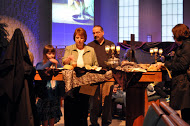
I was presiding at the communion table again, an act long familiar to me and anyone who darkens the door of our church. Like usual, the people processed in and set the table, bringing forward the gifts of bread, wine, and the work of our hands, our offerings. There it was, piled in front of us, the gifts of God for the people of God and the gifts of the people for the work of God. In one way or another it all comes from God and all returns to God.

Just as I began to speak I heard the patter of little feet approaching the table. In our congregation the children also bring forward their own offering. Their gifts include monetary gifts but just as often some other expression, like some art work they worked on during the message. It all goes into their plate and one of the children walks it forward. Though they were just a tad late to the party, in God’s time it was just on time. Sure baby, put your plate right here, we’ve been waiting for you, we’ll place it right on top.

Let’s see, where was I? I was about to issue an invitation for people to approach the mystery of Christ under the auspicious of bread and wine, a gathering of hungry people who know where to sate that hunger, a remembering that brings everything forward and eats with glad and generous hearts. I was just about to say some reasonably inspiring adult thing when I looked down at the children’s offering plate that perched on top of all the other plates.

Covering everything else was a hand-scrawled crayon drawing. Rather than press on I allowed myself to be distracted and then made the highly questionable decision to reach out and pick the drawing up in order to view it more closely. The Gospel story of the morning included the healing of the woman with the flow of blood, a woman who had suffered and struggled so desperately that she just knew if she could touch even the hem of Jesus’ clothing that would be enough. Just the hem. And that was the drawing, a figure of a woman kneeling, reaching out to touch with those hopeful hands. And suddenly Atlantis arose out of the sea and nested somewhere midway between my adult head and childlike heart.

It was not the quality of the art, of course. I have seen the great masterpieces in their museums and churches. I was not moved because some great personal emotional moment had come like the witnessing the last breath of someone you love. I have had those moments, too. And the tears that choked me did not pour out with pathos at some great occasion, like the vast inhumanity in Syria or elsewhere. No, this was something of a different order.

What sat on the top of the plate was a child’s overhearing of the Gospel, a distillation of the most simple thing, that if we reach there is something reaching back. The forms that reaching and reaching back can take are as numerous as the stars. But it’s all there in its essence and simplicity.

After I choked out how moved I was by this child’s mite, I said something like touching the hem of Jesus is like touching a crust of bread or sipping this wine; that’s all it takes, it is enough.

I am really not sure why I felt the hot breath of the spirit on my neck at that moment. And it really doesn’t matter why. Some of the deepest, brightest, show-stopping moments in any day arrive on their own terms and with their own chosen delivery system. That morning it was through an angel with very little hands and feet, one who was somehow catching a mystery that has sustained millions, and by doing so, without knowing it, was sustaining me.