Idiot Psalms

Posted: May 16, 2014 in Uncategorized
Tags: ,

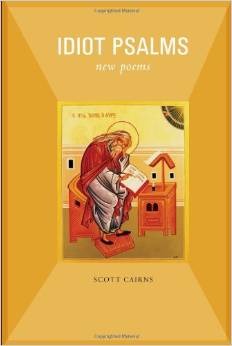
Idiot PsalmsScott Cairns, prolific poet and professor of English at the University of Missouri, has issued another collection of poems under the title, Idiot Psalms (Paraclete Press, 2014). The entire series is punctuated by a series of fourteen psalms and connecting commentary poems between them. The psalms are composed by Isaak, his imaginary writer. Here is the first:

Idiot Psalm 1

a psalm of Isaak, accompanied by Jew’s harp

O God Beloved if obliquely so,

dimly apprehended in the midst
of this, the fraught obscuring fog
of my insufficiently capacious ken,
Ostensible Lover of our kind – while
apparently aloof – allow
that I might glimpse once more
Your shadow in the land, avail
for me, a second time, the sense
of dire Presence in the pulsing
hollow near the heart.

Once more, O Lord, from Your Enormity incline

your Face to shine upon Your servant, shy
of immolation, if You will.


Thelma at Sixteen

Thelma at Sixteen
I knew she was young once
In fact younger than the son
who viewed his mother
as a much older man
pondering the fluidity of age
and wondering how old she was, really:
The freshly minted teen
who knew nothing of husband and sons
and what would come next
or the one whose story I could tell beginning to end
because I witnessed the end
at the same age she was
in the picture.
Or are we all ages layered inside
the same Mother’s Day card,
each number taking its place
beside the last, until
they all add up to more
than any one moment
many moments in one picture
an inexhaustible sum
of life, love, suffering and hope?

Image  —  Posted: May 11, 2014 in Uncategorized

Six Doors to What?

Posted: May 3, 2014 in Uncategorized

Uh oh. There is a rumor in the land that a new book is on the horizon.

This one is a collaborative effort with yours truly and two other creators.

The publisher says it could hit the streets as early as Christmas.

Six Doors???

A Prayer for the Morning

Posted: May 2, 2014 in Uncategorized

(Offered at the South Rotary Club, Columbia, Missouri, May 2, 2014):

Now, in the opening light of day,
We would be mindful of You.
For You are the Alpha and Omega, Beginning and End.
In You “we live and move and have our being.”

As we lift up our eyes from lesser concerns
transform our love of You into concrete love for neighbor,
and when our hearts turn cold or our zeal flags,
remind us again to Whom we belong,
Whose days these really are,
Whose will we pursue,
and what You would desire of us.
Then, rekindled, draw us toward Your unfolding purposes,
Your reign of love that shows itself in justice, faithfulness, mercy and peace.

We pray in the spirit of your presence come among us, Amen.

Last night I attended the premier of a new oratorio by Stefan Freund, The War Amongst Families and Neighbors. The work is a historical sketch of the civil war in Missouri and the way that a divided state endured tumultuous times. As the story was based on actual records, correspondence and documents, the audience was escorted through unthinkable brutality by the soloists, chorus, orchestra and multi-media.

Some moments – direct quotes from first person witnesses to atrocities – were literally breath-taking. And having the events and quotes delivered in a stunning musical medium left the audience in a quandary: Do I clap?

The clap question was expressed in the frequent moments of half-committed applause. It’s courteous to express appreciation, isn’t it? But when is it not appropriate to clap, no matter how beautifully executed the performance?

Since the audience didn’t figure it out and no one from the production helped us I had to answer that question for myself. I simply stopped clapping, except at the end, of course. Clapping is the knee-jerk gesture of appreciation in our culture. But it is often misplaced, a kind of genial, mindless spell-breaker, like clapping after a beautiful musical setting of a prayer.

The truest and best tribute is often that of thoughtful silence. Some performances and some topics deserve nothing less than that. And though I didn’t have either the clarity or courage cued up and ready to go at that event, maybe next time I find myself in a similar position I will simply turn to those around me and say, “This is too important to clap.”

History is littered with the stories of those with power blocking those without it. The motive is simple: To keep power one must make sure others don’t get it. In a democracy, the form of government based on the participation of influence of the people, the struggle to keep or gain power exists in different forms. In the United States the battle is usually colored green as stacks of money buy the outcomes preferred by the privileged.

One of the present glaring instances of power grab is found in attempts to limit the voting of citizens. To be specific, the effort limits access to those who might vote against me.

To make sure that all citizens have access to voting a citizen initiative petition has sought to extend the voting days and times. Once the super majority of the Missouri legislature heard of such a petition – a people’s effort with a direct vote – it decided to oppose it with a particular bill, HJR 90. This bill proposes a constitutional amendment for the Nov 2014 ballot that establishes an early voting period beginning in 2016. It is deceptive, a wolf in the sheep’s clothing, pretending to be magnanimous. Do not believe it. It is a crafty effort.

It limits the period to nine days, much less than the citizen petition. It eliminates Sundays, the preferred day of many of those citizens who work during the week. It nullifies the citizen initiative – blocking direct action by citizens. It does not address the location of sites, which is crucial to access to all people.

This counter bill to the citizen initiative is a sham. It attempts to limit the scope of the ballot initiative in ways that keep certain citizens away from the polls … again. It is an attempt to block – and codify constitutionally – direct action of citizens.

Oppose HJR 90 by calling your senator and asking him/her to oppose the bill and support the citizen initiative for Early Voting.

This is what power does. In this instance it is conspicuous. And citizens can oppose and defeat this pretend effort that takes away as much as it gives.

The name Barbara Brown Taylor is not new to any of us and neither are the titles of her books. But her new memoir, Learning to Walk in the Dark, takes us down a new spiritual path for her even if it is not new to the Christian tradition. The via negativa, as it is called, finds God in the darkness, the no-thing, the silence.

Though much of Taylor’s previous life focused on the via positiva, her present trajectory of spirit has taken her in the other direction, not unusual for mystics in general and even more common as they enter the reflective twilight of the second half of life.

So she speaks of befriending the darkness and the speaking voice that can only be found there. Abandon your cheery quest for the happy feet of contemporary always grinning worship. Unplug from your sensory entertain-a-thon.

In her words:

“Turning to darkness, instead of away from it, is the cure for a lot of what ails me. Because I have a deep need to be in control of things, to know where I am going, to be sure of my destination, to get there efficiently, to have all the provisions I need, to do it all without help – and you can’t do any of that in the dark.”

“If we turn away from darkness on principle, doing everything we can to avoid it because there is simply no telling what it contains, isn’t there a chance we are running away from God?”

Go deep, church. Go ancient. Go dark.

Never Pray Again

Posted: April 21, 2014 in Uncategorized
Tags:

Come on, a book about prayer that says you shouldn’t do it? Well, not exactly. In fact, not at all. Never Pray Again: Lift your head, unfold your hands and get to work (Chalice Press, 2014) certainly is about praying. But it is about praying in a certain kind of way. The merry band of Aric Clark, Doug Hagler, and Nick Larson identify ways to pray through engagement with our foci of ultimate concern, i.e., the things we would normally pray about we rather engage with.

The underlying theology is one of immanence, God active and manifested within the world. If one is to pray and pray to that God then the object of prayer is near at hand and prayer can be an action within that field of engagement.

Never Pray AgainLet me cut to the chase with one of my favorite summary statements in the book: “Your intercession is too urgently required for you to waste time on your knees, whispering words to a deity you imagine to be distant. God is right beside you, right now.” (90)

Lest you think this is one of those typical spirituality or action dualistic tomes, think again. It might more closely resemble another of the well-respected paths in the Christian tradition, the path of prayerful reflection-action.

I recommend the book highly. It’s great for seasoned practitioners of the faith who want to hone a dull edge. Rank and file questioning skeptics will find their eyebrows raising with each chapter. And small discussion groups will have no end to the lively debates it engenders.

Love it or hate it Never Pray Again isn’t going to leave you sitting there unaffected. And that’s the whole point.

You may order your copy here.

The community gathers

The community gathers

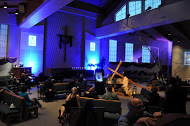
Our open-space worship environment continued through Good Friday as the community gathered, looked, listened, contemplated and prayed.

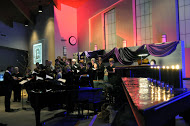
The Chancel Choir sang the haunting Reproaches by

Chancel Choir

Chancel Choir

Victoria, the cycle of questions from the divine lover to the beloved asking why they have rejected and scorned the lover. They began in “flash mob” style, scattered throughout the sanctuary, a few beginning to sing and move joined by others until all were assembled in the loft.

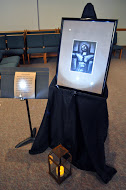
art stationThe prayer stations included the passion cycle lessons and the work of the late French artist, Georges Rouault. His sacred art, especially his well-known Miserere series, focused on the Divine love present in the suffering of humanity as shown in Christ’s suffering.

The printed prayer guide included Rouault’s story, how when he

Rouault

Rouault

was about thirty years old he had an awakening and united him with the sacred source of things and the humanity loved by that sacred presence. His art was derided by other artists and held in suspicion by the religious. Almost forgotten in his own time he has been embraced in the present moment as one of the greatest sacred modernist artists of the last century.

BCC Good Friday 2014 Panorama

You could call it an un-worship, but that wouldn’t be exactly right. For both Maundy Thursday and Good Friday we moved the seating out of the sanctuary and replaced it with multi-media images, prayer stations,

Entering through Palm Sunday

Entering through Palm Sunday

ambient live music and seating areas for meditation and prayer. Stations included places to anoint oneself or a friend with oil, to wash

Self=serve Communion

Self=serve Communion

feet, to write prayers of hope to hang on trees and to commune at the central table.

MT 14 PanoramaIt’s not easier to pull off open-source worship than standard structured worship. It takes lots of work! But I am surrounded by incredibly creative and talented staff and volunteers who make it look easy.

A few people were uncomfortable with such an unstructured experience, but most plunged into the sacred time-space and let their spirits loose. Some meditated for an hour. Others spent time focusing MT 14 Footwashing childrenon the music or images. Tenderness was everywhere on display as people engaged with those they knew who were struggling or passing through times of loss. The Last Supper of Jesus became the Jesus meal for the broken. By his stripes we knew our own … and the source of our own healing.

MT 14 GethsemameWe’re repeating the same process tonight, Good Friday, but this time with ancient song through the Chancel Choir and the stunning images of the late French artist Georges Rounault. Whereas a table was in the center of the space last night there will be a cross tonight. And it all leads to the hope of Easter which is the power of life on steroids. The light has come into the world but the darkness could not put it out. Not then, not now.