It’s not easy to be poor; it’s that simple. A puff of wind pushes you this way or that and you fall off the high wire you’ve been walking. Life is hand to mouth. And if you are a part of the peasant class like Joseph, Mary and their young child, Jesus, you’ll never get out of it. There is no social mobility. It’s not that wages are just stagnant; they are unpredictable. And since a foreign government occupies your land you are heavily taxed to underwrite the cost of the wealthy elite, vast building projects and the empire. Everything is rigged to benefit those in power. Their affluence is funded from the broad bottom. The money runs uphill, the trickle up theory. And that’s where the peasant class lives and dies, on the bottom.

Life is precarious for Mary and Joseph and Jesus, because that is where they live. So the idea of taking a mandatory journey to Bethlehem was no small matter. They could barely afford to live day-to-day.

Living off the charity of extended family and friends in Bethlehem, they couch surf; the manger being that crib, the livestock pen the spare bedroom. That’s what you do when you’re at the bottom, like most the people they knew.

Among other things, that is the absolutely stunning and mind-blowing realization; God chooses to enter the drama through a hatch in the bottom of the stage. It wasn’t the first time, of course. A doomed baby named Moses floated in a basket down the river to a destiny that would change his people. The youngest of Jesse’s sons, David, the one exiled to sheep herding, was anointed to become the king of Israel. And here, again, in the fullness of time and in the basement of history, the Son of David sleeps among the livestock.

I wish I could tell you that it got easier. But I can’t tell you that.

In time, and like a scene from Star Wars or The Hunger Games, the Empire becomes aware of a rebel arising out in one of the distant outposts or districts. In fact, some wandering holy men are escorted by security forces in to have an audience with the monarch of the region, one of the puppet client kings of Rome, Herod. Like most fascist despots this ruler lied and feigned sympathy to locate this rising star. But the wise men are discerning; they intuit the false pretense, the lying, and the posturing. So when Herod releases them – wanting them to find the One for him so that he, too, can pay tribute to him – they know he is not to be trusted. Deeply spiritual people sense the duplicity in those who lust for absolute power. They know that absolute power cannot tolerate a rival. They know he will kill the opposition in one disingenuous way or another.

As a part of a dream fest, the true intentions and situation of threat is revealed to two groups of people. The first is this group of Magi, wise ones, and rather than return through Jerusalem to inform Herod where the star child is they return home by another route. When Herod discovers that his informants have disappeared he is enraged and goes about a campaign of ethnic cleansing to liquidate his supposed rival. He throws a broad net of death over any children who might be in the range of this rival King. The swords flash.

In the meantime, the second group, also informed by means of a sacred dream, has been forewarned. Joseph is shown in a dream that he must flee for the lives of his family. If you thought it was bad to be a peasant, if you thought it bad to be a peasant in an occupied land, if you thought it bad that they had to take the time and resources to travel out of town for an enrollment, it has now become worse.

Mary, Joseph and Jesus have become political refugees. They are not economic migrants moving for better opportunity. No, they are fleeing the threat of death, leaving their homeland that has become a death trap and crossing the border into another land as refugees. Now they are even more vulnerable and depend on the generosity, hospitality and compassion of people they don’t know and that don’t know them. Like their ancestors they have become exiles, strangers in a strange land.

Like his ancestor Joseph of the coat of many colors and his brothers who fled famine in Canaan and crossed into Egypt, so Joseph the father of Jesus headed across the same border but not because of famine. This time he crossed the border to escape the empire’s security apparatus and death squads. The little refugee family hopes the border is open. They hope there is a way to exist in another land. They hope people will take them in.
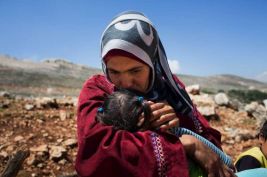
syrian-refugeesLike this Syrian refugee family fleeing the ancient war-torn city of Aleppo, the sounds of war barely behind them, they hope that someone will take them in. They hope that the doors of Turkey, Jordan, Europe or the United States will be open. The powers and principalities of this world have done their very best to bomb them into oblivion and they flee for their lives, often on foot, by boat, by donkey.

Joseph, Mary and Jesus were just such a refugee family.

If you are wondering how and where God enters the world, here it is. God comes by way of the margins, through the basement and undercroft of history, in the faces of the least of these, in ways that confound the places and people of power. The ways of God are found on the other side of violence and hate, through the hallways of hospitality.

If you wonder where Jesus is today, wonder no longer. Jesus is where oppression is at its worst, in the dark little corners of the forgotten world, abiding in hearts of all who are pursued yet remain courageous. Jesus is born and travels ever at the edge and may be found wherever the wise follow and evil attempts to destroy. There you will find him. Not in the conventional religious places that may automatically come to mind. But rather in the surprising places where the God of downward mobility chooses to show up, a trickle-up movement that confounds the world even as it gives unexpected hope. And when you sing the carols of this season it is for the sake of this Jesus and not another that you lift up your voice.

When the 16th century reformer Martin Luther said of the Christmas story that he would rather be one of the shepherds than any Pope, he was not only casting aspersions on the papacy. He was making a statement about the way God works in the world, where God shows up and how.

What Luther was saying then and we can say now is that God defies all expectations. God does not show up where expected, in the places necessarily valued by the culture. God does not show up in the political halls of power and empire. God does not show up in the temple or among religious structures. God does not show up on Wall Street and centers of commerce. God does not show up where news crews assume it’s happening. God does not show up in the great centers of learning. God does not show up according to our time tables and schedules. God does not show up by force or coercion. However one might expect it, God shows up in none of these places.

No, in this story God shows up in the most unlikely of places. God shows up among shepherds. And the first thing we must ask ourselves is just where the shepherds were located.

Shepherds were living outside urban areas, far from the centers of power. Within their own agrarian peasant class they were at the bottom of the social ladder, a place often reserved for the very young or very poor. They lived where they worked which was wherever the flock needed to be. They lived in the fields. They were often migrants, shifting with the seasons to different grazing lands, without permanent home. In every respect they lived on the edge of everything.

And why, you might be wondering, do the angels make their appearance there and to them? Why is so much revealed far from the center of presumed power, enterprise, attention and religious virtue?

And what is this carefully crafted message from angels for shepherds in the fields?

What are they expected to hear through their terror, hear and pass on? What they hear is that they should not be afraid. In fact, the message is for them. What they hear is a sacred song luring them from the edge all the way to a baby who barely has a toehold in this world. Why in the world would such a message be entrusted to such as these? Why would Luther rather be one of these shepherds than every priest, pope or king who ever lived?

The answer is disarmingly simple: If the good news of great joy is going to make it to all the people it will have to start at the edge and work toward the center. It never works the other way around. Herod won’t pass it on. Neither will the High Priest. All those who broker such things will inevitably keep and use and hoard them. This is the human inclination to territory, to self-serving control.

Thankfully, God never uses a trickle-down approach. Against all expectations, God employs a different divine economy, a trickle up plan.

The good news of great joy that causes the heavenly host to sing “glory to God in the highest” starts with shepherds at the farthest edge and works toward all the people from there. It is to these unsuspecting and shocked shepherds that the good news is entrusted, not by virtue of any status, power, wealth or learning. They have been entrusted with the precious news because they have nothing to lose; because they are the least inclined to misuse and distort it for their own purposes. They run with empty hands toward Bethlehem, no agenda other than delivering the news.

You can only imagine the difference this makes to the holy family, these peasants who have traveled far for the census. The news is born by those on the edge, shepherds with nothing to defend or claim as their own. They come wanting to see for themselves what has been told them. And so they do.

When someone on the edge, out of nowhere, with no discernible agenda appears, there is epiphany.

So it was for the young mother of the baby and her husband and all the Bethlehem family gathered in the courtyard of the house, because there was no guest room available. They, too, were on the edge of everything, God’s preferred revelation locale.

It was a peasant-to-peasant call they made that night, and everyone – from the shepherds to the family – were stunned by the way the Spirit was working everything out. There was no rule book. No star performers. And yet God was starkly, palpably, purposefully present.

Of course, that dramatic contrast between the edge and the center, the contrast set in the beginning of the story, would stay that way until the end. God just kept showing up at every edge life contained until off the edge the world decided to throw him.

Whenever we wonder why our sense of the Presence of God has grown stale or cold we might consider that we may have grown much too comfortable with the center of life as we know it.

We may need to go to the edge of the known to find what is hidden. We may need to look for God out beyond the expected and familiar and orthodox. We may need to go out with the shepherds, with those who claim nothing for themselves in order that we might receive much.

Angels still sing for those who will listen. But we will never hear them with hearts tuned to the frequency adopted by the world. Rather, we will hear when our hearts are open to the wide open spaces beyond our control, out at the edge where God still chooses to come, baffling all those who continue to predict how and where and when it will happen next.

Run, shepherds, from field to town, from town to room, from room to manger, from edge to edge. Take us with you. It’s time to leave this place and bow down at the simplest, most beautiful altar on the edge of the world.

Then the Stillness

Posted: December 19, 2016 in Uncategorized

Except for harm and injury, most of us crave the kind of natural forces that bring life grinding to a halt. Ice and snow will do nicely. What kid isn’t thrilled with the news that school has been cancelled? Imagine, the free and clear gift of a day. And adults are not much different.

That is true unless you are one of those tireless civil servants for whom work increases when snow comes or the ones who go in to the hospital or power plant or care center for a long shift. For the rest of us the stopping of the expected schedule is a gift. If you are warm, if you have provisions, if you don’t need to go anywhere, the pause is something to be relished.

Two cardinals are perched on the neighbor’s deck, feeding on sunflower seeds. They are effervescent against the background of evergreen and white snow. It is the most most simple of things; the act of finding, eating, resting. Fly, nest, observe. Wait, whistle, roost.

In my seeing I share in that. In my knowing I am one with that. In my smiling I fly with the flock, flashing red against white, the frosted world beneath rosy wings.

They just didn’t know it yet

Posted: December 13, 2016 in Uncategorized

My friend Steve Cranford died last week following a massive stroke he had while they were visiting in Atlanta. I will miss him in so many ways. Steve was one of my early mentors as he served as Regional Minister for the Mid-America Region. He presided at our wedding. And I often spoke with him about his time serving on the Faith and Order division of the World Council of Churches. Steve went on to provide leadership in interfaith concerns in Tulsa.

In the early part of November Steve and Myrna took a swing through Missouri visiting friends and by chance were able to attend one of our Bluegrass services. That night I told a story about Desmond Tutu, the retired Archbishop from South Africa and world Christian leader. When Steve was serving on Faith and Order Tutu was on the commission – before he became bishop. And Steve thanked me for mentioning him and then told a Tutu story of his own.

The story came from the terrible time of apartheid in South Africa. People had begun to rise up and protest that racist and oppressive system and the church and its leaders were giving moral voice to oppose the injustice. Steve said that as they were meeting in Geneva one time Desmond Tutu told a story from the streets of Capetown.

As he walked along the street and spoke with the throngs of protesters, he watched a soldier force through the crowd and elbowed a diminutive little elderly African woman, knocking her to the ground. And Tutu turned to Steve and said, “What the soldier didn’t know was that she was going to prevail; they just didn’t know it yet.”

Let there be no doubt – injustice, evil and oppression have their day. The impossible and terrible does happen. And it often seems to go on forever. But in the long arc of history justice and truth prevail. In the land of deep darkness light shines. There is weeping for the night, but joy comes in the morning. The fist of Rome smashes all dissent, but the quiet appearance of a baby in the night wins the heart of the world.

Force, intimidation, brutality and rampant discrimination still haunt our world. Little old ladies get tossed to the ground. But ruthless power has a shelf life. Now is not forever. It’s just that they don’t know it yet.

Thank you Desmond. Thank you Steve. Thanks be to God.

I have just finished reading Philip Short’s long but concise history of the rise of Mao and the great Chinese revolution of the last century, Mao: A Life (Henry Holt, 1999). The revolution arose like so many others of its time throughout the world – Spain, Russia, Germany. And many of the same elements are present excepting the cultural setting and history leading to it. What begins under the banner of a freedom movement comes to resemble fascism more than anything else.

In the case of Mao and the Red Army much of the preexisting power vested in national government or culture itself had to be destroyed. That included not only battle against national military power but actual governmental authorities, past cultural signs of authority like religion, and especially the educated. It is the last category – the intelligentsia or intellectuals – that fascinates me the most.

To assure their absolute dominance Mao and his movement had to socially belittle, exile, imprison and kill any semblance of intellectuals who could think for themselves or raise educated objections to the regime. It was essential to cut at the root of the tree, to remove educated resistance.

This was also the model used in other iterations of Maoist revolutions, such as in Cambodia and its killing fields. The educated elite were marginalized and sent to “reeducation camps” which were camps of hard labor. The former teachers, scholars, artists and journalists were separated so they could not influence the proletariat, the working classes (who were really dominated by the revolutionary elites, like Mao). Their voices were silenced so that Mao’s propaganda could not be contradicted by other opinion. Then they were quietly murdered.

In terms of Mao’s priorities on the way to securing absolute power he had to first smash the military, then the governing powers, and then the intellectual elites. All had to be vanquished.

When we consider what it takes to create and secure a vital, free and democratic society, we find the elements of protection ensconced in our Constitution and Bill of Rights. Freedom of speech and assembly assure that a variety of voices will be heard. Laws prohibit the cavalier disposal of those who differ with the regime. And even when anti-intellectualism rules the land, we have safeguards in place that insure a free and continuing  voice of reason, thoughtfulness and intelligence. That is protected.

We don’t read history so much as it reads us. Every time we hear strains of a new anti-intellectualism in our time, when we hear someone or some group disparage our intellectuals, artists, writers, journalists, and prophetic religious voices, it may behoove us to bring the picture of Mao’s reeducation camps to mind. Purging the educated by labeling them troublesome elites may feel good for the moment. But it is like the body chopping off its own head to make a point. Headless bodies don’t navigate well, at least not for long.

the-mocking-of-the-educated

The mocking of the educated

The Matrix is not just a movie

Posted: November 19, 2016 in Uncategorized

I have just received certification as a Matrix Reimprinting Practitioner. Matrix is an advanced specialty of EFT (Emotional Freedom Techniques). Matrix work involves going into the subconscious, past memories and energetic selves where we may resolve that which still operates beneath the surface of our awareness. Through a variety of techniques we clear the painful and troubling emotions and thoughts affiliated with past trauma. It is a wonderful extension of and accompaniment to EFT.

Healing the Divide

Posted: November 12, 2016 in Uncategorized

Required viewing … right now:

When the fog rolls in

Posted: November 10, 2016 in Uncategorized

Some of you know that I have delved into liminal studies for many years. In fact, my doctoral work centered on this and a second edition of Liminal Reality and Transformational Power has just been published (Lutterworth Press, 2016). I’ve been invited to Leicester, England next May to present on liminality at a conference.

What is liminality? It is the state of being between what is known and the unknown that is yet to appear. When we cross the liminal threshold we leave the assumed structure of our lives and enter a territory that lacks all the familiar coordinates. We are “inbetween” and all the balls are in the air.

Liminality comes in many forms, some voluntary and some not. Various cultural “rites of passage” are voluntary and prescribed – the tribe escorts the individual or group through a transitional passage as they move from one state of being to another. Rites and rituals accompany these passages and the society is often involved in the process of transformation.

There are also involuntary times of liminality that crash upon us through calamity or dramatic unanticipated shifts in the world. The twin towers come crashing down, or my marriage, or my health. An unanticipated accident changes my life forever. I am plunged into a foggy “no man’s land” in which the past is gone and I can’t see a future. I become a liminal person in liminal space.

It is also the case that entire families, groups and even nations enter such times. We call this social liminality. A recent example is the shock and disbelief that many in the UK felt when the seemingly impossible BREXIT occurred. The people as a whole were escorted involuntarily into the domain of uncertainty.

As of November 8, 2016, the United States has been swimming in a new liminal domain. With a highly unanticipated election outcome our society has, by and large, entered into a whole new liminal space. People find themselves without anchor and are filled with uncertainty or dread. There are several factors that have created the dramatic liminal domain, conditions more dramatic than the typical transitions affiliated with an election.

Throughout history large systems have passed through times of transition in which the energy and form of those systems eventually give way. When that happens many of the old familiar structures dissolve and even disappear. At the least they are reformed and that change takes place in the midst of great uncertainty. It does not yet appear what we shall become.

This election – and developments several years preceding it – has led to the dismantling of assumed structures, like the dominance of existing parties and presumed leaders. Mavericks and outsiders often appear in liminal times and that adds to the consternation of the people. It is also a sign of the dramatic shift that has taken place.

The rapid ascendancy of President Elect Donald Trump fits this pattern to a tee. When the collapse begins it is often a very rapid one. Once it happens and all those balls are in the air many things shift. People become anxious and afraid

Liminality simultaneously contains great danger and vast opportunities for hope and transformation. It is dangerous because the old familiar structures are not present to reassure everyone that life is safe and predictable. A dramatic unbuckling may lead to a positive transformation or its opposite. Much is at stake when many of the structural rules have been suspended.

On the other hand, liminal reality allows for a new time of creativity and transformation. Depending on the “ritual leadership” – those who are able to lead through the wilderness – the trek may lead to new and unforeseen ways of being. That is exactly what the supporters of Donald Trump have been banking on. Whether that happens is yet to be seen but at a minimum this liminal moment will not resemble anything that has preceded it.

Quite apart from any of our personal takes on the character, policies or style of leadership of any elected leader, the liminal domain and passage is fraught with potential. However dangerous it is, there is a new opportunity to discover and create a new way forward. One does not dispose of principle, values or spiritual foundations to do so. Those become more important than ever. In fact, they are clarified in the liminal domain. Much is revealed in the struggle to transform. The essence of the Constitution, for instance, will become more important than ever before. But the ways that we evolve as a people will require experimentation, novelty and creativity. Old alliances will be reconsidered. New ways of accomplishing cherished values will be attempted. Some things will disappear.

This is the danger and promise of the liminality through which we are now passing. The initial disorientation will last for about six weeks or so – forty days, the Biblical symbol of liminal transformation. As a part of it we should expect disruption of the familiar. And we who rely on deep spiritual foundations will turn to those even more. We are needed now more than ever before. Our people need our calm, forthright and hopeful presence as we remain a light in the darkness, a city on a hill, a lamp on the lamp stand, and leaven in the lump.

It was the year 1865 and Abraham Lincoln was preparing his 2nd Inaugural Address. He had prevailed in the 1864 election to a second term of office, but just barely. On the heels of the long civil war this very unpopular president was faced with a divided and polarized nation. And the completion of the election would in no way lessen that strife and conflict.

For example, in all of Boone County only twelve people voted for Lincoln. And those twelve were white men who held property. The rest voted against him and many of those were slave owners. When the election results were announced there was a mass demonstration on the University of Missouri campus. Imagine, students protesting! Have you ever heard of such a thing? This demonstration was different than the most recent one.

The students – children of those same slave owners who voted against Lincoln – gathered to demand that Missouri succeed from the Union.

This most recent election season through which we have passed may have been the oddest in recorded history, but it has not been the hardest. We have had harder times.

Against a backdrop of division, polarization, strife and conflict, Lincoln prepared his words.

They are the words of a statesman in a time of deep adversity. They are the words of a man who was reviled by many, as would soon be evidenced by the assassin’s bullet. They are the words of a man who had suffered as his nation suffered.

They have such a strange ring, these eloquent words from a real statesman, and they stand in stark contrast to what we have heard in recent months. That is exactly why it is important to share them, to hear again these strange sounding words, to remind ourselves that there is a different way of speaking in the worst of times:

“With malice toward none, with charity for all, with firmness in the right as God gives us to see the right, let us strive on to finish the work we are in, to bind up the nation’s wounds, to care for him who shall have borne the battle and for his widow and his orphan, to do all which may achieve and cherish a just and lasting peace among ourselves and with all nations.” (Abraham Lincoln, from the Second Inaugural Address, March 4, 1865)

And those are the words that haunt us, that ask if it is possible for us to do the same, or approximate the same or even attempt the same:

“With malice toward none, charity for all … to bind up the nation’s wounds…achieve and cherish a just and lasting peace …”

How difficult it is to not have malice! When contention is the way of the day it is difficult to have charity for all!

As we know from Lincoln’s time, striving for justice and truth creates conflict and division and often drives people apart. The abolition of slavery was just such a cause and necessity.

What Lincoln knew is that even though such collateral damage was often required when justice prevailed, there was also an equally important necessity to bind up the wounds, to tend the unity of the people. This hard work had to be done or else the center would not hold and all would be lost.

It seems to me that, though not in the same degree of strife or despair, we have passed through parallel times of political division. There has been malice toward all and charity for none. Unlike Lincoln’s time, though, we do not have to wait for news or propaganda to arrive; as an angst-laden people we are surrounded, barraged with it from sunup to sundown.

Many of us have contributed to this spirit of rancor, each in our own way. We have not been the solution, but added to the problem. Or we stood passively by, feeling quite helpless to affect or change anything. But now, it seems to me, it is time to take up a different mantle, even as Lincoln took up a different mantle after the long battle.

Much of the same could be said of the apostle Paul, who rarely turned away from a fight of principle. Always insisting on the highest vision of being a Christian he contended with many and found himself cross-ways with many. But Paul also knew that in the beginning and the end we are one body of Christ, one people with one head, called to be peace-makers and agents of reconciliation.

To do this difficult work we must put the good of the nation first ahead of any allegiance to political party. And to do that we will have to rely on the spiritual principles that guide us as a Christian people.

What will be required is a language unlike we have heard as of late, a vocabulary that exceeds the drone of hatred and selfishness. What will be required for this work is a substantial and deep language, the words of a statesman and apostle, words that look toward a future we must create together. What will be required for this moment is a sound unlike the noise that fills the airwaves.

And who are able and willing in the spirit of Lincoln to speak words of malice toward none and charity for all? Who are able and willing to bind up the wounds? Who are able and willing to achieve a lasting peace?

Who are able and willing in the spirit of the apostle Paul to be humble, gentle and patient, forbearing with one another and charitable, sparing no effort o make fast with bonds of peace the unity which the Spirit gives?

It’s easy to be a peacemaker when things are peaceable. Anyone can do that. The real nerve and metal of a peacemaker is known in the midst of conflict, contention, divisiveness and bitterness. Who are able and willing to speak the truth in love then? Who are able and willing to beat their swords into plowshares then? Who are able and willing to judge not lest you be judged then?

Who, I ask you? I will tell you: We are.

Who will accept the commission to go forth in the spirit of Lincoln and of the Apostle Paul to do the hard work of binding up the wounds?

“I would,” you say, “if only I knew how.” Well, let me give you a hint as to how. Let me share a real life story about a father and his son.

One day a dad passed by his son’s room only to hear voices coming out.

“Ethan, whatcha doin’?”

“Dad, “I’m practicing.”

“Practicing? What are you practicing for?”

Ethan was in the second grade. He said, “Dad, you know how tomorrow is Halloween?” Yeah, he knew that.”Dad, you know Timmy?” He did know Timmy. Timmy had just moved into the neighborhood and Timmy was kind of different.

“Dad, Timmy still really likes Barney.” Dad knew the purple dinosaur. “I’m afraid Timmy’s going to get on the bus tomorrow wearing a Barney costume, so I’m practicing. I’m practicing what I will say to the big kids if they’re mean to him.”

Dad left work early the next day and when the bus pulled up and Ethan popped out he said, “Ethan, how was your day?”

“Dad, it was good, it was Halloween.”

“I know, so … how did it go with Timmy?”

“Good, he wore Superman.” Whew.

And at that Dad asked his son, “Ethan, tell me, why were you, a second grader, practicing to help a kindergartner who might have made the fatal error of wearing a Barney costume?”

And this is what Ethan said: “Just once, I wanted to see what it would feel like to do something someone in a story would do.” (Storytelling Magazine, October/November/December 2016)

You see, our children are right. When things are hard we need to what the heroes in our stories would do, who are, after all, our own highest selves. We need to practice to do that. That’s what the world needs from us when it needs us most.

When things look like they couldn’t get any worse and Timmy really might wear the Barney Costume, you need to practice what someone in a story might say and do, what our heroes would say, who are really our highest and best selves. And you never know. You might say something strange sounding like “with malice toward none and charity toward all … we need to bind up the wounds … and find a lasting peace.”

Light as a Feather

Posted: October 24, 2016 in Uncategorized

Just recently I traveled to Nova Scotia to attend the Celtic music Festival, Celtic Colours, on Cape Breton island. This long-standing festival brings in the best from the Celtic music scene and gathers them in one place and time. It was outstanding. Until the hurricane moved up the coast and inundated us, that is. But that is another story.

We stayed at a B&B on the northern coast of Nova Scotia on the way. The innkeeper, June, had just lost her husband little more than a month before. She was a descendant of those hardy Scots who immigrated in the 18th and 19th centuries to Canada. June did it all. She tended the property and grounds, cared for the guests and fed them.

In the morning I arose early before any of the other guests and made my way downstairs, book in hand, searching for a little space for quiet time and a cup of coffee. What I found was June already up and preparing the breakfast. The big cast iron skillet held the frying bacon on the stove top at the same time that bread was baking in the oven. I pulled up a stool to the kitchen counter and warmed my hands around the coffee cup as I breathed in the smells of breakfast on the way.

Since I noticed June wearing a cross and had seen some other spiritual themes in her home I felt comfortable in sharing a bit of what I was reading with her, a book that explored finding the mysterious presence of God even in the midst of adversity. After I read a short quote June thought for a moment, looked out the big double doors that led to her back yard and the marshy bay beyond it. “You never know what’s out there,” she said. And then she shared a story.

“I lost my husband about a month ago and my three grandchildren took it really hard. But of the three the one granddaughter was just inconsolable. There is nothing I could say or do to comfort this sad little girl. Then one day, maybe two weeks ago, she was with me at the house when we heard this loud screech from the back.

Being situated on the seacoast June was used to the calls of birds, but this was different.

“I asked my granddaughter to come with me and we went out into the back yard. We heard another screech, looked up, and in the tree twenty feet above us perched a bald eagle. We just stood there, looking, frozen, and he looked back at us.”

What the family knew was that her deceased husband was a free spirit, and his totem, his animal mascot on this planet, was the eagle.

“We just stood there for maybe a minute and then he lifted off with those powerful wings and screeched as he flew out and away toward the sea. We just watched him and my granddaughter lifted up her arms as though giving some hug to the sky. As he departed he left behind a down feather, that silky wisp of down under the feathers, and it began to slowly, slowly waft down toward us, floating earthward, twirling, and gentle as a breath it came to rest in the palm of one of my granddaughter’s outstretched hands.”

They took it inside and June placed it in a shadow box that would reside in her down-feather-in-handgranddaughter’s bedroom. And that was the end of her grieving.

“You never know what’s out there,” June said. “You have to keep watching and waiting and trusting.”