I met her this morning, a volunteer with a children’s program for refugees. But her own story was just as interesting as the stories of those she was helping – children of war.

In her former life, as a professional in Iraq, she brought her education and experience to a career in banking. And then everything changed. It was Desert Storm II that did it. Once the invasion took place her country careened into civil strife. Because she was doing banking for Americans, she was painted as a collaborator. She lost everything. And as a result she fled the country, right along with hundreds of thousands of others who had the resources and connections to get out. Her destination was Jordan. From Jordan she found her way into the United States, landing in Columbia, Missouri.

Here in Columbia her credentials from past education and experience are irrelevant. She had to start from zero and she is no longer in banking. Now she works with children who have been traumatized by war. And in our conversation I told her that she was not alone.

Christians in Iraq belong to the Chalcedonian Orthodox Church – one of the most ancient Christian groups in the world. They still conduct their services in Aramaic, the tongue of Jesus. Just before Desert Storm II took place, the Bishop of the Chalcedonian Church in Iraq was in St. Louis, and I and a number of clergy from other traditions met with him. And his message was this: There will be an unintended consequence of your actions and it is this: The Church in Iraq will be decimated.

Why? Muslims and Christians had lived harmoniously as neighbors for centuries. Christians were permitted to practice their faith freely and openly. What came after the invasion was the result of an association. Even though Christians in Iraq had little to do with Christians in the West, except on a religious level, they were painted as being affiliated with them. In other words, Iraqi Christians were seen as collaborators with the invading forces. That could not be less true, but perception shapes much.

Very quickly churches were bombed, desecrated, and vandalized. Christian shopkeepers were harassed and their stores bombed or boycotted. Christian neighbors were shunned. Their assets were seized. They became unemployable. And in the end, a huge number of Christian Iraqis were forced to flee the country. They became refugees in neighboring countries that were tolerant toward Christians.

The number of Christians in the Middle East has steadily declined – not only in places like Iraq, but in Israel as well. Palestinian Christians, also part of some of the most ancient Christian traditions, have been repressed because they are, well, Palestinian. For instance, Bethlehem has seen a thoroughgoing exodus of Christians during the past two decades.

And that brings us back to my new friend, this Iraqi woman who brought her life in a suitcase to start over again. I’ve personally had times in my life when I had to start over again, but never like that. Somehow she is transforming what was terrible into an avenue for more service, more healing and more life. Life’s unfair, that goes without saying. But hope abounds. In Iraq, Jordan and yes, in Columbia, Missouri.

Economies of Scale

Posted: June 16, 2011 in Uncategorized
Tags: , ,

Economies of Scale

It is hard and not hard to see
this conquest for
what we think we must have
these captives, ghosts
keeping us captive
in our keeping of them

I love this, we say
and this, and that
even though the word, love,
turns pale and thin
when confused with
what we grasp

To make the adored
a possession
some talisman locked in our fist
creates shadows, little outposts
of me, the other shrinking
day by day

I saw the tattoo on her arm
a name, some lover from
then or even now
and wondered if he
was thrilled to have his tag
on the outside of her skin

The dish breaks, and we moan
remembering when we first
beheld its graceful line
how fortunate its falling
our flinch at the sound
teaching what love is
and surely what it is not

I just re-watched the haunting movie, The Pianist, and came away with questions that won’t leave me alone.

The story is set in Poland of the second world war with the ghettoizing of all Jews and a corresponding attempt to exterminate them. No matter how many times and different ways that I engage this history the impact is always the same. I am led to reflect on the several thousands of years that our species has roamed the planet, dominated it, and contended with one another for the sake of power or possession. The review is not good. And here is the question, in one form or another: Can you think of any species that has done more harm than our own? And the second is liken unto it: Can we really continue to believe that human nature is “basically good,” that we are getting better every day in every day, that in the long trajectory of civilizations there is really such a thing as progress?

Let’s see, address this over a cup of coffee. Right.

I do think we are the most harmful, destructive species known to earth. Like no other we systematically destroy entire groups for a variety of reasons. We exploit whole planetary systems, wage intercontinental wars, and direct huge sums of resources doing so. Among all the species we know what we are doing as we do it. Animals kill for food or to protect themselves. Instinct takes over. But we are able to carefully plan our malice with deliberate forethought. We’re a menace.

And the history of our species in the world also includes compassion, creativity, gestures of love, sacrificial giving, selfless acts of bravery and kindness, and solidarity with the suffering of the other. Go figure.

Saints and sinners are we.

It is not as simple as attributing vice to primitives from the past or savages in the present. Very often their virtue far exceeds our own. There are monsters in the present day and saints in the past, and vice versa. Heinous acts take place close at hand and far away.

Some would say that the brain is evolving, and we are growing into enlarged and increasing consciousness. Well, in The Pianist, I was reminded that some of the most exceedingly intelligent and  “cultured” people of the time embodied the greatest evil. I have personally witnessed, on a smaller scale, people who were characterized as educated and civilized acting in ways much worse than any simple beast in the wilderness. So intelligence, as a measure alone, does not insure anything approaching moral life, wisdom or love. Sometimes rational intelligence enables exactly the opposite. Nuclear power can light cities or demolish them.

Is there a growing spiritual consciousness? Well, for some. But I think people of deep spirit are in a clear minority, certainly not confined to this particular historical moment. And they are not located in some places and not others. There is a scattering of these centers of spirit. And that’s why, I think, so many religions have ended up doing more harm than good; they were, in the end, not guided by some advanced spiritual awareness but rather by the same human nature that brought about all the suffering in the first place.

We are all these things, of course. And the future is not automatically insured by the development of technology. That may or may not insure progress. Without a clear moral compass, humble connection to the spiritual dimensions of life and some sense of life that transcends the self, the technology we create, in the end, may become our end. Unless guided by a moral hand it becomes an exceptionally efficient and effective tool of destruction. As Alfred said to Bruce Wayne in The Dark Night, “Some men just want to see it all burn.”

The difference will not be found in being either smart or dumb. Evil comes out of both. The difference will not be found in some cultures and not others – virtue and vice are found everywhere. Scratch the surface of respectable people and we are driven by a raw combination of instinctual drives, grasping after survival and a deep longing for something more than all that, what the apostle Paul referred to as our lower and higher natures.

Once upon a time, at the broad intersection of earth and sky, a cross was raised to destroy what God had sent to unite. It is there that we gaze upon an unmasked description of the dark underbelly of our humanity and the self-emptying nature of God’s love. In that vast contrast between the best of what God does and the worst of what we do there exists a latent, potential possibility. The inescapable questions haunt us: Which shall it be? Will higher spiritual consciousness overcome the reptile in each of us? In the end, can something as simple as faith triumph over evil and all its attendants?

These are the questions of the world. They have not gone away. We must answer them, individually or collectively, or else the reign of the worst will eclipse another kind of reign, the reign of love, peace and joy. Such a way may actually be foreign to our human nature, unnatural when compared to the track record of our species. In other ways not. However it turns I’m betting on resurrection. I’m believing that, in the end, a different kind of reign will overcome, even when the darkness seems impenetrable.

Hope.

Let’s face it, the excellence of the pizza is in the ingredients. Of course, there are other factors like the composition and preparation of the dough and the type of fire. But mostly it’s the ingredients and what they do to and with each other. I am reminded of this because I’m sharing a slice with friends right now. The combination of factors is just about right. Yum.

The same is true of spiritual formation, especially as we think of children and youth. It’s the ingredients and how their flavors all mix together that makes the difference. If, on the one hand, spiritual formation takes place in isolation, separated from the whole community,  it will have one sort of outcome. In that case faith usually ends up looking like a piece of information that was dumped into somebody’s head without the benefit of experiencing it first hand in the gathered community. It’s abstract. And something you graduate from.

In contrast to this is a well-assembled and baked Christian where all the essential ingredients of spiritual formation combine for a delicious outcome. There is broad multi-generational learning, parental engagement and modeling, direct encounters with pastors and spiritual mentors in the congregation, the first-hand experience of seeing/knowing a community worship, serve, learn, deal with problems, and support one another when life is hard. Strong and enduring spiritual formation won’t take place apart from these.

Tomorrow a bunch of young people will be splashing through the waters of baptism. Their arrival at that pool is preceded by much love, teaching, mentoring, a shared journey of faith, and an entire church family that has embraced and is embracing them. And that kind of experience, and its impact, will be qualitatively different than arriving at the same pool without those things.

What kind of spiritual formation do I desire for our children and youth? Well, the same as my pizza: Gimme the works, please. Put all the ingredients together so they can work their magic. And then let it bake until the flavors run all the way down into the dough. You never forget that kind of taste.

What’s the first thing you think of when you hear the words Yin and Yang? Probably you imagine the unity symbol of dark and light intertwining mirror opposing parts. Or you may think of the roots of the concept in ancient Chinese metaphysics. It exists in Confucianism. And Taoists draw upon it as it is found one time in the Tao Te Ching of Lao Tzu. The basic concept is that opposites need one another, and exist because of each other. Only when both sides of an opposition are recognized, when pairs become twins, can the whole be known: Day and night, cool and warm, male and female, even and odd, north and south …

But when I think of the Yin and Yang I now think of flower girls at a wedding. Let me explain.

It was the typical wedding. The guests had arrived and taken their places. The long preparations were finally at their end and the actual event was commencing. The groomsmen stood in a line in front, like so many penguins. The bridesmaids strolled somewhat awkwardly down the aisle. One almost fell off her shoes. And then, preceding the Bride, the flower girls made their entrance. There were two. I will name them Yin and Yang.

Yin was maybe six years old and understood her role well. She was preparing the way of the bride and as she walked up the long, carpeted avenue she scattered rose petals left and right. Yin had a regal air about her, as one carrying a treasure up to the palace.

Yang was younger, perhaps four, and she followed behind Yin. She, too, sensed the importance of the moment, how the whole assemblage was counting on her to do her part. But somewhere along the way the very young Yang had not quite understood the flower girl memo. Because as Yang walked up the aisle,  she dutifully retrieved each and every rose petal left behind by Yin, filling her basket.

On the way to their destination Yin and Yang had both scattered and gathered, arriving with one basket empty and the other full. Together they comprised two sides of the same flower girl, each having offered what the other lacked.

Once upon a time Jesus said something about the first shall be last and the last shall be first. He was always talking paradoxes. And of course, the first and last need one another to be what they are.

In my mind they will be casting and gathering forever, Yin and Yang will. Maybe they always have been.

Just thirteen short years ago, in Lewinsky spring, just as a certain president was going underground, so were the Cicadas. Their rising up in the thawing of spring, this cyclical arch of springing forth from suspended animation, led to the surging song of males that would lure sacrificial females to their job, dropping like, well, cicadas once their eggs were laid.

And now, as a part of renewal and return, they are back. By the billions they are back. On May 25, not too far off from certain predictions of the end of the world, they starting popping out of their tiny holes in the ground. Their name was legion, which was of some concern for the apocalyptically minded.  But in time, a very short time, they will disappear as quickly as they came. And one morning we will go outside and be greeted by a deafening silence.

So what is their purpose in the great big scheme of things? What part of the food chain do they occupy? And why the odd interval, this thirteen-year slumber between insect-scale orgies of mating and giving birth?

We must resist an interpretation from the human point of view as their existence most likely has little to do with homo sapiens.

Did they serve as an alarm clock for long-hibernating creatures we’ve never seen? Or did they go underground one time, in escape from, say, an impending ice age, or a great atmospheric disturbance caused by a rogue meteor, and stay subterranean for maybe thirteen years, until the coast was clear? And did that just become a habit, even though there was no more ice or no more atmospheric disturbance? Face it, habits are hard to break.

I just drove past a bus stop where a man was beating them off as though the furies of hell had just descended. They must have thought him a tree. Or another rather large cicada.  He was shouting at them as he sliced his arms to and fro. I’m not sure what the cicadas thought about the incident, but I am sure that the bus stop man believed he had entered a battle of epic, of biblical proportion.

I’m betting the farm on a more mystical role for the winged, singing creatures. It might be that they show us and show us exceptionally well that the end of the world does come. But it comes in cycles, time and again. So if their particular and limited cycle of life exists within the great big cosmic cycle of life that might be saying something to us about our species. Just what that is, I’m not sure. But even if I was sure I wouldn’t tell. Because you would say that he’s just got cicada on the brain, it’s clouded his mind, there is buzzing in his ears. And you might be right.

The following meditation is from Deb Ward, a Broadway Christian Church member and leader of our Stephen Ministry. She makes the clear connection between nature storms and any storm of life and the kind of theology that can interpret them all:

The Lord said to Elijah, “Go out and stand on the mountain in the presence of the Lord, for the Lord is about to pass by.” Then a great and powerful wind tore the mountains apart and shattered the rocks, but the Lord was not in the wind. After the wind there was an earthquake, but the Lord was not in the earthquake. After the earthquake came a fire, but the Lord was not in the fire. And after the fire came the sound of a gentle whisper.

(Kings 19:11-12)

 On Sunday, May 22, 2011, an EF-5 tornado with winds of over 200 MPH dropped down on Joplin, MO, flattening over 800 dwellings, 500 commercial properties, and leaving a death toll of at least 138. Here in Columbia, a safe distance away, we felt the agony of those who lost loved ones, homes, businesses, their workplaces, and their sense of personal safety to the raging, monstrous storm. The sobering reality was that the storm in Joplin, while the worst of the season’s tornadoes, was only one of a number of tragic acts of nature that struck over a three-month period, including the massive tsunami in Japan.

Gathered in our sanctuary, our safe place, at Broadway on the following Sunday, we listened as Pastor Tim related his experience of “being there” for his brother, a Joplin resident, in the storm’s aftermath. He shared photos, told us things the media didn’t, and talked about picking through the rubble of his brother’s business, helping as he could.

Tim reminded us that this storm was not an act of God, but rather an act of nature. God and nature are not the same. Ancient religions could not discern between God and nature, but we can. We know that this storm was not evidence of God’s wrath. God was not in that tornado. The tornado was a random act of nature, not an act of God.

Life brings us many kinds of storms, whether acts of nature, circumstances beyond our control, or situations we help to create. We can feel broken. But Tim reminded us that while the road ahead may be broken by the storm, God brings restoration and hope.

God is not in the wind or the earthquake or the fire, but rather in the small still voice. God is there for us in all of the storms of life. In a world full of uncertainty, God is the one constant we can rely on. God speaks in the gentle whisper that guides us. God is the source of abundant love. God brings comfort and healing. Take needed action. But also be still. Know that God is near. Listen for the small still voice, and find hope in it.

(Based on sermon by Tim Carson, May 29, 2011.)

 Creator God, thank you for your many blessings. We ask that you would comfort the tornado victims in their losses. Help those in storm-torn areas to accept assurances of your love and mercy. As we face the storms of life, help us to calm down from the adrenaline rush that fear brings. Help us to listen so that we can hear your gentle whisper. May we always remember your faithfulness to us and your love for us. ~ Amen

_____________

To read the full manuscript of Tim Carson’s sermon, And the Lord was not in the Wind (May 29, 2011) click here:

http://www.broadwaychristian.net/article292669.htm

Report from brother, Rod Carson, in Joplin – conversations with people who, having taken cover in center rooms of their houses, basements, or storm shelters, emerged after the tornado only to find the entirely unanticipated:

“A common theme among people I’ve talked to who crawled out of wreckage

is the expectation of finding local damage and instead finding total devastation.”

When people voluntarily or involuntarily are thrust into a radical time of change, an event or passage that strips away the dependable structure,  anthropologists like Victor Turner described them as having passed into a “liminal” time. Liminal existence is defined by its “inbetweenness” – the sensation of free-floating, detached, all the balls in the air.

This liminal period can be ushered in by life changes – graduating from school, going through a divorce, entering the wilderness of widowhood, going through war, having a baby, passing through the middle passages of life, and experiencing a cultural rite of passage. But liminal existence also appears in the wake of tremendous disaster. The Oklahoma City bombing, the Twin Towers  and Pentagon attack on 9/11 and now the Joplin Tornado thrusts not only individuals but entire groups of people – like cities and even nations – into social liminality. It is a state of great dis-ease and disorientation, an inability to find familiar coordinates.

When my brother and I stood in the middle of the Joplin tornado kill zone and beheld the stripping of all familiar structures from our sight, we spoke of how strangely inbetween it felt. We, like everyone else, had become, in Victor Turner’s language, liminal beings. Not forever, but most surely for now. Where is something solid on which we may stand?

Today my brother texted me and said that he was finding a way to set up a new temporary base of operation for his work due to the destruction of his office building. And one of the reasons he gave was that he just needed to do something that seemed ordinary, normal, typical. And so we do. People are often surprised to hear that a new widowed person wants to get back to work. But that is not strange at all. We all seek out the touchstones of the familiar. And so it is following the Joplin tornado. This is one of the reasons that houses of worship will be well attended at first. Happy pastors will mistake this surge for a new spiritual awakening. That is not so. After about six weeks attendance will drop down to the pre-crisis levels as people emotionally adjust and return to their old patterns.

As we stood in line on Wednesday, seeking a permit to enter the disaster zone, we did so with many other persons seeking to do the same thing. The only reason they were in that line was that they had either lost a place to live or a business that they owned or in which they worked. We all had a shared liminality at that point. And because of it were bonded together in an unusual kind of way. We talked with others with unusual familiarity, having shared the same tragedy together. Victor Turner calls that new liminal sense of solidarity communitas. You find it all the time. People served in the military together and survived the same campaign. School mates traveled on the same team. And then there are the survivors of disasters or even common illness. There exists a solidarity of the liminal.

It takes a while to traverse the liminal passage. We certainly don’t want the state of being to become permanent, to become stuck there. The word, liminal, comes from the Latin, limens, which means threshold. We’ve crossed the threshold and are free-falling for a time. The encouraging thing is that there is more opportunity for transformation in that liminal space than anywhere else. I can become a new creature, if I allow it, that is.

______________________

For more on liminality see: http://www.amazon.com/s/ref=nb_sb_noss?url=search-alias%3Dstripbooks&field-keywords=Liminal+Realtiy+and+Transformational+Power%3A+Tim+Carson&x=12&y=20

Limnal Reality and Transformational Power (University Press of America, 1997)

Razed Path Through Joplin

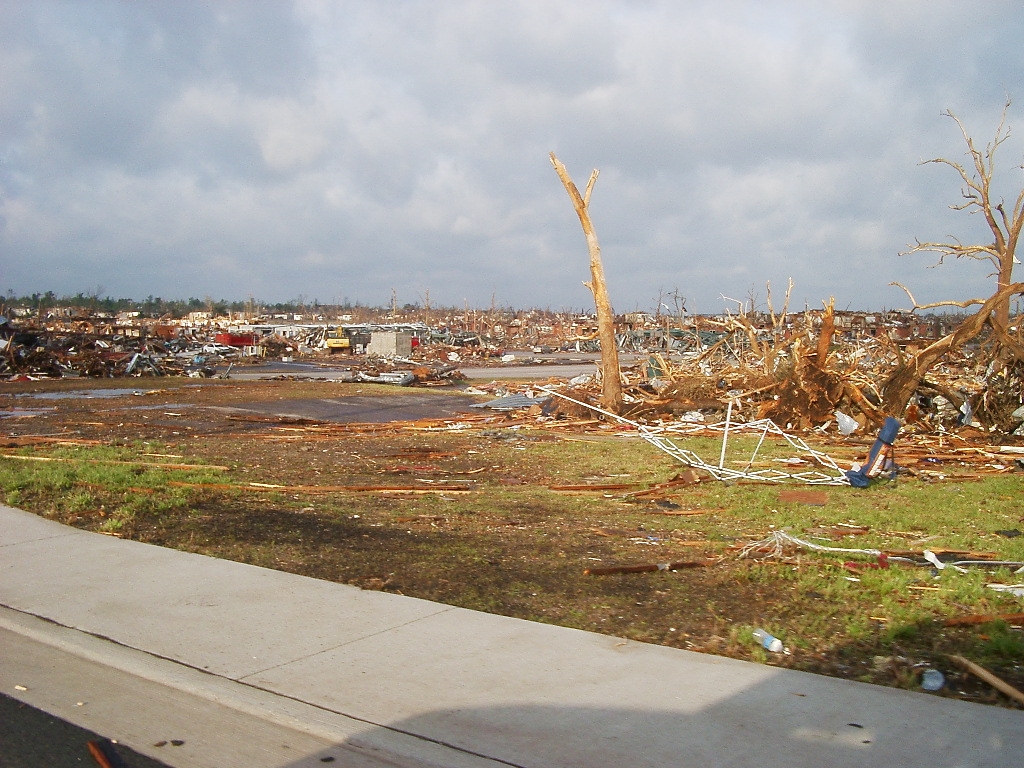
On Sunday, May 22, around 5:30 p.m., the worst single tornado strike in U.S. history since 1950 mowed a path through Joplin, Missouri that was at least a half mile wide and six miles in length. Over 100 were killed and many have not yet been located. And since my brother and his family lives in Joplin I drove there on Tuesday.

I arrived in time to hear the story of the past 48 hours from my brother, Rod Carson.

My brother was one of the fortunate ones; his house is outside of town and was not in

Rod Carson in front of his former office

the path of the F5 tornado. He has well water so didn’t have to worry about the must boil water alert for the rest of Joplin. And he enjoyed electricity, something many other citizens did not have.

The authorities pleaded with people to not go to or return to the disaster zone that Sunday night. So after a fitful night and with first light of day on Monday, my brother and his office administrator found a way toward his Chiropractic office. They knew it was a part of the kill zone and so were not hopeful. Their expectation was confirmed: His office was entirely demolished. What they were able to do was to remove the computers and hard drives, in spite of the broken natural gas lines. Like angels, half a dozen guys from an unknown church asked if they needed help, which they did. They garbage bagged all patient records and passed them, as a bucket brigade, out of the rubble into the back of a truck. The files are now sleeping quietly in my brother’s front room.  The helpers left as soon as they appeared without an opportunity to thank them.

The first responders were awesome. Police and Firemen and their vehicles and equipment arrived from every municipality on the Missouri and Kansas side. Fantastic coordination from Joplin authorities established perimeters and a coordinated search and rescue. By the end of Tuesday, and a curfew that went into place at 9:00 p.m., the search and rescue dogs were withdrawn and the so called “cadaver” dogs took their place – looking for the dead. At that point the security around the disaster site was well established. Wednesday morning would bring even stricter security.

By Wednesday only official workers, law enforcement, utilities companies, and heavy equipment operators were permitted access. Residents and those with commercial offices were required to obtain a permit to return to the disaster area. There were four such permit stations around the perimeter of the disaster zone. My brother and I obtained ours and traveled to the remains of his office. We sorted through the debris, sometimes sharp and hazardous. And we salvaged a few things of value that could be used. When we pulled away from that location it would be the last time my brother would go there. There was nothing to which a person could return.

The difference between a Katrina or flood and this is simple: There is nothing left. There is nothing to repair, muck out or make habitable.

Hiroshima without the radiation: It's absolutely silly to think about work groups or volunteer church groups going to do anything. That won't happen, not in the kill zone. The only thing that will happen is this: Over months heavy equipment operators will move the debris to dump trucks and haul it away. Someday, then, people might build on it again.

The only place where volunteers could help would be on the perimeter of the kill zone. Because tornadoes are uncanny in their surgical cut, the edge of the disaster zone is clearly delineated. The houses outside of the zone are intact, though damaged by high wind and buffeted with flying debris that fills their yards. A mile away a neighborhood looks like nothing ever happened. So is the striking life of the tornado.

Volunteers were most helpful in shelters for the many homeless. All the motels were full; not even the responders could easily find a room. There were distribution centers established to provide essentials to people who needed them – clothing, personal hygiene items, food, water. Because the high school and two nearby schools were demolished they could not be used. I know for certain that North Joplin Middle School gym was used for distribution. Thank goodness that the high school seniors and their families were not at the high school celebrating on Sunday night, but rather at the community college which was not affected. Some were leaving the college and heading into Joplin when the tornado arrived.

Like dominoes, the needs multiply following the tragedy. If your home is destroyed, you have to secure temporary shelter. The kind you find depends on whether you have family to take you in, money, or access to a shelter. If you have a job, you have to see if your business is still existing and functioning. If not, you’re also unemployed. If you are a businessman, like my brother, you have to find a new office – which we did Wednesday afternoon. More than one person showed up as did we in front of buildings that had “for lease” signs out front.

St. Johns Hospital was severely damaged and many died during the tornado. In addition, some of the ones moved across town to Freeman hospital didn’t survive the move. Because they had to do crisis triage, some hopeful ones were treated while others were left to die on the parking lot. Medical personnel poured in from many other communities.

The governor made an appearance, as will the president. These are largely ceremonial appearances, meant to communicate support and solidarity. In times like these all that matters.

I talked to an insurance adjuster who had set up shop to help people needing to make claims and he talked about some other similar situations. He told me how amazed he was to see everything turned to splinters and then, six months later, the ground be cleared, and then a few years later new construction taking place. It seems unimaginable just looking at the rubble.

So, great thanks to first responders who are the best. Thanks to neighbors and friends who support one another. Thanks to agencies that make it their business to be there when the worst happens.

Our consolation for those who have lost dear ones or don’t know where they are. Our consolation goes to those who had everything taken from them and have no way to replace any of it. Our consolation goes to those who have no way to support themselves and can’t imagine a future.

The shock of this time will pass, like it always does, and beyond rescue and recovery there will be new life on the other side. The other side, however, will be different. Because nothing stays the same after something like this.

The Indomitable Tree of Life