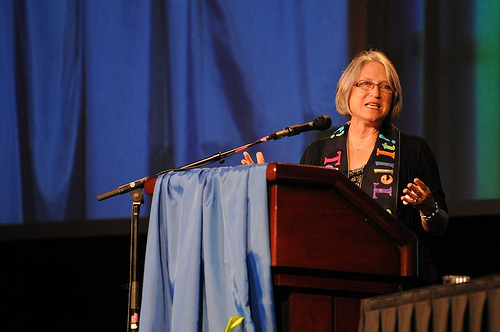
And so the many congregations of the Disciples of Christ gather to be a congregation of congregations. And there is good worship, and civil discourse – faithful conversations – about issues relevant and sometimes disputed, and lots of reunion with friends across the years. I conversed with friends from four congregations I’ve served. Some of them are joyful and some are struggling. Age has caught up with many the way age does. But love abides.

What I forget, and am reminded when I attend a General Assembly every two years, is just how diverse we are as a congregation of congregations. All of us live in our own contexts, and much of the time we experience much sameness. But not at the General Assembly. There is a national, world congregation in attendance. And we are becoming more ethnically diverse all the time. Most of the newly forming congregations are ethnic ones. Our leadership is diverse. And we are becoming the mosaic that the body of Christ may become, perhaps not in one location, one time, but in all of us when you put us together.

It’s always enjoyable to worship in another Disciples congregation, as I did Sunday morning. The liturgy at Vine Street Christian Church was elegant classic worship at its best. What a treat to sit among the congregation and worship.

My golly, the youth and young adults! It’s heartening. One of the most important statements I heard on the Assembly floor came from a ten year old boy. Mission groups from across the country served before the Assembly. And one of my own spent her own time cooking for hundreds of them.

Sharon Watkins was re-elected for a second six-year term as General Minister and President. I’m proud to call her a friend. Whatever else she is she is a spirit woman. Good for her and good for us.

Imagine, if this happens within one of the families of the Christian household, the Disciples of Christ, how wide and long our reach of love, community and service with the whole, world-wide community of Christ. We are becoming, the Christian community is, less and less Western every day. And yet there is one table and we always pull up another chair to make room for the next and then the next.

To follow the resolutions voted upon by the Assembly and watch video clips of various speakers and worship services go to: http://www.disciples.org/

Casey Anthony Verdict

Posted: July 7, 2011 in Uncategorized

It is quite unlike me, but I am speechless.

Have you ever had a close friend, a trusted friend, who was so out of sync with you and your world view – religion, politics, education – that you wonder just how you could be such good friends? I know you have and I have, too. The relationship actually defies logic. There is no reason that you should have such good rapport. But you do. There is some deep down connection that matters more than all the rest. Thank God for that.

I have such a friend and we had a recent conversation about the oil spill in the Emigrant Creek in Wyoming. I happened to be in a congenial mood and asked what he thought about it. I wasn’t looking for a sparing partner. But that’s what I got.

This is why, he said, that it’s not that big a deal. Compared to other oil spills this is small potatoes. We can’t beat up on the oil company; they are doing their best, they wouldn’t want this to happen either. So we have to expect that these things are going to happen and write it off to probability.

Ok, I wasn’t rushing the field with a Hang up Oil Executives sign while wearing my Greenpeace T-shirt. But immediately positions were staked down, even against imaginary opponents. That’s what is happening today, isn’t it?

Why did my friend, whom I admire so much, rush to defend Big Oil, almost reflexively? It’s because the polarization lines are already neatly drawn. It’s Unbending Environmentalists on the one side and Free-Market Don’t Regulate us Capitalists on the other, right? It’s one or the other. There is nothing inbetween. If you even glance toward the stated objectives of the other you are automatically a traitor.

Before my good friend built a grenade-proof shield around the oil company that owned the hardware that fouled Emigrant Creek he might have asked what I actually thought. And here is what I could have said:

I’m sure the oil company didn’t do this intentionally. At a minimum it’s in their best interests to have good relationships with neighbors who value the creek, even if they didn’t. But I’m guessing that there are plenty of people who want to make money with oil who also love the pristine environment we all enjoy. In the past there have been some bad boy companies that fouled mother nature in inexcusable ways, but we can’t assume everyone does or does anymore.

In other words, just because an accident takes place I’m not automatically going to assume the worst. It could be reckless endangerment, but we’ll wait to see if that’s the case. It could be that we’re all sad about the same thing, that something went wrong.

If that’s the case, let’s clean it up, but more importantly identify the take-away learning. What didn’t work well and what do we need to change. Once we know it let’s correct others like it. And let’s not do it again. If we do, then we’re being naughty and should have our hands slapped with a billion here or billion there. But maybe we won’t do it again.

But here’s the part I never got to tell my friend because he was already doing battle with windmills:

I believe that the earth is the Lord’s and the fullness thereof. And so anytime I foul the earth I’m disrespecting nature, messing with God’s domain. I have no right to do that. This is not a political statement, it’s a religious one. So, respecting God and God’s handiwork – over which I’m just a temporary steward – I will not intentionally do anything to harm it. If I do I’m remorseful and try to make it right and don’t repeat the offense. And I make it right with anyone or anything I’ve harmed.

It’s so simple. And it’s not a case of us and them, the greens and the greenbacks. It’s everyone saying we’re going to respect it, this planet. We’re going to make money but do it responsibly. We’re not going to do any harm for the sake of profit, we’re just going to seek profit because that makes the economy go ’round.

I have a friend who talks about the spirituality of money. And he talks about keeping a spiritual eye to how we spend it, a spiritual eye to how we save it, and a spiritual eye to how we give it. What he doesn’t talk about, though, is the fourth leg of that table, and that is keeping a spiritual eye to how we make it. Does it do harm? Does it build up? Does it benefit the many? Is it come by honestly?

So my friend and I are going to talk again. But this time I get to lead out. I choose to begin with the words from Genesis, “And the Lord saw that it was good.” And we can go on from there.

At our Bluegrass service at the Old Meeting House in Rocheport, Missouri, July 2, I shared thoughts and musings about the relationship of the religion to the republic, and how founders crafted the boundaries of that relationship into the First Amendment to the Constitution. Many people at that service asked that I share those words with a broader audience. And here they are:

The First Amendment has two clauses that directly bear upon religious practice. There are the so called “non establishment” and “free exercise” clauses. It reads this way: “Congress shall make no law respecting an establishment of religion, or prohibiting the free exercise thereof…”

What the non-establishment clause means is that the government, the state, should not establish any religion as normative, the religion of the realm, the official or state-sponsored religion, or a religion that speaks for all other religions. Put it in historical perspective: The founders had quite enough of the monarch, the government, imposing one state church on all citizens. For us the meaning is clear: No governmental or state institution should endorse any religious expression. Yes, that means courthouses, public schools and all the rest. No state institutions endorsing one religion as the only religion. It can teach about it. Values are shaped because of them. But they cannot be endorsed and we don’t want it so.

What the free exercise clause means is that the government in no way should repress or interfere in any religious expression, much less persecute people because of it. A diversity of religious expression is expected and they are to be left to their own way. As long as they don’t break any laws of the land they are free to determine their own beliefs, mission and practices. Where it gets murky, of course, is exactly at that point: When does freedom of religion conflict with general laws for all citizens? The Branch Davidians in Waco? Christian Science adherents who don’t seek medical treatment for sick children? Where is the line? That’s where the courts have to step in and make some judgments. And we have many legal precedents. Most usually the courts have been fairly conservative on this score, not treading on individual religious rights except where violations seem egregious. Most of the time they want to leave it to the religious communities to handle their own affairs. But what happens when they don’t? How about clergy abuse of minors? That becomes a civil matter, not just a religious one.

Today our immigration patterns are much broader than the European migrations of the first few centuries. Today our migrations come from all over the globe, from virtually every continent, and along with that, every religion. We are now the most religiously diverse country in the world, and it’s not just different shades of Christians with a few Jews sprinkled in for good measure. No, it includes all major branches of all major religions – Islam, Hinduism, Buddhism and many more.

And guess what? On this July 4th we are able to say, proud to say, that our Constitution, our First Amendment, is the perfect governance for such a time as this. We neither establish any religion nor limit the freedom of exercise of any religion. Our founders would not even recognize our present way of life, so different is it from their own time, but the principles they put in place still work. And for that we should all be grateful to be part of a democracy that extends religious freedom and other freedoms to all of us. The Statue of Liberty beckons people to a way of life and they have and do come. And our robust religious diversity is a sign that, in this regard, the American experiment has worked and is working famously.

en·tre·pre·neur

[ahn-truh-pruh-nur, -noor; Fr. ahn-truh-pruh-nœr] noun, plural -neurs  [-nurz, -noorz; Fr. -nœr]

A person who organizes and manages any enterprise, especially a business, usually with considerable initiative and risk.

Entrepreneurs make the world go ’round. They catch a vision, see a need, identify a market and take the personal and corporate risk to meet the need. If successful, they create wealth and jobs and, yes, contribute to the tax base of the community. Entrepreneurs do things no one else does. They are often the most daring and hard-working people around. I admire them. I learn from them. And with great frequency, in our nation, you see them in immigrant populations who are exceedingly industrious.

Yeah for entrepreneurs and the atmosphere that helps them thrive.

The church, at its best, can also have an entrepreneurial spirit in the way it approaches its ministry and mission. It, too, can see a need, catch a vision, take a risk and go for gold. It requires courageous and risk-taking leaders and people who believe in the power of the possible. I want to re-claim the word, entrepreneur, in its best sense, for the church.

We are not a business, to be sure. But the way we envision ourselves reaching into the future requires something similar to this. An entrepreneurial spirit in the church is very close to the creation spirit: Believing that something can come out of nothing, that there is no such thing as finite resources, that new creation creates more, that abundance is untapped.

For sure if you are doing new church development you have to have this spirit. It’s impossible otherwise. And we often learn it best from faithful business people who do it well … and ethically.

The opposite atmosphere kills churches. When churches act like regulatory agencies, limiting the creativity and risk-taking ministries for God, the creation spirit is stifled. Churches that are exceptionally control-centered want to manage the movement of the spirit. They want to regulate it. This represses generosity, creativity and risk-taking.

I remember reading about one entrepreneur who rewarded his innovative employees with a party whenever they had a grand failure. They would bring in a cake, talk about what happened, share what was learned as a result and then blow out all the candles and clap. Then they would say, “Ok, what next?”

Some have called this the development of permission-giving churches. Do you have an idea for a ministry? Let’s try it on for size. Run the idea up the flagpole and see who salutes. As long as it is consonant with our identified mission, let the creative spirit loose. But don’t say no to God before the spirit has a chance to work.

Entrepreneurs. Church. Time to let the cat out of the bag.

“Last year, Manhattan hedge fund manager John Paulson took home $4.9 billion in pay. Before the crash, Paulson helped inflate the housing bubble by designing junk mortgage-backed securities for Goldman Sachs – and then profited from the pop by betting that those very securities would fail.” (Sojourners, July 2011, 9)

Long over due: A Christian language in moral ethics that defines sin not by the little, safe targets, but by the big ones – the mindsets and behavior that propel over-the-top greed and harm of neighbor for the benefit of self. We would have thought that the economic meltdown would have brought about some remorse. It has not. And those who were most culpable have profited most conspicuously.

Wouldn’t it assist our moral clarity to define such practices exemplified by Paulson and his cohorts simply as sin? It is sinful. And for that only repentance, on a public scale, will do.

Like many I cut my teeth on Elizabeth Kubler-Ross’s On Death and Dying. At the time her work with dying patients was new, fresh and helpful. Her stages of grief popped quickly into the public imagination and became applied to every circumstance of loss imaginable: shock, denial, anger, depression, acceptance. She provided us with a language, an experiential idea base to interpret grief.

In the most recent issue of The Christian Century (June 28, 2011, p. 35) Tom Long discussed the new book by Ruth Davis Konigsberg, The Truth About Grief. Basically, she challenges both the science and conclusions of Kubler-Ross. She thinks her research flawed and schema for grief unsubstantiated. Well, I can’t say anything about the science, but I can say plenty about the conclusions.

Where I think Kubler-Ross has it right is in the existence of the powerful emotions she identified. If you consider your own grief, or that of others, you will be familiar, for instance, with the waves of anger – either directed outwardly or inwardly. Those emotions are easily observable, universal and repeating.

The place where I believe she overstepped was in making them appear more sequential than they really are. I would say, from my experience, that there is little if any predictable pattern. You don’t move through one and become finished with it forever, moving cleanly on to the next. No, they cycle and return and when they do they come in different and unusual forms. And many of the deep emotive responses coexist, taking place simultaneously.

I am frequently amazed how some deep emotion will wash over us like a wave, often when least expected. We thought we were past that, but no. And then it reappears with a vengeance. Something triggers it and it returns in living color.

Even more mysterious is the resolution of grief. By resolution I do not accept the notion of “closure” as it is popularly presented. I think that idea has been created to attempt to control grief. As long as we feel and are connected to the love of another life or thing, it continues to exist in relationship with us. That relationship changes over time and the sharp edges of pain may wear off. But we don’t “get over” someone we have loved and lost. Rather, they become part of the living biography that makes us persons.

Talking about our grief with a trusted soul may be helpful. But also sitting with it, waiting for it to unfold in its own mysterious way is just as important. It can’t be rushed. And then someday, somehow, we cross certain thresholds and it is transformed. I remember a moment in my own grief over the loss of my mother, on the tenth anniversary, my grandmother called me up and reminded me what day it was. After I hung up the phone I had a dramatic emptying of the remainder of the unfinished grief I had been carrying consciously and unconsciously. From that time on my experience of that loss changed shape. Its new form was a continuity of love. And I was not doing “grief work” that somehow caused it to happen.

Thank you, Kubler-Ross, for naming some of the ingredients in this wild, uncontrollable and mysterious stew. It’s not as tidy or systematic as you may have led us to believe, but you gave us a starting language. Now we will take it to places where you were not able to go.

The presence of something absent. Well, they call it the via negativa, the way of knowing something is there, deep down on the inside of what seems to be empty, or absent, or silent. Wait long enough and the big void will start speaking.

Maybe that was what philosopher George Bataille meant when he said, “The absence of God is greater, and more divine, than God.”

That can be taken a hundred ways, of course. Does it mean that you’ll miss me when I’m gone? Or that only the absence holds the real mystery? Or that we so often fill up the vast silence with our own noise that it effectively drowns out the sound of God? Is it only when the room is empty enough to echo that we can finally hear?

It can be a slippery slope, this absence business. At least Lawrence Raab thought so when he wrote the following words:

The absence of God … an idea God might have come up with if he’d been French and worried about how to make it through the twentieth century. Do you want this? If I take it away, will you want it more?

Or will you forget? That’s the problem with absence, it leaves itself open to so much.

Supernatural forces, for example. Glowing lights, out of which the aliens appear like anorexic children. Let us help you, they say, although of course they never speak.

Once they just wanted to take over the planet. Now they feel sorry for us, the way God must have felt when he chose to retire into his silence. No more threats. No more angels, either. Only these lost children, come back to startle us, and vanish.

(The Gettysburg Review: Supernatural Forces, Vol. 20, Num 4/Winter 2007, p. 11)

And Who is the Neophyte?

Posted: June 24, 2011 in Uncategorized

I’ve received some interesting responses to the last post, Notes to Neophytes. Metaphors may easily be confused, so allow me to clarify intent and direction.

That blog post was written for the sake of persons new to the ministry who, lacking experience, find themselves perplexed by what they are encountering. The audience is anyone in that category or who cares about people in that category. The location is universal, any church or minister anywhere. And it’s meant to describe, encourage and guide through what can be a strange new world.

Happy sailing – newbies, oldies, everyone inbetween …

Neophyte (N): But the search committee told me one thing, dreams they had, and assured me they needed someone just like me to lead them into the next grand era.

ChurchWrinkle (C): Listen well and learn. Search Committees lie to their candidates, but not that way, not because they are malicious. It’s because they are so hopeful. So they paint a story of how things could be, but not what they really are. You will always find the truth after the blush of courtship is over.

N: I keep preaching and teaching about the way of faith, of Jesus, and all the rest. But it seems like we make decisions just like any other community group might. I don’t see much difference except we might say a prayer first.

C: Yes, it’s like that. And because you are so idealistic it is troubling. You believed you were called to a very high-minded way of life, and you were. But not all people are, though they all live side-by-side in the church. You always have to keep a spectrum of commitment in mind; some are very faithful and committed, and are motivated by the highest ideals. They are a slender minority. Next are large numbers who do it because they somehow feel they are supposed to – an ethic of obligation. And then there are the consumers. Church is like a religious WalMart, just shopping for the best deals. This is your introduction to human nature. They are all there, side by side, but motivated differently because the depth of faith is different. You’ll have to accept this, learn to work with it. You will observe some of the greatest virtue ever known in this place. And you will become acquainted with its opposite. 

N: But some people are so selfish, so power-hungry. How can they call themselves Christian, I mean, by the way they act?

C: There are some of those and their negative energy can ruin it for everyone else. They even can do great harm to the church in the name of some principle, a smokescreen for their own egotism. But don’t focus on them. Focus on the many remarkable people who make this world better just by virtue of the fact that they are in it. Focus on the beauty all around you. Focus on the things people didn’t have to do but did anyway, just because it was right and compassionate. Choose to focus on these things, even when other people rattle the cages and claim that the sky is falling. Be something else, don’t settle, and don’t get pulled down by their gravity.

N: At first it seemed like they adored me, I could do nothing wrong. But more and more it seems like I get blamed for anything and everything, even the things they are responsible for. How can this be?

C: The adoration is an illusion and so is the blaming. If you dare to be who you have been called to be you are like a movie screen upon which people project every wish or frustration or left over issue they had with someone. Don’t be that. Be who you really are, deep down. That will last after their projections have come and gone.

N: But they gave me authority to lead, and then resist my leadership. Why? Why don’t they just hire a secretary, a custodian, a chaplain? If they know what they want already, just hire someone to to implement their desires. They say they want leadership, but I’m less and less convinced. I mean, don’t call a pastor. Just hire an administrator.

C: In the same way there is no free lunch so there is no free leadership. They, the people, temporarily confer authority on you. It is provisional and can be withdrawn, at least in our free church tradition. Focus on the vision you share and help them to discover. Love them and in time – sometimes a long time – they will love you back. And when they love you then they may be responsive to what you have to say, the directions you point, the wisdom you share. But that authority is not often conferred before the trust is earned, not entirely. The church is dying for lack of leadership, that’s a fact. They both desire and fear it. And people are so afraid they will lose some kind of control they usually tread water in place, pretending to go somewhere when they are not.

N: But I’ve prepared academically and spiritually for this. I’m ordained by the same church that has affirmed my calling, told me how important this role is. And I take it seriously. They set me apart for this. And then I share some things and they look at me like I just landed from Mars.

C: Well, you have just landed from Mars. It is the Mars of what they don’t know and the fear that you will confuse them with ideas that don’t make sense. You have to become an earthling before you can talk about your experience on Mars. It takes time. Be patient. Don’t be anxious. Some will have positive regard toward your ordination. Others will see you as a paid professional because that’s how they see the rest of their world. Don’t get trapped by all those perceptions; know who you are and whose you are.

N: Everybody seems to get upset about what we can and can’t do, how limited we are. I look around and all I see is bounty, potential, provision and blessing. But all I hear instead is “we can’t.” They sing a constant song of scarcity. How can I convince them that we have to walk by faith and trust?

C: By believing it yourself, Pilgrim, by believing it yourself.