Often behind the pack, I have just now completed George Lakoff’s Moral Politics: How Liberals and Conservatives Think (University of Chicago Press, 1996). A friend suggested it to me, no, gave me a copy. It was well worth the read. And Lakoff’s strong, balanced and scholarly analysis provided a real legitimacy to his project: Identifying the moral models and metaphors that underlie particular political thought.

At the center of his work is the identification of family moral systems that are projected into the public sphere. These moral systems, with their accompanying worldviews, explain why persons and parties believe and act in the ways they do. In many respects the moral systems are incompatible with one another. And when a system is understood to be absolute by its advocate, any other system can only be described as mistaken or, in the worst case, immoral.

The two family models, with variants, are these: Strict Father Morality and Nurturing Parent Morality.

Strict Father Morality is an authoritarian system of hierarchy, with a strict father figure at the top establishing rules and discipline to conform to the system. Women have domestic responsibility as well as making sure the father’s rules are followed. Children must obey parents and never rebel. The goal is for children to become self-reliant and responsible. Good parents do not meddle in their lives later in adulthood. Being good is becoming self-disciplined, succeeding, and prospering. Weakness is immoral. Protection is manifested in protection of the family from all outside threats.

Nurturing Parent Morality is a model of caring for and caring about, living with mutually beneficial relationships. Children are shaped through understanding, respect and reasonable freedom, all of which creates a caring and responsive member of society. Children become obedient through respect of parents, not fear of punishment. The goal is to create self-fulfilled children who help others to become the same.Therefore the most important characteristics to learn are empathy, the capacity to nurture others, and freedom to explore many thoughts and ways of understanding the world.

Both of these moral models hold certain worldviews and they are instrumental in political life. They also manifest themselves in different forms of Christian churches. If you are operating primarily out of one or the other then your conclusions about social policy, the role and place of government, and operative values are a reflection of those worldviews.

This explains the radically different conclusions that emerge when it comes to political or social choices. They are distinct ideologies based in a moral outlook. And unless we understand the underlying moral code by which people operate we will never understand why they would come to the conclusions they do. They are often not reconcilable. The reasons that people make the decisions they do are often not for the stereotyped reasons their opponents present. Rather, they are motivated by a paradigm, a model, and principles that are accepted as the way the world should be. You can like that outlook, hate it, or want to argue about it. But to ignore the moral underpinnings of each system is to entirely misunderstand why they are the way they are.

Sign of the Cross II

Posted: February 23, 2012 in Uncategorized
Tags:

It’s the morning after, but there is no Ash Wednesday hangover. Some things do, however, hang over.

In the midst of ashes and observations of mortality, babies were with us in their own mysterious way. And as one friend mentioned while cooing over a a little one after the service, there is something right and good about the newness of life, the freshness of life, helping the rest of us who are not so new and not so fresh.

It’s like babies at funerals. There the story is told, the great turning, emerging and passing, from beginning to end, the whole span. And it’s not that we need a distraction, though we probably do, but that one part of the story is put in its whole context.

When my father was near his death, riding his hospital bed toward eternity, my step-brother brought in his newly born son for a visit. And there the old one struggled to the edge of the bed in order to hold the new one. There was a wholeness in that snapshot, the moment captured, that somehow told the truth.

Perhaps one of the requisite quorums at every Ash Wednesday service should include the presence of at least one baby. “Do we have a baby yet? You know we can’t proceed until we do.” Ok, maybe not a requirement. But surely we’ll be the better for it.

Sign of the Cross

Posted: February 22, 2012 in Uncategorized
Tags: , ,

I saw my first one this morning near the mall. She came out of Target and crossed the street, cross on her forehead. Obviously the young woman had come from a morning Ash Wednesday service. I assumed she would sport the ashes for the rest of her day, displaying the dust from whence she came and to which she would return.

Then there was our own Ash Wednesday service with lots of people listening intently to words about mortality, brokenness, and that which separates us from God. They came forward in a line, like prisoners waiting to receive a sentence on their foreheads. Afterwards our choir director conducted rehearsal with a plus sign on his forehead; none of us thought it strange. I expected to see us wearing the ashes just like I expected to see someone, somewhere doing the same at the mall.

What I did not expect was to watch the Colbert Report tonight and spot a an ashen cross on Stephen’s forehead, right there in the middle of his usual tongue-in-cheek commentary. I stopped and remembered that he is a practicing Catholic. And he wears his faith right there in front of a national audience doing what he always does without a self-conscious bone in his believing body.

If Colbert can do that on television, neither seeking special recognition nor fearing ridicule, what might I risk?

Perhaps I shall give up cowardice for Lent.

So I’m reading along in a pretty good book about commitment to God, going the distance, a true discipleship that is more than going through the motions (Radical, David Platt). The author talks about how very much we in the church have it wrong, that we confuse our culture and its values with the call of the Gospel that is really something altogether different. I’m nodding in agreement. And then he tips his hand to reveal his underlying theology, Christology and dominant model of atonement. I stopped nodding. I began shaking my head. It’s a familiar construct, what he describes, and it’s dead wrong.

A few quotes:

“Why was he (Jesus) trembling in that garden, weeping and full of anguish? We can rest assured that he was not a coward about to face Roman soldiers. Instead he was a Savior about to endure divine wrath…All God’s holy wrath and hatred toward sin and sinners, stored up since the beginning of the world, is about to be poured out on him … wrath due your sin and my sin being thrust upon his soul. In that holy moment, all the righteous wrath and justice of God due us came rushing down like a torrent on Christ himself…at the cross, Christ drank the full cup of the wrath of God…This is the gospel. The just and loving creator of the universe has looked upon hopelessly sinful people and sent his Son, God in the flesh, to bear his wrath against sin on the cross and to show his power over sin in the Resurrection so that all who trust in him will be reconciled to God forever.”(34-36)

Nah.

First, wrong God. Wrath isn’t what defines God and justice isn’t all about wrath. There are many attributes of God, many taken from our human grab bag as we attempt to describe the ineffable in our tiny ways. Basically this is a strict/punitive father model, the cosmic disciplinarian who is going to discipline the children for their own good, in his own way. Insisting on this model of God continues to alienate and send people away from any engagement with the faith, not because they are cowardly or lost, but because it is untenable. It is untenable for me. Wrong God.

Second, wrong God punishes his own son to placate his rage: Bad Dad, cosmic child abuse. Hope he feels better afterwards. Somebody has to pay, says strict Dad, so I’ll send son to suffer because the perpetual sin of humanity enrages me. How dare them. After I’ve been their strict father for all these centuries and I get what? Ok, kick the dog, the scapegoat, mmm, my son. Ok, now we’re good. He’s taken a beating for you, and don’t forget it. Jesus isn’t afraid of suffering, no, he’s afraid of Dad’s wrath.

This is substitutionary atonement, very popular in some Christian circles, the backbone of Mel Gibson’s Passion of the Christ. The more blood spilled, the more strict father god is satisfied, the more we are now OK. It’s an absolute failure.

Third, this is far from the only way to understand God, the saving work of Christ and how we are reconciled and made one with God and one another. For example:

The loving God who created and is creating the whole world and all humanity always desires that we be in faithful, loving, committed relationship. But we are separated from that love, by our own designs and the ways of circumstances, and our lives are often in bondage, enslaved to everything but God. The creator of the universe never gives up on the beloved and always reaches to restore relationship through love, sacrificial love, love such as took his faithful son all the way to the cross – not to endure God’s wrath, but to express the boundless love that suffers for the beloved. God’s truth spoken is punished by the world that does not want to be known for what it is. When you see that sacrificial love it breaks your heart and turns you back to the divine lover who never gives up. Until we do turn, our souls are withered, small and pale, lifeless when cutoff from our source. We experience that separation every day. But through the mercy and grace of God, through Jesus, God’s wisdom become flesh, we are given a new way, a new path and life in Christ. And as he is lifted up on the cross all humanity is drawn to the love that will not let us go.

Like that, for instance.

Pray to One Like This …

Posted: February 15, 2012 in Uncategorized

A friend recently opened a meeting with this evocative prayer from the Unitarian tradition:

Let us pray to the One who holds us in the hollow of His hands,
To the One who holds us in the curve of Her arms,
To the One whose flesh is the flesh of hills and hummingbirds and angleworms,
Whose skin is the color of an old Black woman and a young white man
and the color of the leopard and the grizzly bear and the green grass snake,
Whose hair is like the aurora borealis, rainbows, nebulae, waterfalls, and a spider’s web,
Whose eyes sometime shine like the Evening Star, and then like fireflies, and then again like an open wound,
Whose touch is both the touch of life and the touch of death,
And whose name is everyone’s, but mostly mine.
And what shall we pray?
Let us say
Thank you

Whooooo Says?

Posted: February 14, 2012 in Uncategorized

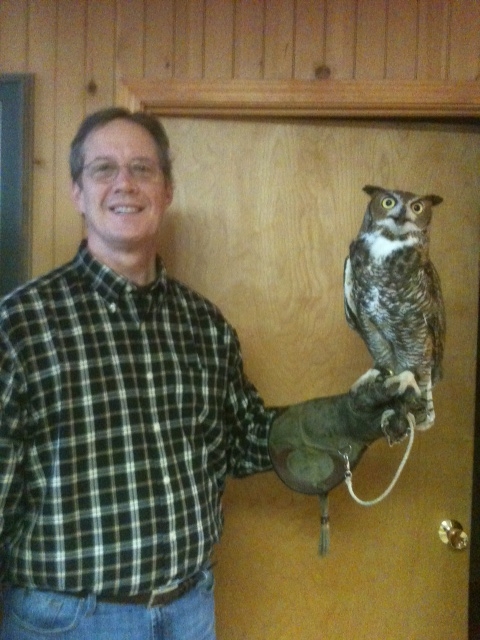
Mo, the great horned owl

I’ve always been enamored with raptors in general, the whole world of birds of prey, our eagles, hawks, owls and more. And I’ve always wondered how I might actually be able to work with them in a kind of rescue setting. Since they are federally protected birds there are stringent standards for their care in captivity.

I happily discovered our very own Raptor Center at the Veterinary school at the University of Missouri. So I’m a volunteer in training. There is much, much to learn. But I like it already. In fact, I find myself in raptor attention.

At a recent men’s retreat we watched portions of the movie, Field of Dreams. Having built this gathering for men around the metaphors of baseball, they did come.

The last clip of the day was the penultimate scene in the movie when the main character, played by Kevin Costner, was united with his father – as a young man. The two play a game of catch in the dusky light, the ball sailing between mitt and mitt. Following the clip, our guest presenter, Coach Tim Jamieson, baseball coach at the University of Missouri, and I both shared our stories of the loss of our fathers to death from cancer. We lost them at roughly the same time, a dozen years ago. And now we have different experiences of our fathers, known through memory, through a different kind of presence living through us.

Men have intriguing relationships with their fathers. They are not all the same. And our father-son relationships shift, move and change. We model after our fathers. We determine not to be like them in certain ways. We become like them in more ways than we like to admit. And later, after we experience life, struggle, loves and losses, and children of our own, we come to know them differently. We often gaze upon them with softer eyes. We forgive and hope for forgiveness.

Somewhere in the twilight corners of memory there is a summer evening in the yard and a ball sailing between father and son. It is the game of catch that is oh so much more than that. The back and forth, giving and receiving, sharing of the same object exchanged time and again, creates a wordless bond that is universal. Perhaps that is the memory, or ones like it, that connect us to our fathers and other dear ones. And somewhere in the mystery of life and death, we play catch with time and eternity, a throw at a time, until it becomes too dark to see, and the voice calls us in to supper.

Seat Mate

Posted: February 6, 2012 in Uncategorized

On a recent flight I struck up a conversation with my seat mate, a young very pregnant woman who was heading off to be with her husband, a medical student in his residency. Her home state was Texas and this temporary change of address for the residency was just that, temporary. After the required time away they would be heading back home, understandably.

Somewhere along the way the conversation took an interesting turn, I believe  as a result of the interesting political climate of the current campaign year. This young woman, scarcely thirty, I would guess, pronounced her loyalties: “I’m a Republican, but I’ve got some reservations about all this.”  So, tell me, what are they?

It soon became clear that she was affiliated by family tradition. And yes, she was a fiscal, free-market conservative. But after that the waters became muddier.

Immigration issues? Ridiculous, said she, our economy is bound up with immigrant labor, legal or otherwise. Find a way to legitimize those here and fast track ways to legally make it possible. Our economy is bound up with that and it’s silly to think otherwise.

Drug trade, drug wars and enforcement? It’s all a supply side problem, and we in the U.S. are the supply. Not with the heavy drugs, but with marijuana legalize it, decriminalize it, tax it, regulate it. Take the market away. We’ve got bigger fish to fry.

Same sex marriage? For God’s sake keep the government out of people’s bedrooms. And give equal rights under law to all citizens regardless. I want that for my many gay friends and their families. This is nature, not nurture. Time to wake up.

And then the flight was over and she was heading to the baby shower. And it occurred to me: Most Americans, most, are much more complexly layered – politically, ideologically, socially, religiously – than we simply portray them with convenient labels. And if we only recognized this diversity of perspective within the mainstream we might actually be able to find solutions to our many challenges.

As it is the extremity pulls us apart, polarizes us, casts us into dark and light, good and bad, friend and foe. I don’t believe that has to be the case, as my soon-to-be-mother seat mate reminded me. There’s hope. But we have to actually talk.

Messages Head to YouTube

Posted: February 2, 2012 in Uncategorized

Yes, at last, the unavoidable phenomenon: Sunday morning messages hit the electronic streets. Broadway has opened a new YouTube channel and our morning messages may be accessed there. Enjoy, pass on, post on social media!

I used to … but now

Posted: January 30, 2012 in Uncategorized

I used to think life was long, but know I know it is short

I used to think I might change the world, but now I hope the world doesn’t change me

I used to think that everything was in the plan, but now I try to fly with less of one

I used to think that the outside was the measure of success, but now I know the outside illusion

I used to think that rational mind could take us anywhere, but now I know its poverty absent spirit

I used to think that time doing nothing was wasteful, but now I know that doing nothing accepts our creaturehood

I used to think that love was a choice, but now I know that it is a surging sea with its own rules

I used to think we could organize peace, but now I know that peace is a gift received and shared

I used to divide life into material and spiritual, but now I know that spiritual is in the material

I used to think it was my responsibility to turn others to God, but now I know the harder path of loving them

I used to think that criticism by others was about me, but now I know that it is always and only about them

I used to think that loving people meant rescuing them, but now I know that loving them is helping them to be free of all rescuing

I used to think that this slice of civilization is somehow special, but now I know it simply takes its place in the long sludge of history

I used to think that prayer was a sending a message from one to another, and now I know it is simply being with the other

I used to think that people were getting better every day, but now I know that the darkness of human nature continues to persist

I used to think that we should only appeal to the highest motives of people, but now I know we are moved by many motives

I used to think that the church was holy by virtue of its own nature, but now I know it is holy only by virtue of what it points to

I used to think that we could trust individual virtue to protect us from social sin, but now I know that we must protect ourselves from ourselves when it comes to greed and power

I used to trust explanations from those in power, but now I know them all to be self-serving, an attempt to create an illusion

I used to think that helping people meant providing for them what they did not have, but now I know that provision comes from God and I may help remove obstacles to its flow to all people

I used to think that creativity was employing a technical skill set, but now I know that it arises as an inner vision that employs a skill set

I used to think I could make a list and capture all important things on it, but now I know that any list, especially mine, is incomplete, filled and completed only by a communion of saints, living and dead