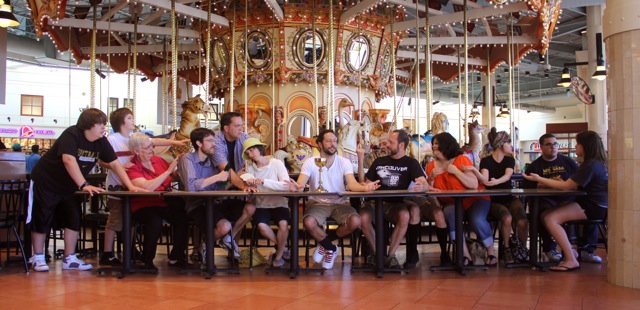
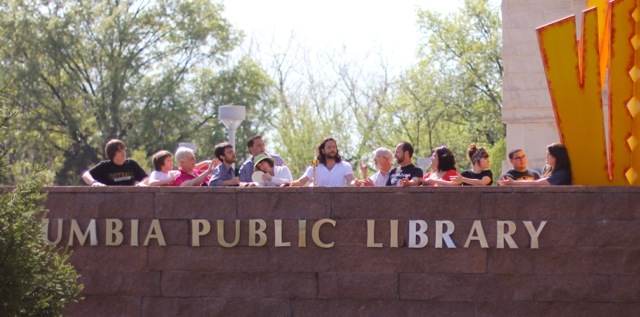
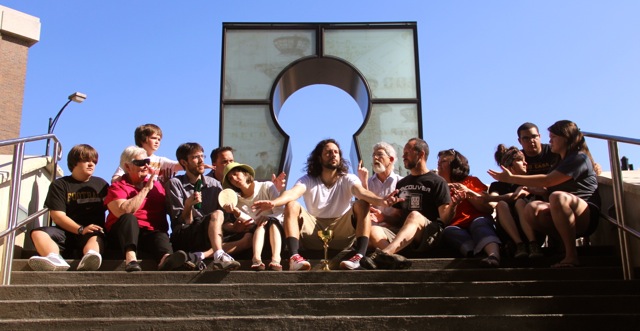
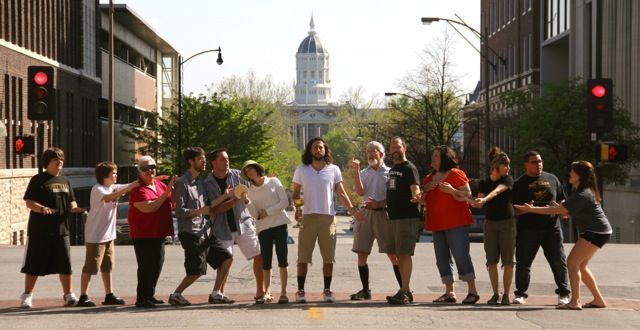
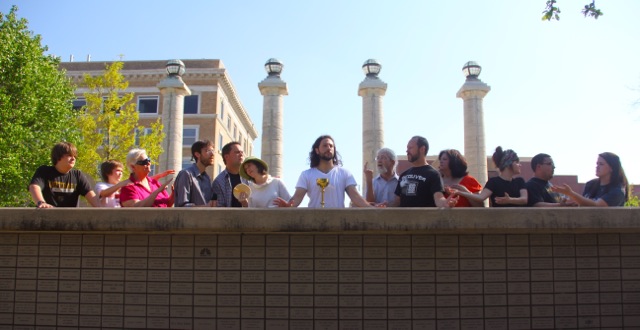
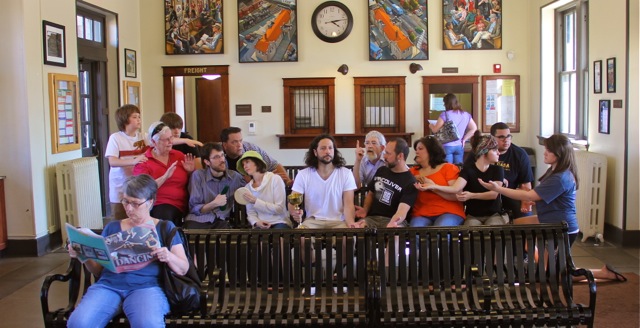
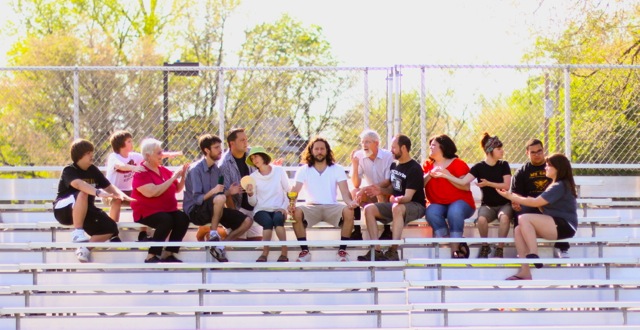
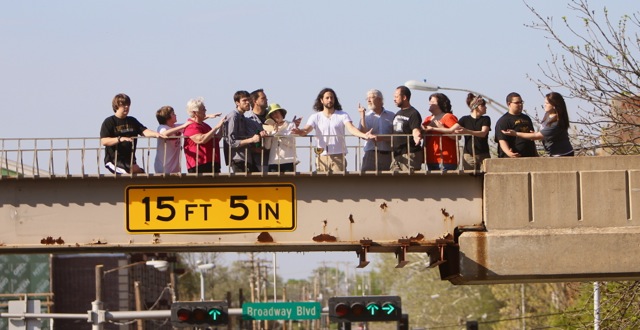
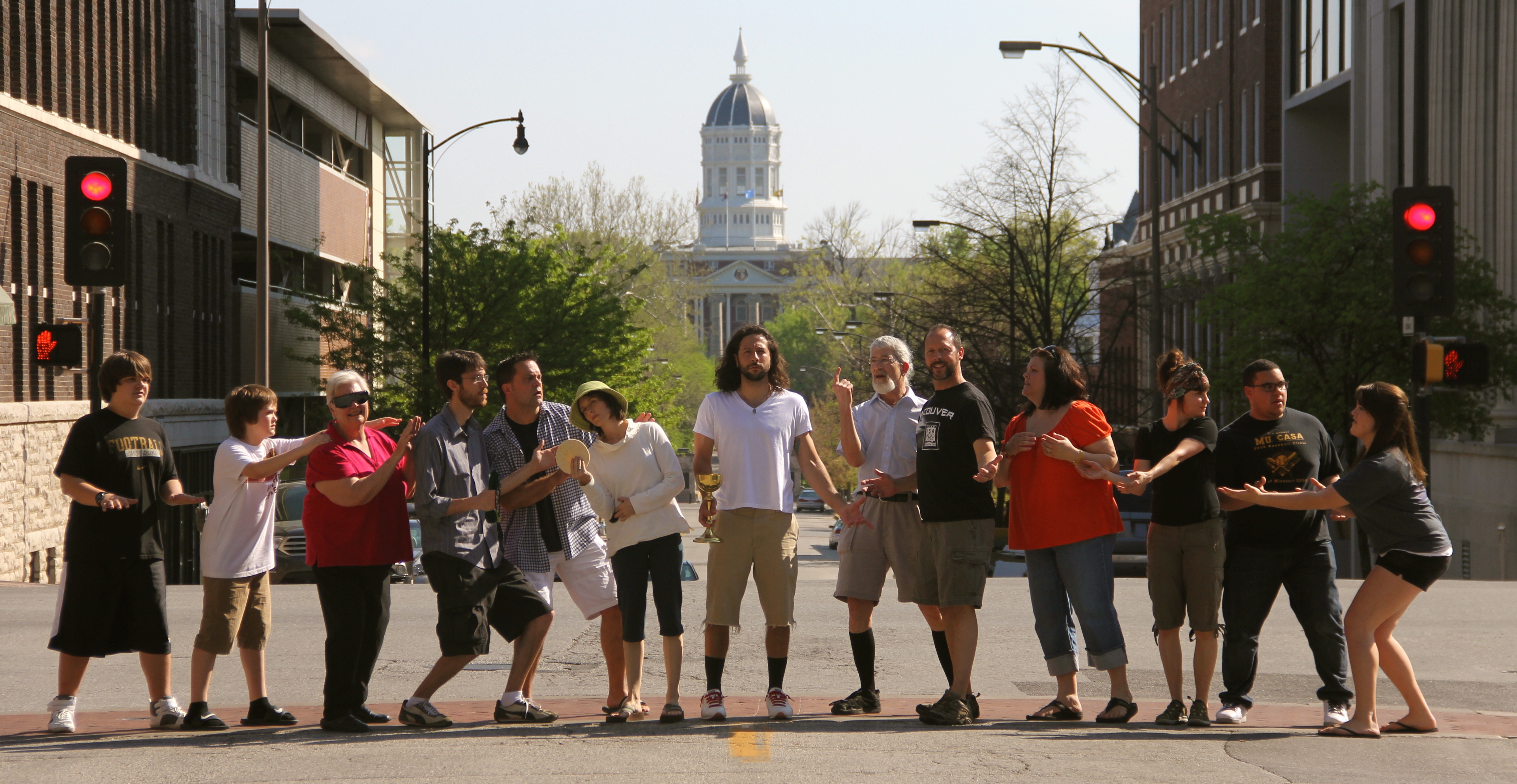
On Saturday, April 19, a moveable Last Supper based on DaVinci’s iconic portrayal moved about Columbia, Missouri. Erasing the arbitrary lines between the sacred and secular, we took the supper to the city, and on Maundy Thursday evening will be bringing the city back into the supper. Thanks belong to Dave McGee for the great photography and here are a few:

Carousel in the Mall Food Court

Shelter Gazebo

Columbia Library

Top of Parking Garage

City Hall

Crosswalk at Broadway and 8th

The Columns

Wabash Bus Depot

Columbia College Bleachers

Boone Hospital

Bridge at College and Broadway

Sure, take it to the Streets:

The Last Supper at Broadway and 8th

So today is World Autism Awareness Day. You’ll be seeing lots of blue here and there, a reminder that we’re on to this condition and dealing with it. That doesn’t make it easier if you’re a parent of a child on the autistic spectrum, but you also know you’re not alone. That counts for something.

At church we’ve been doing some educating around the whole issue, raising awareness especially with youth. But the most important thing took place tangentially, as a part of our typical spiritual formation and worship.

Every year we have a class for baptismal candidates that continues for about twelve weeks. During that time the young people meet with pastors, mentors and attend a special retreat. Most usually they make their “confession of faith” – own that faith that has been carried for them by the church and family to date – and it is public, in the context of worship. This year, since we now have a special program that includes children with disabilities called All God’s Children, the question presented itself: How do we include our children with special needs, often autism, in this communal formation and ritual?

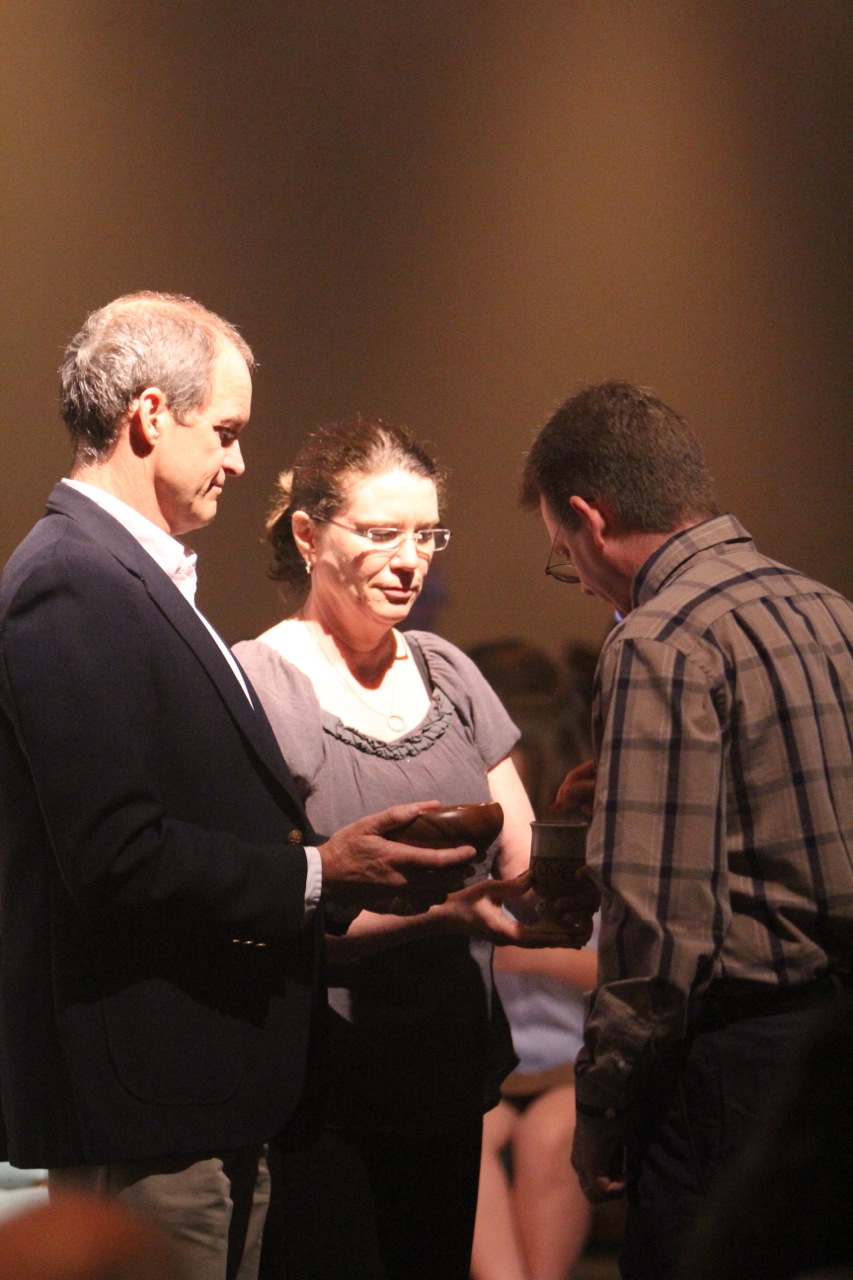
The answer to that question is two-fold. First, we created an adapted confirmation class, one session to cover main ideas. Secondly, and most importantly I think, we decided to include them in the public profession of faith in worship right along with all the other children. And we did. Yesterday, on Palm Sunday, at the close of the service, all of our children and their mentors lined up to receive a single question and provide an answer. The question, in its doctrinal form is that of the so called good confession: “Do you believe that Jesus is the Christ, the son of the living God?” But the way we posed it to each child varied, depending on how they were able to understand it.

When we came to some of our kiddos on the autistic spectrum, we essentialized it: “Do you love Jesus?” Well, yes they do and said so. And if there was ever a more whole celebration of the community’s embrace of Christ in the many ways we receive him than this,  I don’t know of it. There was not a dry eye in the house, including my own.

There was a time when the sacred canopy of the church so enfolded the reality of a culture that its rituals and dramatic enactments appeared part of the given fabric of life. Like keeping a season such as Lent, or walking through Holy Week. It was perceived as an actual entity that existed, in and of itself, in time and space. That was the reach of that symbolic universe.

Even with a reticence to state the obvious I will say it anyway: those times are over. There are no longer any “meta-narratives” in which winner takes all, the culture bows, curtsies, and says, “Of course, it’s Holy Week. We’ll be keeping that in mind.” Nope.

What we have, rather, are the particular sacred stories and symbols of particular communities of faith. And whether or not Holy Week or anything else has meaning derives from one’s willingness to fully enter into that story. The reason, today, that the ecumenical church has a “church year” in which the story of our faith is parsed out in chapters over twelve months, is to get the truths seeping into the bones of those who are observant. There is nothing objectively more sacred about the forty days before Easter we call Lent than any other time. But setting aside a particular time to tell and re-tell the stories insures that we visit it often enough, which we usually don’t without it.

My thinking has changed about all this, and it’s probably the product of age. Or I should say the perspective age brings.

I used to think that these arbitrary observances, cooked up by Popes and councils and Bishops, were quite beside the point. Right along with my radical reform ancestors each Sunday is just like any other Sunday. Each day is like any other day. Now is the time so get to it.

All of that is fine and well, especially if you’re a super Christian who just lives and breathes the Spirit 24/7. I mean, why tarry around church seasons? Except that we really aren’t super Christians, not in the long haul. We are weak, flawed people who forget a lot. We get lost and wander around, looking for our moorings. Our knowledge of our guiding stories becomes blurry. And that’s why I view all that differently now.

We basically need the structure of seasons that recount the sacred story over and over again. Our children need that exposure. With each run at it we are given the chance to go deeper, depending on where we are in life. And now I realize I don’t have that many runs at it left, not really. Time like an ever-flowing stream bears all its sons away …

I don’t absolutize church holy days like I used to in my spiritual storm trooper days. And I really don’t expect the culture to get it at all. I mean, really, most people couldn’t care less. They’ll make time for anything but those things. And to tell the truth they only make sense if you participate in the symbol system that provides the sacred drama in the first place.

What I do embrace and find helpful for individual Christians and Christian communities is the way we focus on seasons of spiritual story telling. Advent, Lent, Pentecost – they all give us permission to tell those aspects of the Christian story again, to hear them again, digest them one more time. And that’s good because we’re not so smart when it comes to doing that on our own. In fact, because we are so naturally oriented to what we already believe, we screen out most of what we don’t want to hear. Having it programmed so we have to consider it anyway is a good thing.

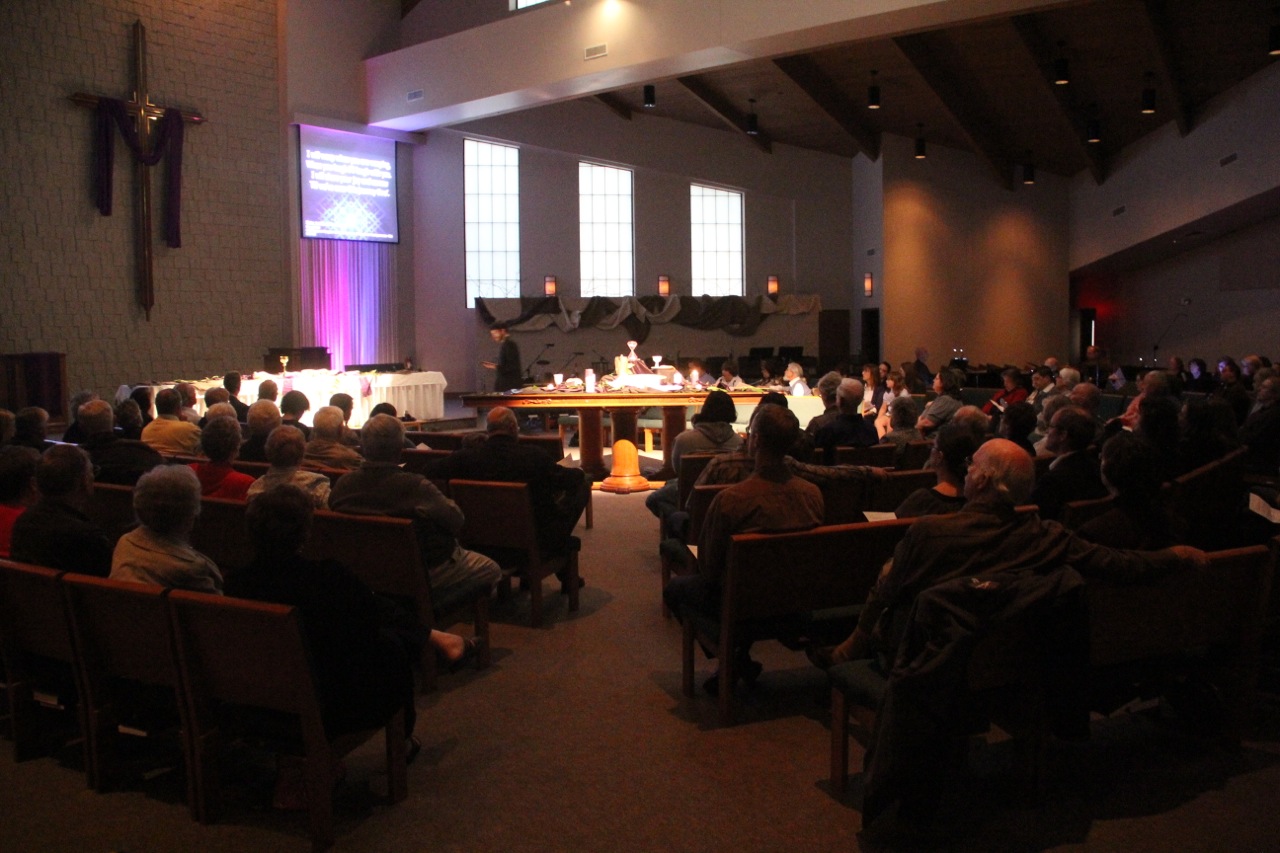
At the entree to Holy Week this year we gathered a group of people who were willing to pose – in street clothes – DaVinci’s iconic Last Supper out in public. We chose about seventeen locations around Columbia, Missouri, showed up, struck the pose, and moved on. The impact on the culture around us may have been minimal. Perhaps it provoked thought, unearthed forgotten memories. I don’t know. But one thing I do know is that the people who were in that drama became that story for several hours. They took it to where it’s meant to really live, in the world, beyond the illusion that sacred and secular are separate. And when, on Maundy Thursday, we bring those images of that Supper-gone-to-the-world back into our worship, we will remember why it’s so important to tell and re-tell the story. I mean, really, once is not enough.

Happy Holy Week.

Yes, I made the obligatory pilgrimage to the cine du jour, The Hunger Games. It is an “edge of your seat” kind of movie, but not one that will ring the originality bell; we’ve seen the plot and the themes too many times before. It’s based on a trilogy by Suzanne Collins (watch out sequels!).  One of the finest aspects of the film was the leading actress, the heroine, none other than Jennifer Lawrence, the young woman who surprised us in Winter’s Bone.

The plot is simple: A force has taken over our country, divided the conquered into twelve districts. The occupiers live decadent lives of excess. And as a punishment for a past revolution, the districts are forced into a combat to the death once each year. Two representatives, one male and one female, are chosen from each district. In gladiatorial fashion they are touted, paraded and bet upon. One shall survive at the end. Only the hope of getting to that last survivor position keeps the games intact.

As a form of “survivor,” last person standing, the story pits wits and brawn against the designs of the contrived and controlled system. It is not simply a matter of competition, Darwinian style, but the machinations of those directing the show – which is televised everywhere, much like the Truman Show – adding and adjusting limits and obstacles along the way.

Much like other narratives of occupation and resistance The Hunger Games holds a tension between the regulation of those in power and the innovation of those who would shake free of it. In the end those in power are left with the awareness of an ominous fissure in the armor, a vulnerability that unsettles presidents and brings hope to the oppressed.

More than anything, Hunger Games plays with the themes of determinism and free will. There is much in the lives of our characters that is circumscribed. But within that imposed design are spaces for free thought and action, novelty and creation, that is beyond what oppressors could have predicted. Handlers will not be able to control outcomes as they thought, not as long as freedom, hope and courage are at work.

You can’t help but root for them, the citizens of the districts. And that’s the point, I suppose, that we wonder how we contend, survive, and stay human in our own hunger games, in the many ways they come to us. And they most surely do.

If God Invited You to a Party

Posted: March 26, 2012 in Uncategorized
Tags:

From the 14th century Sufi poet, Hafiz:

If God invited you to a party, and said,
“Everyone in the ballroom tonight
will be my special guest,”
How would you then treat them when you arrived?
There is no one in this world
who is not upon His jeweled dance floor.

There are lots of good books out there of various genre. But in the land of non-fiction I have to hand this year’s gold seal to Jonathan Haidt and The Righteous Mind: Why Good People Are Divided by Politics and Religion (Pantheon, 2012). I just spent a few days reading it. Haidt and a few others, in my estimation, are getting to the crux of our present social polarization, which is a mighty one indeed.

The researcher and professor from the University of Virginia delves into what he calls moral psychology. His work, rich in its texture, draws on sociology, anthropology, brain research and evolutionary psychology for its sources of knowledge. The conclusions of research are in many ways surprising, unexpected. They certainly do not confirm popular assumptions about the way we are as persons or groups of persons.

He first delivers us from certain rationalistic delusions. The deep, subconscious intuitions about life make most of our decisions before we know it. They are the “elephant” in the room and our reasoning is the “rider” that either explains the elephant or makes mild adjustments to its course. That elephant includes assumed notions about the way we think the world should be. Those notions come from lots of places, but in the end, they take the day.

There is no such a thing as a singular moral index by which all personal and social good should be evaluated. Rather, there are a handful and people do not embrace the same ones. There is the flash point of division: everyone is believing and acting according to assumed moral principles, it’s just that they are different ones. How could the other not see this issue, it’s plain as day! Well, from their identified moral priorities, they are. We just don’t agree on which moral principles are the primary ones.

For instance, there are a handful of moral principles that guide individuals and societies such as

Care for the Needy
Freedom
Fairness and Justice
Loyalty
Respect for Authority
Sanctity

Different social or political systems embrace some and not others, weight some as more important than others, and in some case exclude some from moral decision making altogether.

Libertarians, descendents from our Enlightenment ancestors who wanted to throw off the shackles of kings and bishops, have an instinctual suspicion of government and its meddling. Free markets are sacred. But their Care scale is low, as is Authority and Sanctity. The market will sort out the story for the needy; don’t meddle and make it worse. Authorities are to be questioned and kept in check.

Social Conservatives have quite different configurations than the Libertarians. They hit on all six of the principles with fairly even weight. They Care for needy, but with a suspicion of government doing the caring. They hold loyalty and respect authority unless it is intrusive. A sacred moral thread informs their decisions even when it is not financially or socially convenient. They value fairness, but it is usually not fairness for the underclass, but rather fairness for the people as a whole, especially when it comes penalizing people for hard work and success. Freedom is important as neither government nor external nations or forces should get in the way of pursuing the right to life and happiness.

Classic Liberals fire on primarily two of the moral indices: Care and Fairness/Justice. They arose as a powerful movement in the wake of industrialization and the abuse by captains of industry. Care for the downtrodden became their marching orders, especially those abused not by the government (as libertarians would most fear) but by large super-organism corporations. Only governments have the power to hold back and control their tyranny, as is believed today in the Occupy Wall Street movement. Establishing social fairness and correcting wrongs moved from industrialization to the great depression to the civil rights movement. Care for the downtrodden and establishing justice became the two moral principles by which everything else was to be judged. Like the Libertarians, loyalty and authority were to be questioned; they were the seeds of tyranny.  Sanctity, usually, became limited to the adoration of nature.

Haidt is clear that for Liberals, two indices for moral argument and reasoning are not sufficient. Social Conservatives fire on all six, though weighting them differently. And Libertarians are single-minded in their pursuit of unrestrained freedom (which is why they differ so greatly from both Liberals and Social Conservatives, depending on the issue).

These moral foundations, often found in the unconscious elephant people ride, are highly significant in shaping the social contracts by which we survive and cooperate. We disagree on which foundations are most important, however. Unhealthy systems position conserving and progressive people as dualistic opposites waging a cosmic battle. Healthy systems recognize that both provide the yin/yang, the balance needed for cohesive and growing society.

Though natural selection and the survival instinct may make individuals highly self-interested, we humans are also remarkably “groupish” – willing to serve along side one another for the good of the many. That tribal sense is what contributed to the dominance of our kind in the last 12,000 years or so. Moving beyond reciprocal care within the tribe to those outside it is the mark of a very unique and advanced consciousness (something spiritual masters and, yes, Jesus talked about all the time!). But it doesn’t come naturally. The bee hive takes care of the bee hive, and magnificently so. Cities, states and even countries can do the same. Even collections of countries may act “hiveish” under the right conditions.

Religion – far from being dismissed as the thing that divides and harms (though it has) – is most usually a galvanizing force that provides the central guiding metaphors, ideas and practices of a people. It is the “sacred” moral index that provides transcendent meaning. Societies that have lost that are less effective, less cohesive and prone to failure, throughout history.

But “what binds us blinds us.” If we live on the inside of a moral system we come to evaluate all others through a particular unsympathetic lens. That is true of every person, regardless of what worldview they assume. The question is: Can we suspend our own moral judgement making long enough to understand the systems of the other? We will often not agree. But to know that different people are operating by different rules is the beginning of wisdom.

I leave you with his concluding paragraph:

“This book explained why people are divided by politics and religion. The answer is not…because some people are good and others are evil. Instead, the explanation is that our minds were designed for groupish righteousness…that makes it difficult – but not impossible – to connect with those who live in other matrices, which are often built on different configurations of the available moral foundations.

So the next time you find yourself seated beside someone from another matrix, give it a try. Don’t just jump right in. Don’t bring up morality until you’ve found a few points of commonality or in some other way established a bit of trust. And when you do bring up issues of morality, try to start with some praise, or with a sincere expression of interest. We’re all stuck here for a while, so let’s try to work it out.”

The Good Old Days

Posted: March 22, 2012 in Uncategorized
Tags:

Remember way back when Saddam was our proxy in the Middle East and we could count on Iraq to keep those pesky Iranians under control? Yes, those were the good old days. In the protracted war between the Babylonians and Persians, those ancient civilizations ever locked in combat, they just shed the blood until there was hardly a drop left for the sand to swallow up. Saddam was our foil. And as long as he was willing to do our bidding we turned our heads at little things like the gassing of the Kurds. He was ruthless, no doubt about it, but he kept the oil tap open. And of course, he was our chess piece against Iran.

Today we don’t have a Saddam, a strongman distraction. Instead, Israel and the United States have to rattle their own sabers. Attack, bomb Iran now? A preemptive attack? Really? Well, let’s at least get all the way out of Afghanistan so that both of our ten-year wars are complete before we start a new one. Is this becoming like … an addiction?

I suppose we should have given up making war on Iran for Lent.

Here’s something to consider: There is a pro-democracy movement in Iran. Our CIA tells us all about it. It gets painted by opposition as traitors, a movement colluding with outsiders, Western powers. Right now their hard-line secular leadership and fundamentalist clerics are starting to turn on one another, rather than on the pro-democracy folks. Might it be best to just let them duke it out?

At times like this you miss good old Saddam, our bird in the hand. We  sure could use him in a time like this. But like it or not, we’ve got to go it alone, do something ourselves. Or do we?

I’ve recently been enjoying volunteering at the Raptor Center at the Vet School here in Columbia. The birds of prey are phenomenal, rapturous:) Among other birds like owls, hawks, falcons and vultures there are the eagles, and the bald is one most known to us here in Missouri, especially as they winter along our waterways.

Not too long ago, in 1963, these birds were headed toward extinction. Conservationists counted around 500 nesting pairs in the lower 48. In 1978 they were declared an endangered species. Today, after years of protection, the count is more like 10,000 nesting pairs. Intentional protection made all the difference. What brought about the threat in the first place?

The answer is simple: shooting, habitat loss, pesticides.

Of course, unthinking people shot the birds. But more importantly their habitats along waterways – prime nesting places – were going away through unmindful development. The restoration of wetlands made a huge difference in eagle habitats. And then there were the insidious effects of fertilizers – especially DDT – that always runs off into water sources and up the food chain to the top predators, the raptors. Like lead poisoning in fish population is passed on to other species of fish or humans who consume them, eagles consumed the DDT-carrying prey.

Short story: It matters how we humans act as stewards of the environment. For years serious outdoors people, hunters, fishers and conservationists have been paying serious attention to native habitats. They know that every species, including our own, depends on them. And environmental groups that operate on the macro level address the egregious abuses that fall under the radar of most citizens.

We know why the eagles came back from the edge; it’s no mystery. And every time I see them soaring I am reminded again of the creation story in which the human creature is given dominion – stewardship – and what a real difference it makes.