Right Hand Turn

Posted: May 14, 2012 in Uncategorized

It was a beautiful day to hit the bicycle trail and so I did. I rode about a five mile circle, a rolling circuit with a few steep hills both up and down. The jaunt concluded in a rather congested area of town that included both cars and pedestrians. Preparing to turn right I did what they taught all of us in basic bicycle safety decades ago: With your right hand remaining securely on the hand grip, extend your left shoulder out and forearm up creating a kind of “L” with your arm. You execute the signal and then return your signal hand to the handlebars to actually make the turn.

This I did, to the best of my ability. But just as I flashed the right-turn signal, my arm extended out and hand up, a fellow was cruising through the intersection very slowly with his window rolled down. Believing that I was not signaling, but rather waving to him, he shouted out a jovial greeting like you would give to a long-lost friend. “Hey, man, how are you?” Not wanting to put a damper on what seemed to be a singular moment of joy for him, I retorted, “Fine, thanks? Hey how’s the family?” By the time he could reply his car had moved too far to be heard and I, having actually turned right, was headed toward who knows what, perhaps other unexpected encounters with total strangers.

At least two things occurred to me about this ephemeral bike turning experience.

The first was how easily we misread the communication of others. We suppose we know what people mean. So often we have it wrong. Generally it’s wrong because we’re assuming that what we see is close to something else we’ve seen before, like someone waving. It’s just that we screen out the fact that the one waving is riding a bike in traffic, wearing a silly looking helmet and making gestures as he turns. Other than that, it’s just like the guy I saw waving at me in the restaurant last week. Close enough, but wrong. And we get it wrong lots.

The second has to do with the need for a wave. I think lots of people, myself included, walk through an average day waiting for someone to recognize that they are alive and breathing, occupying space on the planet. That’s why I always say hello and chat it up with people who are eating alone at a restaurant and look like they don’t want to be. If I’ve mistaken those cues and they’ve really just escaped the crush of people to find a rare moment of solitude and I’ve ruined it, we’ll I’m sorry. But it’s usually not that way. After the bike incident I was near our apartment and an elderly woman was standing out on her porch, just leaning against the rail, taking in the day and the world. She watched as people walked by, hoping she wasn’t invisible. And I talked about the weather with her. It’s hell being invisible.

And the guy at the intersection was, I am convinced, not only confusing cues and mistaking a turn signal for a wave. Oh, it may have been that. But I think it’s more likely that he was waiting for somebody to do something like that in his direction, and when it happened he seized the moment. I think we all wait for moments like that and of different kinds and depending on our courage or desperation or frivolity shout out like we’ve known them forever.

We all want to be known, have someone raise an eyebrow in recognition, smile our direction, because life can be lonely. You can wave to yourself or smile back in front of the mirror but there is nothing like seeing, hearing that your space has been noticed, not in a grandiose way, full of narcissistic preoccupation, but with simple hope that you exist and belong. It’s no wonder that almost every theistic major religion says something about being seen by God. We’re here, you know. It may be for a short time, but we are.  Just wave, will you?

The Art of Happiness has been lost perhaps because by chasing it, we have chased it away.
The Art of Suffering has been lost perhaps because by running away from it, we have tightened its knot on us.

Ragunath Padmanabhan

Ecstatic Union

Posted: May 8, 2012 in Uncategorized
Tags:

As I slept
You entered me
as if I were a desert tent
and you, a thief who crept
by night across dark dunes
to slip inside as I lay empty
pitched on sand. but when
I woke, I found you, here,
close as my breath, no,
breath itself, and I, a tent
lit from within

(Ruah, Sarah Rossiter)

Butterflies and the Fox

Posted: May 7, 2012 in Uncategorized

Postscript: In the wake of Butterfly People and appearances beyond the pale … a story told by Ted McNamara (Parabola, Summer2012):

“What do I remember about that summer? The ending of a marriage, the returning raw to Alcoholics Anonymous meetings, passing through the sweltering city heat receiving one day, one hour, one moment as it came, trying to remain sober…I kept on walking, not denying the pain, simply letting it pass through the body, and then one morning in the midst of it all, the fox came.

I remember sitting in the garden with my eyes closed, in the precious light-time before the first stirrings of dawn. When my eyes opened they met his, sitting gazing up ever so quietly by my feet…everything is in movement, and at the appointed moment the animal rose and slipped away. I remained a long while close to the feeling that I had received the gift of attentive company.

The days passed and to both my surprise and wonder, each day he would return to join me in my sitting, and gradually he would stay longer. I would go about my work, and he would sleep by the bamboo or in the honeysuckle…in time he followed me through the French windows and slept by my bed.

One day during the cooling of September he was not to be seen, neither the next, or for days after. Then came a morning in early October, his head peeped through the whispering floor length curtains. There was such a joyful reception in me for him, and all the more when I stepped onto the veranda to see a young vixen. They playfully stayed awhile. She remained back a little, but he came right up, and I stroked him. Then he turned, and together they traveled away.

The years have passed and sometimes I wonder why he came and went, the silence given silently by a living friend, and I was helped to be in my aloneness that memorable summer.”

Beth Pike has created a masterpiece in her documentary, Deadline in Disaster, an in-depth portrayal of the events surrounding the Joplin tornado, especially the news coverage provided by staff of the local newspaper, The Joplin Globe. The film premiered in Columbia on May 3 and included conversation with the Globe reporters.

During the Q&A time participants raised the question of the Butterfly People. These conversations referred to the reports and rumors of angelic beings who sheltered and directed people in the midst of the storm. One reporter shared that he wouldn’t have believed it if he hadn’t heard the phenomenon cited by so many people. Those mentions were often not first hand. But there were first hand accounts.

Joplin Butterfly Mural

The mural that appeared in Joplin the following September keyed off of the butterfly theme, both in the the symbolism of rebirth and with indirect reference to the Butterfly People.

What does one make of such reports? To begin with me might listen to the voices of skeptics, perspectives that are most certainly understandable.

Psychiatrists working with survivors referred to the human need for a security or safety figure, a projection of the parent figure, a hope that there is something benevolent looking out for us. Angels are the personification of our deep wish for protection.

The agnostics among us, those who simply claim to not know, reflect a more measured view. The Butterfly People are perhaps representations of benevolent forces we do not understand, personifications of the good, but not to be taken literally. One never knows what presence is at work and how. To describe it in terms of a butterfly, such a beautiful being in the midst of ugliness, is hopeful and touching.

Most surely the stories of the Butterfly People went viral, traveling the Joplin grapevine at the speed of light. They moved from person to person, person to groups, groups to the whole consciousness. Most of those were second hand reports. Though first hand stories, especially from children, were most persuasive. The Butterfly People story especially made the church circuit and was told in public worship and small groups.

What do I make of it? That’s a good question without a good answer. I’ll take a stab.

First of all, my faith doesn’t depend on external manifestations such as this. I believe, trust, and act accordingly with or without that kind of evidence.

Second, visual representations of invisible powers are just that; representations. They can be real without being literal. But a butterfly image, even classic angelic representation, is as good as any. It’s probably symbolic in content.

Third, anything is possible. Just because phenomena don’t conform to my limited worldview doesn’t mean they don’t happen. In fact, my belief about the possibility of certain things might allow me to see or keep me from seeing.

Fourth, modern physics illuminates religious claims of this sort. Newtonian physics didn’t have room for the invisible beneath the surface of the visible. The new physics does – in spades. There is a semi-permeable membrane between this level of reality and others. That we might be connected to them – especially in turbulent times – seems more likely than before.

Fifth, my skepticism suspects that wishful thinking is often the cause of the constructs we assemble. This tempers my view of such claims. But I also have personal stories from my own family that confound my skepticism. Irrational stories of appearance litter the pathway of our family history album.

Sixth, I really don’t know.

Seventh, why not? Stranger things have happened.

Talking in Loud Voices

Posted: May 3, 2012 in Uncategorized

As it goes, I’m frequently in and out of care centers and nursing homes. They provide the most interesting public space, at once tending to personal needs but almost absent privacy. Considering our human need for social interaction that could be considered a strength, at least on some levels. But not always.

Two conversations overheard because you couldn’t not hear them unless you were deaf:

The first arose from one resident to another, a long-termer to a new arrival:

“Welcome aboard, come on in and it’s just fine. We like it here and hope you will, too. We were in your shoes one day, just newly arrived, out of place, not knowing what it will be like. We understand. But you’ll be fine. And I look forward to getting to know you better …”

The second came out of the mouth of an aid, speaking on the phone, who forgot to close her door:

“Well, he left me for another woman (pause) I know, it happens all the time, I’m not the only one (pause) Can you believe that the dope wants me to stay on the loan for his car (pause) Yeah, that’s what I thought (pause) So what am supposed to do now???

Both of these conversations were so very real. Both were about belonging, our fear of loneliness and isolation, and the intersection of despair and hope. What about future? And what shall I do now?

At such times, I just pray.

The Person and the Principle

Posted: April 30, 2012 in Uncategorized

My daughter with Aspergers Syndrome is the queen of black and white; the world is drawn in two shades, either this or that, but rarely something in-between. The perfect example took place last Sunday.

One of our church members is being deployed overseas for a third tour of duty. He is in the National Guard and will be leaving behind a wife and daughter. And for his last Sunday before departure we blessed him on his way.

Daughter and Dad often have a pastime ritual that begins something like this: “Well, what did you think about worship Sunday?” She is generally looking for the best, extracting the positives to ply her father with compliments. Not this week. In her mind a significant ethics violation occurred right there in front of God and everybody. The sacred had been compromised.

What had been intended as an innocent gesture of support for a person heading faraway into harms way was really much more than a gesture. It was tacitly endorsing a way Jesus wouldn’t appreciate. It was softening the separation between church and state. It was selling out to the military-industrial complex. In particular, you, Dad, sold out.

She is direct if anything.

When she uses the word “hate” it is the strongest feeling word she knows. She hates certain events, actions and people. She hates those responsible for injustice and greed. She hates. It usually takes us a while to deconstruct the H word and identify what bothers her in particular. Beneath it lives a strong sense of right and wrong, fairness and compassion for the weak. Any participant in wrong-doing, violation or harm is in her sights. So what about this issue?

“We shouldn’t be praying for soldiers.”

“Why is that?”

“Because they are going off to do harm in the name of good.”

“In every case?”

“In every case in my lifetime.”

“Do you think a nation should have a military, be entitled to defend itself?”

“Occupying other countries to control oil and resources is not defense. Using billions of dollars for questionable wars rather than taking care of needs here is not furthering freedom or justice.”

“I understand your concerns. You know I’ve spoken to you about my concerns about certain wars. I draw a distinction between just wars and unjust ones. Do you?”

“I guess.”

“And if we think that a military is permissible for a nation to defend itself and we ask people to serve in it, should we blame them for serving?”

“No, but they should know where they are going and what they are getting into.”

“But soldiers don’t choose where they go or what wars they enter – they receive orders. And civilian governments generally decide the wars, not the military.”

“Then they shouldn’t be a part of something where they can’t choose between right and wrong, case by case.”

“I understand, and that’s right, it’s a choice, and ethics are involved. Some soldiers drop out because of that. And others won’t serve for those reasons, because they can’t do something that breaks their moral code.”

“So why pray for him, reinforce this whole thing?”

“I separate the person from the big thing of which he is a part. I may or may not support a particular action or policy but I care about the person and his family. I want him safe. I hope for his return. And I hope for peace that won’t require him to go anywhere.”

“I still don’t like it.”

“I know you don’t. Thanks for pointing it out. So how did you like the sermon?”

“Ok, but you’ve had better.”

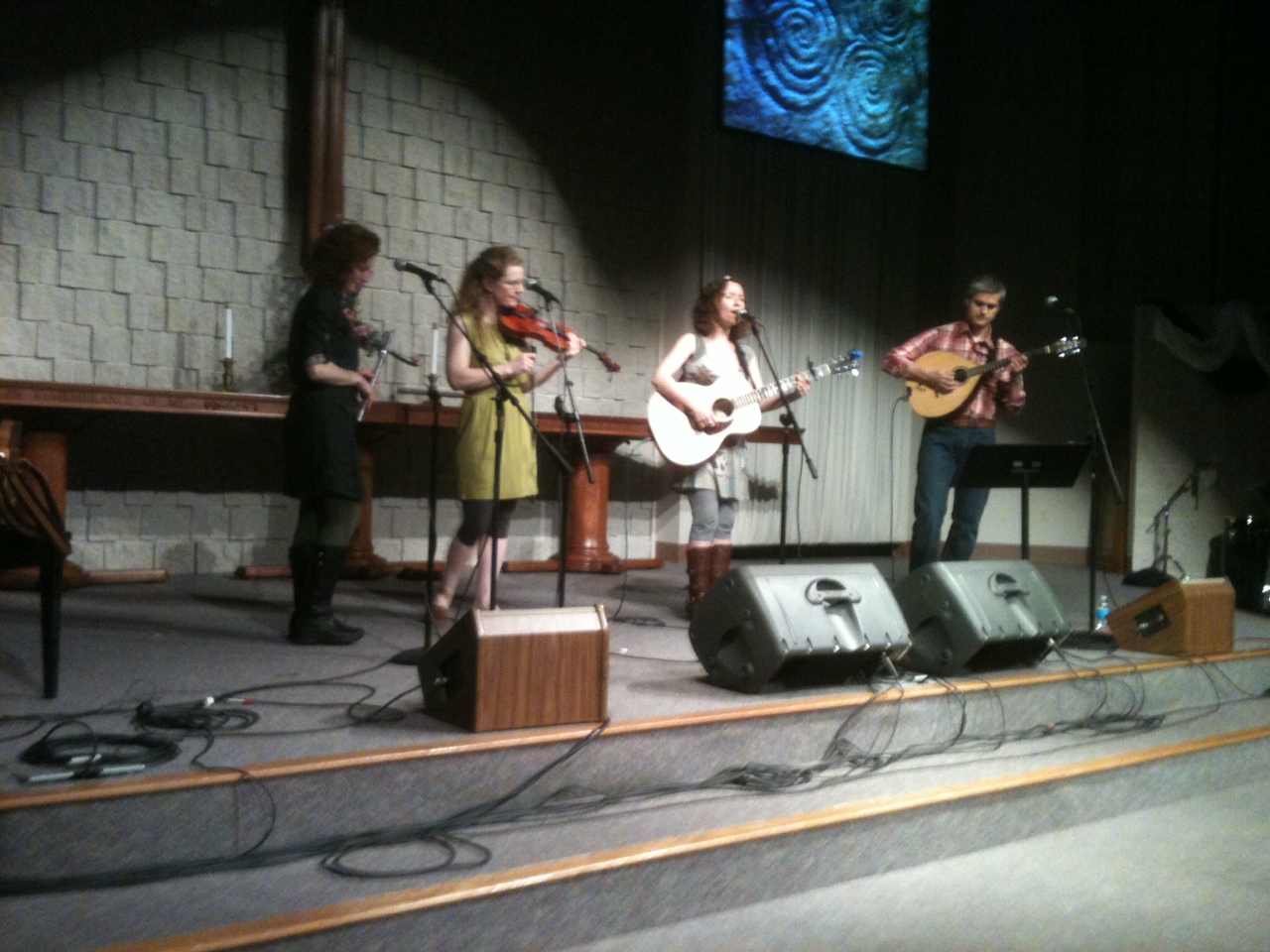
They didn’t disappoint! Long Time Courting shared their endearing instrumentals and vocals at Broadway Christian Church last night, April 26.

Long Time Courting at Broadway Christian Church April 26

Long Time Courting, the Neo-Celtic acoustic and vocal group from New England, will be in concert at Broadway Christian Church on Thursday evening, April 26, at 7:00 p.m. Tickets may be purchased directly from Broadway Christian Church or at the door.

To see and listen to the group on Channel 6 of Portland, Maine, click here: http://www.wcsh6.com/video/129258999001/1/The-music-of-Long-Time-Courting

All God’s Children, the innovative program of Broadway Christian Church, Columbia, Missouri, provides an adapted Christian education program for children with disabilities, especially autism. Recently, KOMU covered AGC and you can read the story and see the video here:

http://www.komu.com/news/all-god-s-children-helps-teach-autistic/