Just Next Door

Posted: June 6, 2012 in Uncategorized

In my naive days I evaluated the data of life from its outside appearance. That, I discovered, was reading the world incorrectly.

Oh, yes, much of what you see is what you get. There are people like that, circumstances like that, books like that, religions like that. But there is much much more that is not.

First impressions are tricky. Depending on person or context they may indicate the true reality or not. More than once I have misjudged a book by its cover. I have either under or over-valued a person, place or thing. I’ve repented over those occasions. But the temptation to be wooed by the externals is a strong one.

Some years ago our family had some investment rental property. The next door neighbors were a fine family – two parents and three children. The father was a bus driver for the city and a strong working guy, involved in the neighborhood. The mom worked in a school cafeteria and knew everyone. The parents spent time with the kids and the family was always doing things together.

One day dad came home from work, walked from the drive to his front door, and on the way somebody emerged from the side alley and pelted him with bullets. He died where he fell.

It was a neighborhood tragedy and I remember going to the mourning house, walking through the zombie-like children and shattered mother to express, what, some consolation. They numbly regarded my gesture. I was not surprised.

How could this happen to such a family? What monster would destroy such harmony?

Maybe two months later I saw a news piece that featured this grief-stricken wife and mother. She had been arrested and was charged with conspiracy to commit murder. It ends up that she and her lover put a contract on her husband’s head to have him snuffed. She’s now in prison.

And I remember walking into her kitchen, expressing my sympathy, and she lifting her heavy eyes toward mine. “Thank you for stopping by,” she said. And I thought to myself, “How could anyone do something like this to this family, this woman?”

We are not what we seem, to ourselves or others. People are better than we give them credit … and worse. And quick judgments based on first impressions are often … mistaken.

I once read an author who asked a simple question about bringing peace and love into the world. The question was, “How can we begin to bring about peace and reconciliation to the four quarters of Jerusalem when we can’t bring peace and reconciliation to the four quarters of our own heart?”

It’s the right question.

The All God’s Children ministry of Broadway Christian Church, Columbia, Missouri, is ramping up to its next initiative: A Special Needs Vacation Bible School.

Of course, why not?

Get the whole story in a special feature from the Missourian:

Missourian article on Special Needs Vacation Bible School, Broadway Christian Church

Around the Bend

Posted: June 2, 2012 in Uncategorized
Tags: ,

I like float trips down beautiful moving water. For me, it has to do with becoming one with the river, communing with the wildlife, and sensing the unity of floating pilgrims if, that is, you’re not going it alone. Our church youth group headed downstream yesterday and I was one of the merry band.

The day was beautiful – partly sunny and cool – and the Current River was not overpopulated with human kind. The journey was mostly uneventful until one particular tight turn in the river. That was memorable. Let’s call it Devil’s Bend.

As such hazards go, trees and debris extend out into the river in such a way that the current draws you directly into it all. That often spells a spill. And so it was, that we capsized then and there, as did many of the canoes following us. In and of itself, such an occurrence does not spell a disaster; gather up your things, stay with the boat until you can unswamp it and get waterworthy again.

No, the hard part comes with what is unseen. The most difficult challenge of negotiating such a spot is found in its unseen dimensions. For me the unseen thing was a submerged stump, and as I capsized my ribs became intimately acquainted with it. Ouchy. Take the wind out of you ouchy. Think you broke your ribs ouchy.

Happily, the end of that story is a good one. Rest, Ibuprofen and an elastic wrap pretty well took care of it. And time, of course.

Known obstacles provide the advantage of forewarning. They may still be difficult, to be sure, and stretch you to your limits. But the concealed obstacles slap you silly as you are unaware and unprepared. In a moment your life is turned upside down. The current sweeps you across painful objects. Concealed obstacles have the advantage of surprise, and they don’t waste a bit of it.

When that happens, and it will, the rule book changes. If you have never felt especially good at improvisation, you had best let go of that inhibition. All of the variables and relative chaos surface with one question: Now how will you respond? It’s not as though you have the luxury to debate whether it is fair, could have been avoided or if others have encountered the same predicament before. Those ruminations are legitimate, but come later. Right now, hanging horizontal in the stream, with as many unknowns as knowns,  one must decide and act.

Those concealed obstacles destroy some people. They make others stronger. And almost everyone is changed by them, in one way or the other. Whether they be enormous health challenges, a shift in employment, or a personal crisis, the river not only changes our situation but changes us. And it’s not all bad, if you survive it, that is.

Life is not for sissies. That much we know. But for each hidden obstacle that threatens to undo us, there are a thousand glints of beauty that have the potential to melt the ice crystals clinging to the underside of our hearts. Keep on the lookout for those, too. They are also frequently hidden from view, waiting to knock us out of our boats, strike us with grace, and take us where we never imagined we would go.

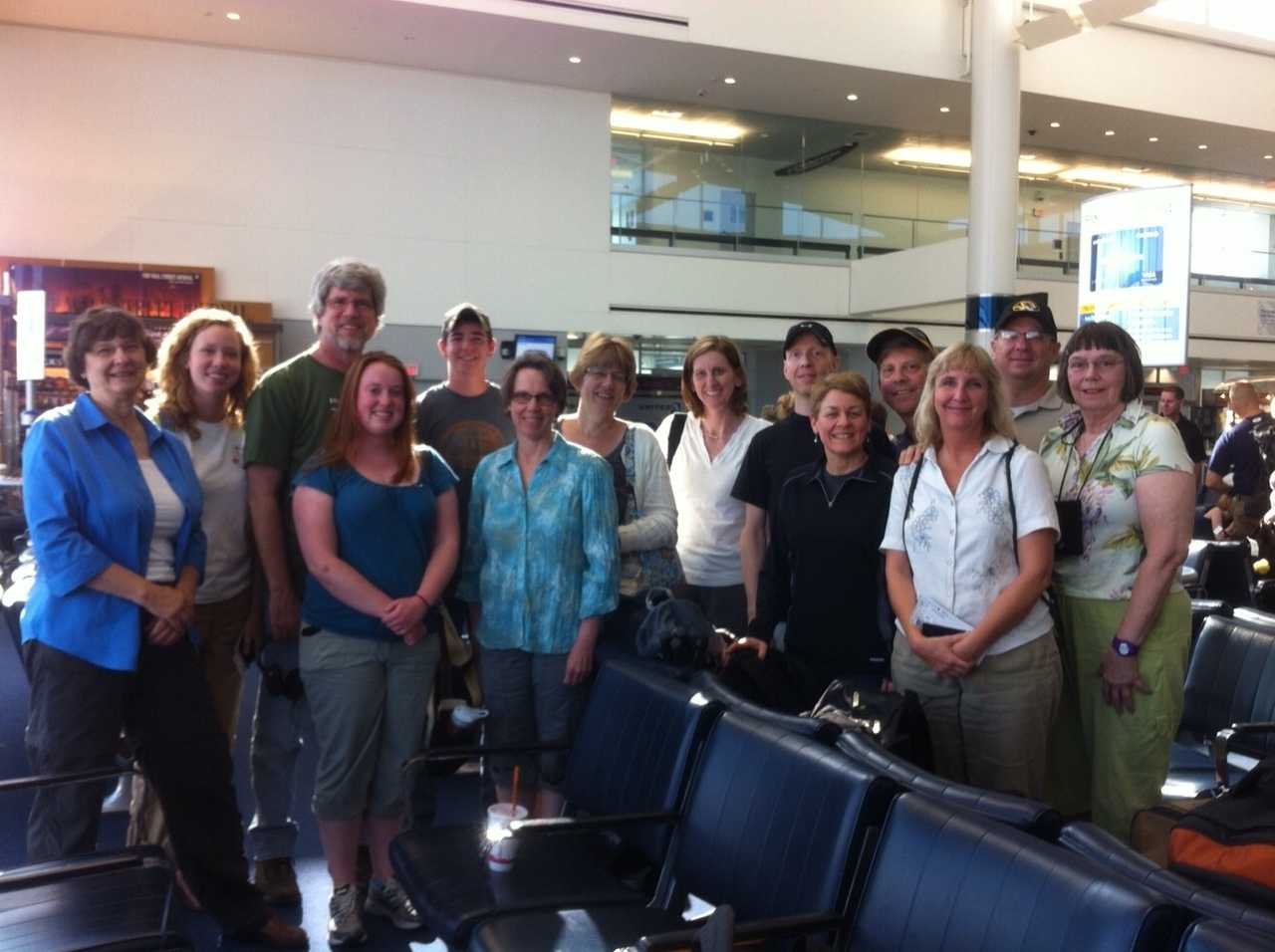
Walking together, that’s what we’re doing with brothers and sisters in El Salvador. Our Broadway team is walking along side partners in the region of El Espino. Most important are the relationships we form, the way we stand in solidarity. Of secondary importance is the way we work alongside Salvadoran friends who have defined the priorities for their church and community. And ENLACE is the facilitator of this project.

Prayers, blessings and a full measure of solidarity with our team!

On the way in the airport

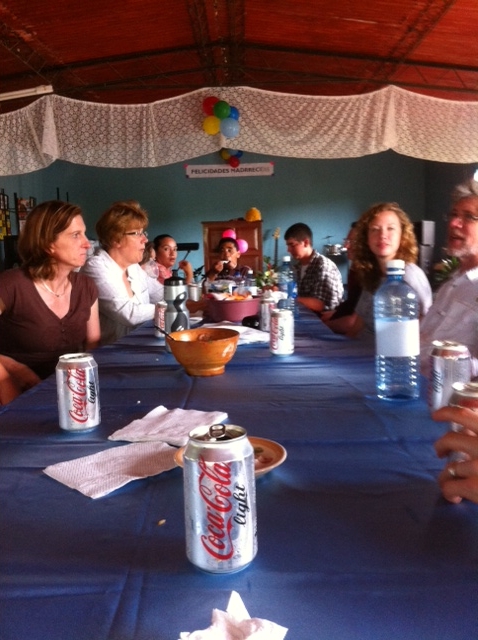
Dinner after Church

Gabby’s house – the completed project of last visit

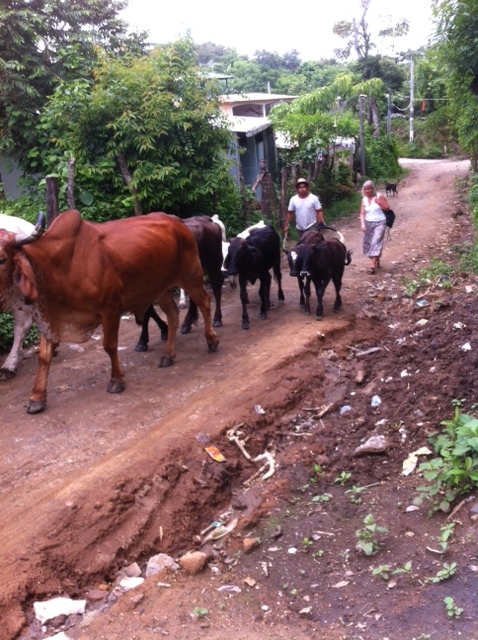
Cinda Eichler herding cows!

If The Language of God was not enough, world acclaimed geneticist, former Director of the Human Genome Project, and the present director of the National Institutes of Health has done it again. I’ve just finished his latest book written with his co-author, physicist Karl Giberson, entitled The Language of Science and Faith (IVP, 2012). If you want to read a book that addresses the intersections between religion and science and maintains the integrity of both, this is it. The hard science is there as well as a grounded sense of the Christian tradition.

I won’t ruin the book for you by saying too much, but here is a teaser that should get the blood flowing:

Although science and religion certainly overlap in some cases, neither is an exhaustive source of truth capable of swallowing up the other. There are still questions that only science can address, and religion should simply concede on those points. And science cannot answer questions about life’s purpose or the existence of God. Scientists in the public square should refrain from pontificating on these topics as if suddenly science has become a religion. We also have to keep in mind that science makes mistakes – sometimes significant ones – but science is self-correcting over time, as history shows so clearly.”(90-91)

Yes, get your copy. If a scientific layperson like me can get it, you can too.

Backwards into the Future

Posted: May 26, 2012 in Uncategorized

My daughter and I went fishing this afternoon. Lest I mislead, we are not pros. Novice would be a flattering designation. We have a our rods, reels and tackle. The lake was just fine. The fish weren’t biting. The sun beat down. And the row boat got us there.

Only row boats were available at the public facility and that was about our speed. Of course, I was the rower. As we moved from place to place, observing any form of wildlife except  fish – herons, hawks, snakes – something suddenly occurred to me: In a rowboat, if you’re the rower, the only way you get anywhere is backwards. You literally row with your back to your destination. In terms of time it takes on a different shade of meaning. In a rowboat you move into the future while looking at the past. That’s not bad, especially for Memorial Day.

Rowing into the future requires a back to the wind, not knowing what’s coming other than a general direction. The most helpful coordinates are the ones we already passed by, those sitting on some distant shore of what’s already been. That centers us somehow. It doesn’t provide all the answers because some of those live only in the future and are never provided in past tense. Rowing backwards keeps us reading the way things have been as an aid to understanding what will be. It’s not always a one-to-one correspondence, of course, but very often it’s close enough.

A couple of things help rowing backwards. Since good navigation has to do with comparing the future with the past, you can’t only look backwards.  Some people do that – only look backwards – and it generally doesn’t work.

The first way to accomplish that is to keep glancing over your shoulder. What you’re doing is comparing your destination with where you’ve been already.

But the second thing is to include an on-board companion, one who is not rowing backwards like you are, but rather facing forward. Their observations become another helpful measure of direction. The perceptions of another provide a different point of view. Together they make some magic.

Backwards into the future; not a bad way to travel, fish or no fish.

To Laugh and Weep

Posted: May 25, 2012 in Uncategorized

Right now I am sharing in two situations of love – one that brings tears and the other that brings laughter. Both are real because they are based in love, in caring, in desire for the best for these companions of the heart.

In the one instance my heart is torn for the anguish of the other. As they share the moment of the shattering of glass, I can’t pick up the pieces for them. The glass that dropped, that struck the hard surface, exploded on impact. But it is not the end. How can I communicate what we all know in retrospect, that it is not the end, though it seems so at the time? Holding the other in love is perhaps all we have at such moments. That is probably what is most important.

On the other hand I am blessed to share joy with loved ones, to celebrate, to lift the glass in a toast to life. How is it that such unexpected joy may come our way? What makes it doubly joyful is its unplanned appearance. To turn the old phrase around, “Why do joyful things happen to rank and file people?” We didn’t earn it. The blessing did not come because of conspicuous valor, but perhaps in its absence. I share joy with them.

All of these are experienced because of love. Love holds the heart in just such a way that it catches both radiance and shadow. It does not discriminate for when it is open love receives the entire cargo of its caring. And so we love and wait. We weep and laugh, laugh and weep.

Such is the way of love. And it is so worth it.

Since volunteering at the Raptor Center in Columbia I’ve been paying closer attention to birds of prey in the wild. In our vicinity the hawks are plenteous, staking out their hunting territory as they do. An average hawk stalks an area equivalent to about one square mile.

Because the food source of hawks includes not only mammals and reptiles, but smaller birds, hawks are bad news when they show up near the roosting area of other birds. Only the most brash birds are willing to get in the face of the stronger, deadlier hawk, however. Like crows, for instance.

Crows are big, aggressive and smart. They are tough enough to take on the neighborhood bully. If not in a fist fight, then throwing rocks, taunting and letting the air out of his bike tires. Crows harass hawks so that they will get out of town.

Because crows are so social, and hawks are most usually solitary hunters, the scenario usually involves several crows ganging up on the one threat, the hawk. They swoop, dive bomb, raid and shriek until the hawk has had enough. He’s not afraid, just irritated. When he takes flight they usually give him an escort to the county line. And don’t come back, really.

Yesterday a hawk was proudly perched on a pole out behind the church. It was near evening rousting time and the other birdies were settling into their trees for the night. The presence of the hawk was not welcome, not at all. For some reason one crow, abandoned by his mates, took the fight to the big boy. And he swooped and spit and cussed. The hawk paid him no never-mind. But eventually, the hawk launched off the pole to search for more serene surroundings. The solitary crow flew him out of Dodge.

Sometimes all it takes is a solitary voice to stand against tyranny, injustice, harm, violence or abuse. One voice can do it. Certainly silence will not. But the most effective strategy to offset the neighborhood bully is a flock working together. That group of protest is taken seriously. Mobilizing many voices as one voice has its effect.

I think of the way that women in Bangladeshi villages organized to quell wife battering there. No one woman could stand against the stronger, more aggressive male. But they started organizing. And whenever a woman was battered not one, but a dozen angry women showed up at his hut. That usually did it. There were just too many crows and hawk stopped, moved on, ceased and desisted.

Even if the crows don’t shed a drop of blood, pluck out one feather, their presence – active and persistent – makes all the difference.

Let those who have ears hear the story of the Hawk and the Crow.

Graduation and Death

Posted: May 20, 2012 in Uncategorized

We’re on the way to the college graduation of a family member, my daughter and I. We’ll all be there, the extended family, sharing in this rite of passage. And suddenly out of the blue I turn to my conversation partner, this girl who thinks really odd thoughts, odder than mine, and share something equally odd:

“This graduation, you know what it’s really about?”

“What?” she asks me.

“It’s about death.”

“Come again.”

“It’s about death and how all of us a little older are rooting on those a little younger in hopes that they continue our species. It’s about hope in the face of death. In addition to loving the person who is graduating, we want the race to survive. It’s the same whether it’s birthdays, weddings, graduations …”

“That’s weird, Dad.”

Maybe so. But I don’t think so. We swing into a little town and I say I want to check on a friend. When I pull up to his business she decides to stay in the car. It won’t be long, I tell her.

When I go inside the receptionist greets me with bad news. “You haven’t heard, have you?” No I hadn’t. “He’s in chemo now. It’s bad, not responding.” I’m in shock. He was a high school buddy. But I’m fortunate because my friend stopped by for a while and he’s in his office in the back. They take me back to him.

We talk about his condition, the choices he’s having to make and why. We talk about his children. We talk about some silly times we shared together. We hug. I tell him I want to know what happens. And when I walk out the door I look him square in the eye and he does the same. We both know this may be the last time we see each other face to face.

Out in the car, time has moved on without daughter knowing why Dad is so delayed inside. I apologize. I tell her the story. She says it’s alright, she understands. We pull out of the parking lot and head down the road.

Maybe ten minutes pass in silence. The always thinking daughter says, “I know this makes you sad. I’m sorry.”

More time passes.

“It’s ironic,” she says. “I mean this just after you talking about graduation. You know, graduation and death, why we go, what we’re doing.”

“Yes, it’s ironic,” I say. And we keep driving toward the caps and gowns, the address and diplomas, the beginning and end, the long road we must all travel.

It was a gala night whose purpose was to fund dance in Columbia. On that score it succeeded. But it was more than that.

Like the popular national show, celebs are matched with pro dancers and compete for the top spot. The pros make everyone look better than they are. Some of the talent is surprising. But for me one aspect loomed above all others.

Those people fox trotting across the floor have other lives, real lives, when they are not on the dance floor. And so the doctor, school principle, business owner and fitness center trainer all take the stage. The good, bad and ugly of their professions melt away beneath the pulse of the music and movement of their bodies. And when people cheer, it’s not only because one of their own dared to make a fool of themselves for a good cause. No, it’s the dance of life.

They dance across life, dance for joy, because now is the time to let go of everything that hinders and strut the stuff. Some wear the outfit better than others. This one communicates the attitude to the audience. And that one floats along on the well-wishing of their friends. Judges make funny and half-serious comments.

If life is a dance, then who are we dancing for and why? And in the end, could we stroll across the canopy of the sky, kicking up our heels one last time, a holy cha-cha to the mystery?