Our Christian congregation has been in relationship with our Muslim brothers and sisters at the Mosque for some time. But now there are new reasons to come together in solidarity. The current atmosphere of fear and suspicion requires renewed efforts at unity and solidarity.

We were just invited to evening prayer and a light supper at the Mosque and a number of us – men and women – attended. Our conversations spanned everything from shared common living to distinctive practices to the impact of current politics.

In my small after dinner discussion group there were two doctors and a business owner. They have raised their families in the United States. But the shock waves of anti-Muslim and anti-immigrant rhetoric and policy proposals have affected them and their children in challenging ways.

One child psychiatrist who taught at the medical school for decades is now working with an agency to equip ELL teachers (English Language Learners) with skills to work with children who are traumatized. They are at risk because many of them come from countries of origin embroiled in war and conflict. These children often witnessed the unbelievable. Now the fear of deportation – even if they are legal – hovers over them. It is a time of great insecurity.

In our conversations we spoke of how important it is for different faith communities to stay connected and evidence unity and solidarity, especially in a time in which people are being divided and turned against one another by fear. We need to find ways to give witness to the opposite.

We will be returning the hospitality of our Muslim friends by inviting them to dinner at our church in the near future. Our women and the women of the Mosque are planning some lunches out in public places. There is talk of maturing our relationship into some progressive dinners hosted in our homes.

This is a time in which Christians are called to practice an uneasy faith and swim against the cultural current. Isn’t it Jesus who always reached out to the stranger, the other, the one society banished to sidelines? Of course it was.


Living at the Liminal Edge

Posted: March 15, 2017 in Uncategorized
Tags:

Hello liminality fans! I was just interviewed on a podcast on, what else, liminality.

If you are interested click here!

Leftover Ashes

Posted: March 1, 2017 in Uncategorized

I have a friend who, on the occasion of her mother’s passing, honored her wishes by cremating her and then scattering the ashes in several of her favorite places. For many of us that is a familiar scenario; not only burying or scattering ashes but doing so in places that meant something during life.

The backstory for my friend is that she had a terrible relationship with her mother, one that was fairly traumatizing. When she scattered those ashes she was closing a certain chapter that needed to be closed. The closing of that chapter may have held as much relief as sorrow.

One day my friend was cleaning the basement when she ran across a box. To her horror it contained more of her mother’s ashes. How could they have not scattered all of them? Suddenly the closed case seemed open again. What to do? How to get those ashes out of the house?

Toss them in the trash? No, too disrespectful. Bury them in the flower garden in the back yard? No, too close for comfort. At last a solution appeared – give them to a friend to enrich his garden. Fair enough and far enough.

Every so often we discover a leftover, something we thought was long gone, but whose remnant lives on. Like finding leftovers in the fridge from two weeks ago we were just certain we would have for lunch the next day but did not, we are not a little repulsed by the fact that we misplaced or forgot them and they are still there often in a deteriorating condition.

But the hardest things are not found in the fridge. The hardest things are often found in the basement of life, down in the reaches of memory and loss and pain. There they live like the remnant of ashes which have not yet been scattered. As we run across them, in wakefulness or sleep, they often torment us.

“I thought I was done with this. I can’t get away from it. This again! Why won’t these regrets, memories, or failures stay put where they belong?”

Those leftovers in the basement are the gifts that keep on giving; the unconscious has no garbage disposal and they can live there indefinitely. And until we do something with them – identify them, touch them, remove them – we remain haunted. As long as the unresolved aspects of the heart slumber in the basement they keep showing up for surprising cameo performances in our dreams, our present relationships, a lingering melancholy, the sense that something seems unfinished.

It is no accident that the ashes we smear on our faces tonight come from leftovers, from leftover palms from last Palm Sunday. A year ago we dramatized the entre of Jesus’ final week, his entrance into the death trap of Jerusalem, the short-lived adoration of crowds that would turn dark soon enough. We watched his suffering for the sake of love.

And then we gathered up the leftover palms off the ground and stored them in the basement. During the year we kept running across them – “Oh, those palms!”

The day finally came when we gathered them up, burned them into ash and prepared to mark ourselves with them. We gather and say that the leftovers of Jesus life describe who we are and what we are passing through. The leftovers from Jesus’ walk will mark our walk.

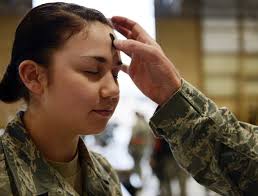
What do we do with the leftover ashes? We could do lots of things. We could bury them somewhere. We could scatter them. But of all things Christians wear them. We wear them as a sign to ourselves and one another.

A long time ago I went to a mid-day Ash Wednesday service, received the mark of the ashes on my forehead and then went on about my day. I actually forgot I was marked. I went to the store, got a haircut, and walked down the sidewalk.

Every so often I noticed that people were looking at me strangely. But I had forgotten what was on my forehead. They gave me a peculiar look or averted their eyes but there was something strange about me. It was all a curiosity until I glanced in a mirror and noticed the black ash riding around on the carriage of my face. Then I realized what had happened, that I was being seen differently, strangely, for who I was as a Christian. Of course, today such a smudge seems out of place. But so is being a Christian, wearing the leftovers of Jesus, living as one acquainted with death and grief but at the same time living in resurrection.

There are those other religious traditions – and even Christian variations – that sport identifiable markings of the faith, through clothing or marks on the body. Year round they wear what they live and others know it. Though it is highly improbable that this will occur in our highly urbane congregation, it also couldn’t hurt. Being an anonymous Christian is fine as far as it goes, and avoiding external show for the sake of some religious vanity is also important.

But much of what gets passed off today as Christian is little more than civil religion, the values of the culture that have been baptized and dressed up in Christian rhetorical clothing. It often bears little resemblance to Jesus himself, which is of course the point, and it is good to know the difference.

Wearing the ashes is a powerful reminder that we are, after all, Jesus people. Wearing the leftover ashes from the basement of time is the antidote to our denial and forgetfulness: This is the way life is, this is who we are, and we sometimes wear Jesus even without knowing it. Maybe people will look at us funny. Maybe that’s not so bad.
Wearing the Way it Is

Posted: March 1, 2017 in Uncategorized

ash-wednesday-7Everyone knows what Mardi Gras is; the last hurrah before the Lenten fast, the final excess before introspective restraint, the dark side on parade before it goes underground. Or more particularly, Shrove Tuesday is the day on which the pantry and fridge are cleaned out before heading out into the forty day wilderness of the spirit.
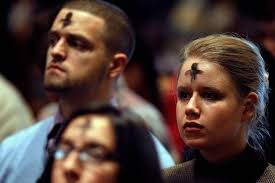
Ash Wednesday is the lead-off batter of that procession of days, setting the pace and tone. On this most uncomfortable day of the year a smattering of Christians dare to gather and listen to unvarnished words about mortality, brokenness and sin. Then somewhere among confession and reliance on the grace of God they submit to having the burned leaves from last Palm ash-wednesday-3Sunday smeared on their foreheads. Some of them sport the dark sign of the cross for hours. As they come and go in public some think they must have forgotten to wash up that morning.

But deep down this small little gaggle of Christians bears a story and a condition for all to see. In the first place the ashes testify that everything you know is temporary so don’t be tempted to pitch your tent on shifting sand. In the second place they remind us that we’ve made a mess of way too much in our lives. These are the two truths you can’t miss if you walk through the doors of an Ash Wednesday service. And it’s the same reason why so many people don’t walk through those doors.

It’s really not the case that Lent sends us on a forty day journey. Rather, Lent names a journey we’reash-wednesday-6 already on. And when we dare to dramatize it yet again we locate ourselves on the map: You are here. Sometimes that feels pretty good and sometimes not. But we are here and not somewhere else. God is always where we are, even and especially in the wilderness places, wandering around with ashes on our faces and navigating by nothing more than faith.


One more time: Another report comes that our growing small city has need of more police officers on the streets, on the payroll, serving the community. Columbia, Missouri is woefully inadequate in providing reasonable law enforcement. The shortage creates work loads and lack of coverage that squeezes and stresses the force. And pressure from the top of the food chain simply instructs them to do more with less. We lose officers all the time to other departments or agencies because of low morale.

As the reports continue to come and the noise level rises the public pretends to be concerned. Well, ain’t that a crying shame. But the simple and inconvenient truth is that we continue to vote down tax increases that could remedy this situation. We do that even as our local tax rates already hover in the bargain basement rage for cities our size. But we won’t ante up. Instead, we pretend to care and say inane things to officers like “Thank you for your service.” You want to really thank them for their service?

Hire more officers. Increase their salaries, benefits and retirement programs. Provide reasonable equipment and gear at no cost to officers. Make sure they have the most current vehicles and technology. Keep military style firearms and ammo off the streets and out of the hands of the bad guys and mentally ill. Re-institute the motorcycle and  mounted patrol horses. Offer routine continuing education and opportunities for our force to achieve best peer city practices.

We can settle for mediocre, overworked, understaffed and unsafe, or we can do the right thing. We can pay for this. What that means is voting yes to the next proposed tax increase. Just do it.

And while we are on the subject Missourians, go ahead and increase Missouri state taxes. We are at the bottom of the barrel. It’s ridiculous. The ultimate answer to every fiscal dilemma of our state is not slashing essential programs and lowering taxes even more. No, to the contrary, as a moral issue increase our taxes.

Wake up Columbia. Wake up Missouri. Okay, wake up USA. Stop pretending to care when you really, really don’t.

The first Dean of the School of Journalism of the University of Missouri was Walter Williams, a man who would later become the University’s President. There is one composition by which Williams became known far beyond his own locale and that is The Journalist’s Creed. It echoes  high mindedness of a 19th century moral tome. That, I think, is why it has endured. Though the Creed employs the language of its own time it names truths that may speak to all times:

I believe in the profession of journalism.
I believe that the public journal is a public trust; that all connected with it are, to the full measure of their responsibility, trustees for the public; that acceptance of a lesser service than the public service is betrayal of this trust.
I believe that clear thinking and clear statement, accuracy and fairness are fundamental to good journalism.
I believe that a journalist should write only what he holds in his heart to be true.
I believe that suppression of the news, for any consideration other than the welfare of society, is indefensible.
I believe that no one should write as a journalist what he would not say as a gentleman; that bribery by one’s own pocketbook is as much to be avoided as bribery by the pocketbook of another; that individual responsibility may not be escaped by pleading another’s instructions or another’s dividends.
I believe that advertising, news and editorial columns should alike serve the best interests of readers; that a single standard of helpful truth and cleanness should prevail for all; that the supreme test of good journalism is the measure of its public service.
I believe that the journalism which succeeds best — and best deserves success — fears God and honors Man; is stoutly independent, unmoved by pride of opinion or greed of power, constructive, tolerant but never careless, self-controlled, patient, always respectful of its readers but always unafraid, is quickly indignant at injustice; is unswayed by the appeal of privilege or the clamor of the mob; seeks to give every man a chance and, as far as law and honest wage and recognition of human brotherhood can make it so, an equal chance; is profoundly patriotic while sincerely promoting international good will and cementing world-comradeship; is a journalism of humanity, of and for today’s world.

The Invitation She Carries

Posted: January 28, 2017 in Uncategorized

Inscription on the Statue of Liberty:

“Give me your tired, your poor, your huddled masses yearning to breathe free, the wretched refuse of your teeming shore. Send these, the homeless, tempest-tossed to me, I lift my lamp beside the golden door!”

Infinite Power of the universe: Out of Your womb we came, wandering this fair and spacious land. From generation to generation we have covered the face of the earth, standing where those before us walked and lived as we do now. The first peoples made their way with seasons and territory, tradition and tribe. And before them the earth itself unfolded with billions of years of growth and change, a small garden in the corner of our ancient and ever-new cosmos.

Here we are today, the descendants of those who came from every corner of this planet, called to live in this place in this passing moment. How infinite is your space and grand the sweep of time. And how peaceful we feel when we know, deep down, that we are a part of you. In the clamor of events which surround us, so full of potential and uncertainty, we dare ascend the spiral staircase to our highest and best selves.

No matter whom we are or from whence we have come, we ask, we seek, we reach for the peace that passes understanding, the courage to stand for justice, and the wisdom to know what that looks like in our own time. Give us the will and courage to live out our creed so that conviction is matched by virtue and declarations are animated by actions.

In the course of human events, both large and small, some are lifted by a mysterious providence to govern your people for a season. We ask that those who have been vested with the authority of government will honor the positions they now fill. Give them wisdom and courage to fulfill their roles and duties. Let them rise above self-concern to address the needs of whole nation.

May we in our many states of mind and heart devote ourselves to the best good for the whole people, walk in the challenging footsteps of Jesus, constantly pursue truth even when it is unclear, follow the wisdom that exceeds our own, and strive to take the higher rather than lower path.

We do not claim, Creator of the Cosmos, that our time and place is somehow harder and more challenging than any other time. But we do ask you for the insight and solidarity to be forces for goodness and beauty in this time and place where you have planted us. Fill us with your lively Spirit so that we might be your weavers of visions, lovers of souls, painters of hope, models of compassion, voices of justice, and agents of transformation.

We ask all these impossibilities through the spirit and life of the One who makes all things possible, Jesus our life-giving revealer, Amen.

Is it time to refresh our Constitutionally challenged minds?

Amendment I

Congress shall make no law respecting an establishment of religion, or prohibiting the free exercise thereof; or abridging the freedom of speech, or of the press; or the right of the people peaceably to assemble, and to petition the government for a redress of grievances.

My winter’s read between Christmas and New Year’s has been Robert Nelson’s intriguing God? Very Probably (Cascade, 2015). Nelson is a professor at the University of Maryland. His focus has been on implicit worldviews active in the worlds of the sciences. The subtitle is: Five Rational Ways to Think about the Question of God. No, he’s not going down Aristotle’s proofs for God track. He rather strolls out into the ring as an economist/mathematician and an uber well read student of the Neo-Darwinians/Atheists. He takes the intellectual fight to their own scientific backyards.

If you are looking for some defense of classical theism or creationism you will not find it here. Neither will you find a mindless defense of what has come to be called the Darwinian synthesis. Nelson exposes the conspicuous lack of considering new evidence and screening out of inconvenient facts regardless of the camp in which they live.

For example, creationists screen out a fossil record of millions of of years because they need a creation that took place 6,000 years ago. Neo-Darwinians screen out the fact that almost all paleontologists in the field who examine their core stratigraphy records note that nothing like a gradual evolution of the species takes place; dramatic ruptures in the process are more often the norm and individual species change very little over very long periods of time. As a matter of fact, there is more novelty that takes place through cross-fertilization than within individual species.

Nelson explores the miracle of Mathematical order, Darwinism as a secular religion, scientifically unexplainable human consciousness, divine agency in recorded history and the intersections of secular religions with Christianity and modernity.

Each of these chapters merits a book in and of itself. Nelson gathers them all in one, which is no small achievement. This is not an easy read, but it is written as a popularizing of arguments that have formerly been highly academic. But for the motivated, this is a great winter’s read. Dare you.