This past week, just on the heels of the massacre in Las Vegas, I attended the regular meeting of the service club to which I belong. Like in most places where people have been collectively impacted by a tragedy the mood was pensive, uncertain, reflective.  When we inhabit the ambiguous liminal space on the other side of some unthinkable threshold we live somewhere between here and there, a somewhere that is often nowhere.

What struck me was the inability of normally articulate people to say a word that made any sense.  Rather than naming the elephant in the room, the president made an oblong reference to the past week and then proceeded to tell some jokes he hoped would lighten the mood. He is a really fine person. I admire him in many ways. Then, during an announcement about a forthcoming event, another person promoted the occasion by saying that with all that has transpired it will be good for us to get together make merry. After all, she continued, this just means our work at building relationships is not done.

No breakfast conversation at my table actually reflected on the tragedy at hand. There was no collective action that addressed it. We left the meeting in the same fog through which we entered. It occurred to me that that they were utterly unequipped to deal with a tragedy and deal with it together. They had no language for such a thing.

I contrast this with a mid-week prayer service our congregation provides in which we prayed for brokenness, unspeakable loss and the strength and power to overcome evil.  I think of the difference between the vacuum of my service club with a Saturday night Bluegrass worship service in which we talked about the hypocrisy of praying for the families of those affected by the shooting but not pursuing a courageous solution that would stop this plague of gun violence in our land. I compare my service club to worship yesterday morning and the direct ways that we named the tragedy, provided for expressing sorrow, told stories of hope, and even suggested that creating beauty is the right response to hate and ugliness.

In the tradition of the church we have an advantage, admittedly so. We actually reflect on suffering and death. And we have a very specific response to suffering, loss and tragedy. It is called lament. We carve out space to outwardly lament, give voice to our sorrow, fear, bewilderment and disillusionment. Lament is scattered all over the Psalms. It is found on the lips of Jesus on the cross as he quoted Psalm 22, “My God, my God, why have you forsaken me?”

Those same Psalms and Christian scriptures combine lament with hope. We sorrow but not as those without hope.  It is scattered through our hymnody. The season of Lent and Holy Week major in it. People often say, “Oh, Lent is just too depressing.” It can be heavy. It looks sin, violence to others, suffering and death right in the eye without blinking. Which is exactly why it is so important. This language, these clear and unflinching truths about life, are exactly what prepare us for Las Vegas and anything like it. We have a language, a narrative and symbol system for this.

I do not harbor any kind of contempt for my friends in my service club. They were simply out of their depth. They had no language or even ideas to deal well with something that terrible. Expecting them to be fluent with suffering in a moment like that would be like me expecting a non-Spanish speaker to translate events in Spanish.

There actually is a language we may speak following events like Las Vegas. This language has a grammar, syntax and vocabulary. It includes words like evil, suffering, sin, hope, restoration, redemption, healing and justice. It is a sturdy language, sturdy enough to speak after the shooting has stopped. It is insistent on ways to prevent such inhumanity. And in the end it is a language that we, the ritual makers, use to walk the path of life in a particular way.

For those who are interested, this way involves a person named Jesus who was and is the way, the truth and the life. You should get to know him. He’ll teach you how to understand and speak a new language.
image

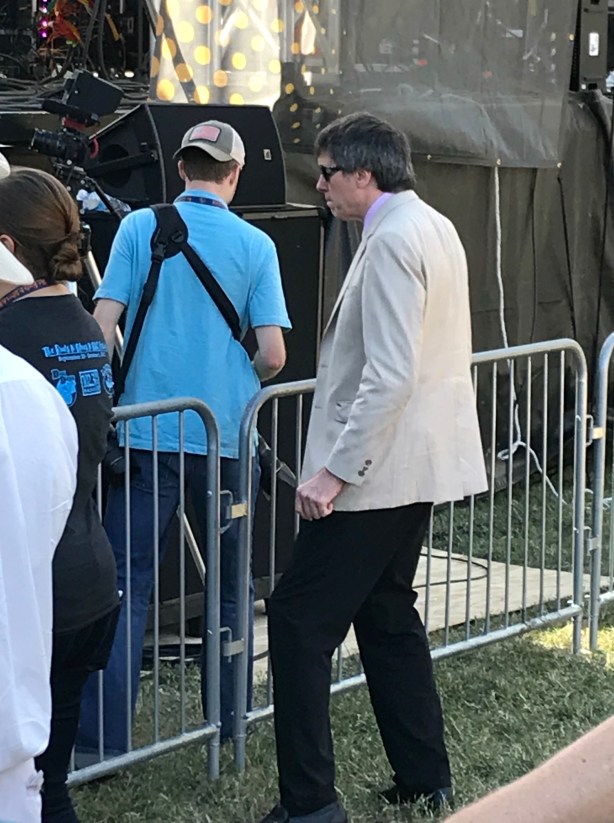
Beatle Bob at the 2017 Roots and Blues Festival

As I made the long walk from parking to Stephens Park for the recent Roots and Blues Festival in Columbia, Missouri who should be walking directly in front of me other than the now iconic Beatle Bob (Robert Matonis, b. 1953). This well-known fixture at scores of concerts dresses in a retro Beatle wig and coat and is reported to have seen over 10,000 bands in the last decade. He attends at least one concert a day somewhere in an unbroken chain of concerts.

Bob is so well known that he gets shout outs from the on-stage performers who immediately recognize him stage side. Grooving and moving through the whole performance, Bob is a part of the whole experience. What is it like to be permanently in attendance at concert after concert, life as one long performance?

Of course, for Beatle Bob it is a matter of identity; he has cultivated a specific persona through decades of being the true fan. He is known by and has a place for this identity. Others regard him so. In terms of belonging his position is secure, part of the social concert landscape. He has become this character and more than simply accepting his eccentricity people welcome it. They say what I say, “Look – it’s Beatle Bob!”

In Liminal studies we would say that a concert is liminoid space, a space between the ordinary structures of life. This is artificially designed space at the edge, the border, the margin of life. Different kinds of things manifest there. You have the freedom to become something else. Insight, feeling and experience may be revealed in unique ways.  In this regard, attending a concert in today’s highly technical production provides a temporary alternative reality, a Liminal space and time. In this regard a concert can parallel church, without the doctrine, prayer and communion. It holds multiple rituals, togetherness, and moves the emotions from one place to another.

Liminal space, however, is occupied differently depending on who is doing the occupying.  For Bob his life is defined by permanent liminality – a continuous habitation of liminal space. Like the other great traditions of the permanently liminal – monastic life, the wandering vagrant itinerant, people living at the edge of society – Bob lives in the permanent liminal space which has become his primary space. He does so voluntarily, unlike the liminality of prison, for instance, which is involuntary permanent liminality.

Bob reminds me how our reality is so very much determined by the kinds of spaces we inhabit. Landscapes provide the boundaries, safety or confinement that make them and us what we are. When we  dare step outside the structure of the ordinary or are pushed out of that space by unexpected circumstance, we discover what it is like to become a liminal person. For most of us that is usually a temporary state of being. But for some, like Beatle Bob, it is ongoing and permanent. Though Bob and I stood a mere ten feet from one another at the foot of the stage we were actually in very different space; I was passing through and he was there to stay.  Which is why two people can inhabit the same location but be in very different dimensions at the same time.

Look! It’s Beatle Bob!


Gun laws in Nevada

Posted: October 2, 2017 in Uncategorized

Nevada state law does not require the registration of firearms. Following the passage of SB 175, handgun registration (or registration of any kind), is no longer required in Clark County or anywhere in the state of Nevada for handguns or long-arms (which already did not require registration). Governor Brian Sandoval signed this bill into law on June 2, 2015.[25]

Nevada is a traditional open carry state with complete state preemption of firearms laws. Effective June 2, 2016 SB 175[22] and SB 240[23] (duplicate provisions) is legislation that prohibits counties, cities, and towns from enacting ordinances more restrictive than state law. The legislature reserves for itself the right to legislate all areas of firearm law except unsafe discharge of firearms.


Dealing with Trauma

Posted: September 28, 2017 in Uncategorized
Tags: , , ,

The upcoming edition of COMO Living includes a feature article on dealing with trauma. I am included as one who helps people address it. You might want to take a look at Rethinking PTSD.


It has rolled around once again – the Roots and Blues Festival in Columbia, Missouri.  On the weekend of September 29-October 1, thousands descend on the city from around the country to take in non-stop music and all manner of spectacle. It has been the proud distinction of Broadway Christian Church to be the exclusive church sponsor of the Sunday Gospel Celebration, which means we sponsor a nationally known Gospel group. This year it is the Fairfield Four.

imageOne of the opportunities Broadway Christian Church enjoys is sending our own Browadway Blues to perform on the main stage at the Festival. Our hour-long set is scheduled for Sunday, October 1, 11:30 am. This will be the third time BB has participated in R&B.

Our lineup will include thirteen gifted musicians playing an eclectic set of everything from Gospel blues to Bluegrass to vocally-driven a’capella ballads.

One of the traditions we have established is a Festival pre-concert in our own sanctuary and we always pack it. This year the concert is Wednesday, Sept 27 at 7pm. It’s free and open to the public so if you are in town come and bring a friend.

Our congregation is extremely engaged in our community on many levels. The arts is one of those locales where we plug in big time. Let the music begin!

To plug or not to plug

Posted: September 19, 2017 in Uncategorized

Just yesterday I sat in a discussion group of clergy from across our region and talk turned to the ways that being connected to news cycles either helps or hurts our emotional selves and leadership selves. And the unanimous conclusion was … Yes.

To be responsible and effective we need to stay connected to the world in order to speak a relevant word. But to remain spiritually centered we ought not allow our minds to be dominated by fleeting news of fleeting events. So as in most things, yes and no, plugged and not plugged.

More than a few of us shared times when we needed a real sabbatical from the 24/7 deluge of news and commentary.  And the challenge is more than raw accounting for the events of the day; commentary, biased commentary, carries with it a spirit of hostility that can be contagious.  Our circle shared stories of Facebook postings gone toxic.

And of course there is the posing of erroneous information as though real: “Oh, I’m not saying I really believe it or not, I’m just passing on what I’ve heard because it might be something to think about.” No, you are complicit in passing on lies and misinformation, that’s what. You are no better than the Russian cottage industry of misinformation. To do so is to participates in the ideology war, the war of ideas and the war of worldviews.

We can’t keep our wagon hitched to that communication star all the time. As in most of life, balance is the thing. Those deep philosophers and theologians who spun out wise council through the centuries spoke from a source that transcended the transient occurrences of the moment.  But they were also generally educated into human nature by being careful observers of the way humanity acts in the public sphere. Both of those things.

As for myself I do not want to allow the data dump to determine my state of mind day by day. At the same time I do not want to be ignorant of what real life is transpiring in my world. I will be more selective, however, and will shut down and even expose purveyors of clear distortion and lies. I will continue to seek understanding of the issues of the day by tuning in, but the answers to those thorny problems may actually be found elsewhere. Oh, yes, sometimes solutions will also appear with identification of the problems – the thoughtful expose, the careful research. But there is also the wisdom of the ages and the prompting of the Voice still whispering among us. To that, I believe, I will plug in first and also last.

Daring to Dream: Truths about DACA

Posted: September 8, 2017 in Uncategorized

In the interest of dealing with facts rather than ideological fantasy, here you go:

These young people were brought into this country as children.
They are not here illegally.
Every two years their papers are renewed.
They are documented.
They cannot remain if they commit a serious crime.
They cannot receive welfare.
They are here and have been here, contributing to our society, our economy, our country.

Okay, now that is out of the way, it’s time to cut through political double-speak:

There is no emergency that requires some kind of action now. All deadlines are purely arbitrary.
This repeal does not address the predicament of the nation or the immigrants.
This will destabilize families and our society.
It diminishes one of the great skill pools in our midst.
They do not take the jobs of Americans away from them.
Companies really do want their skill and commitment.
Cutting this program before congress legislates is immoral and unnecessary.
The “base” that pressured the Administration to take this action does not represent the majority of the American public. It does not represent me.

Exposing the Cracks

Posted: September 2, 2017 in Uncategorized

I am now reading  David Brooks’ moral fishing expedition The Road to Character (Random House, 2015).  This is his own quest for some moral compass in the midst of a culture that has lost one. In particular he is looking for a larger set of morals for the public square, not an overly individualized version. And where does one go to find that, especially when the traditional role of religion has been minimized in that regard? Where do narcissistic people turn after they have caved in upon themselves? His answer is to select characters of virtue who exhibit admirable qualities, all shaped differently by different influences. They are often flawed heroes. But they could be called inspirations, examples. Reading this book is pleasurable and uplifting mostly due to the biographies. As to guidance for a moral system it is a bit like dragging a magnet through file shavings, picking up random fragments as we go.

In the section on George Eliot the author described the Victorian era in which she lived and how rising science caused great consternation and varying reaction among religious people: “Science was beginning to expose cracks in the Church’s description of human creation.”(155)

The response to this state of affairs moved in a variety of directions. For laced up Victorians one answer was to double-down on the moral front, living more restricted than ever. Some Church people moved back to the ancient way of things, reclaiming a more medieval form of worship, buildings and piety. Some moved inward to the place of personal devotion and mysticism. Others moved outward in social relevance by addressing the evils of society. Others such as the Diests sought out the universals of truth without tying them to dogma or religious structures; God the divine clockmaker has set things in motion but is relatively uninvolved in the ordinary way of things. Figure it out, said they, and move as a moral person in the world the best you can.

In moments of transition such as these do the faithful isolate in order to affirm and claim tradition and the truths the value? Do they engage in order to become more relevant? And if so how do they maintain the balance between honoring their own center and finding a faithful response in the world?

We all have our blind spots, our unawareness of influences, both past and present. In reading these descriptions I became aware of one of mine. I grew up in a religious community that leaned on tradition to articulate the universals of belief and practice and also a kind of enlightenment rationalism that engaged with all arbiters of truth. In other words our responseto the dilemma of Eliot would be to constantly reassess the sources of truth, both religious and secular. Science is not to be avoided but rather engaged with. Social contexts are meant to be explored and entered. And all this while continuing to look through some kind of spiritual lens, the universal sources of truth within and without.

When the cracks are exposed we move inward, outward, upward and forward. The answer is in the future, as the Process theologians would say. It is yet to appear. And we should not be afraid.

What are your influences, past and present? Where do you lodge your authority? How do you negotiate the truths of tradition and the demands of the present moment? What do you do when the cracks are exposed?

What IS Labor Day, Anyway?

Posted: August 31, 2017 in Uncategorized

When I was growing up I would ask my parents why there was a federal holiday the first weekend of September and they really couldn’t tell me, at least not very well. They weren’t union and didn’t know much about the labor movement to begin with. So for them it was something generic about the dignity of work. Work was good for you and it was good to be industrious. They praised the Protestant work ethic. Then grilled on Monday.

What they didn’t share were the deplorable conditions for workers preceding the labor movement in our country. Wages, conditions, hours, children, unemployment insurance – all of these things were routinely ignored by powerful employers. It wasn’t until collective bargaining, strikes and legislation that the lives of workers were honored and protected.

There has always a tension between management and organized labor. That was due to more than profit margins and impact on the bottom line; it had to do with ownership’s desired autonomy to do whatever it chose to do. Restrictions, standards, mandates and money created conflict. It often became violent.

Over the past few decades the power of the unions – and membership in them – has declined overall. With that decline the wages and benefits of unrepresented labor have also stagnated or declined.

Over time powerful political entities have methodically stripped away power from the workers. Corporations talk about valuing their labor force but decisions are routinely made that pursue exactly the opposite course. In fact, as workers’ wages have declined upper level management’s salaries have skyrocketed, creating huge and increasing gaps. That is one of the reasons why employee loyalty is now at very low levels. Today they can’t count on the kind of security that middle income Americans assumed as recently as a generation ago. They no longer expect to hold a long-term career in the same organization. Morale sags and so does production and innovation.

Of course, there are many shining examples of companies that have responsible investment in their workers. Investing in staff and workers is always the critical first step in making sure that an organization performs at high levels and the labor pool is dependable. It shows in these company’s bottom lines. The organizations that are built to last, to borrow the phrase, know how to do this. A living wage is a start. So are health insurance benefits. And a retirement.

We make a mistake if we consider these issues of labor, employment and wages as only political matters and business concerns. These are actually moral issues that have to do with our understanding of the dignity of work, the social contract between management and labor, and fairness in the treatment of workers. Just watch when tax reform comes before our congress. Watch carefully and ask who the proposed changes will benefit. Ask yourself if it represents a benefit to the broad middle of our society. I believe we will be shocked by the bias. And it will not be a bias toward the worker.

Until we restart valuing workers in a real way I suggest that we just cancel Labor Day. We can make up another reason to have a long weekend. But let’s not pretend that we have the same appreciation for the rights and well-being of workers that we used to before we started devaluing them. Let’s not pretend. That would be, now what’s that called? Oh yeah, hypocritical, that’s it.

This is a moral issue.

Last Saturday I joined with other interfaith clergy to staff a booth at our local Columbia, Missouri Pridefest. It was a large well-attended event. Our booth had a simple concept: We were offering blessings. The form was a kind of glitter paste we would apply to hands, foreheads or cheeks. Lots of people seized the opportunity.

Of course there were those who declined, maybe one-third of those passing by. Some may have been like me, not wanting to get glittered up. For most of the crowd that was not a problem. I suspect others carried grave suspicions about religion in general, so receiving a “blessing” from a religious stranger represented maximum threat. I’ll pass on this one.

Many others presented themselves with curiosity or even longing. All ages responded. They chose their color and where they wanted it applied. And then a pastor gave a simple blessing, something like, “May your life always be filled with peace and joy; you are loved; you are a child of God.” That was typically followed by big smiles and gestures of appreciation. Some were moved to tears. Without having the luxury of long conversations I can imagine why.

For some who had no religious background to speak of this was intuitive, the interior longing for transcendence that many of us have in native ways. They know there are sacred things out there that are mediated by people, events, and experiences. This was one, and if they risked it, they found something, perhaps the tiniest affirmation. It meant a great deal to some. They closed their eyes and soaked it up.

For a smaller number this was a reaffirmation of something they had misplaced or lost, a memory from childhood. Some said explicitly that they hadn’t had touch with church since they had come out or been rejected by a church. One woman sobbed. Her partner said that she was a preacher’s daughter and had lost it all. And now she was given this little gift of love and faith.

Though I still wonder how to reach to the margins to those who have been forgotten or rejected by society and have my doubts about how well mainstream churches can reach out, there is something here. We have to go to them not the other way around. Love has to be the real currency. And probably those within their own community need to do the reaching. It’s an open question. There are so many unsafe churches out there and the LGBTQ community is rightly cautious. Many churches say “welcome to all” but when people enter they discover the opposite under a thick coat of religious varnish.

My favorite response came from a man who said that he really needed a blessing. He was struggling with depression and couldn’t lift up and out. He said that he grew up a very fundamentalist Christian and simply couldn’t stand the rigid and judgemental way of faith. When we said that love is the answer and that we fully accept those in the LGTBQ community he asked, “So you love Jesus? And you also love us unconditionally?” When we answered yes he said, “Amazing! So you can love Jesus and not be an a%$hole?”

That gave us a laugh. But it also told a truth. He and many others equate the two,  Christians with a%$holes. That couldn’t more sobering right now, considering what Christians are doing and how. But that gives us our charge. We have to demonstrate that it ain’t necessarily so. I love Jesus. And I really don’t want to be, well, you know.