 I am now reading the exquisite book Nomadland by Jessica Bruder. She takes the reader on a wild ride she first took herself with people who have opted out of a system defined by permanent housing – owner homes with mortgages, rentals – because the American Dream betrayed them. Because they lost their houses, couldn’t afford to survive the divorce, watched their 401K evaporate after the recession of 2008, or simply couldn’t survive on Social Security alone, they opted out of the system and invested in “wheelestate” – vehicles that doubled as homes. They became nomads wandering by season and opportunity to encamp, often with many others, where the temporary work was – but with a parking pad and hookups for their RVs, cars with trailers, and vans.
The new nomads immediately let go of the single most expensive aspect of a budget – mortgage or rent, utilities, insurance and real estate taxes. They became ingenious in adaptability. They supported this newfound freedom with an online and actual community of fellow nomads – people often later in life, traditionally defined as retirement age, though retirement became an idea of the past. They now parked and worked at Amazon centers, national parks, agricultural harvests.
They became nomads. It wouldn’t be the first time in world history that such a category existed.
People have migrated with seasons, available work, enterprise and clan tradition forever. Agricultural migrants, Gypsies, river barge workers, farm and ranch hands, the help in large estates, the circus, military – all lived in provided quarters as a part of their compensation. So it is emerging again today, a repeat of previous American history. In stunning numbers people are opting out of the system, going off the grid, and leaving behind what everyone said they had to have to survive and be happy.
The itinerant life is not new, of course. And though becoming a nomad is often the result of economic pressure, something many Americans experience because we live in an economy beneficial to some but not to all, the experience of the wanderer has ancient roots. Which brings us to this season in which we now find ourselves.
A goodly share of the Christmas story is about itinerancy – a liminal state experienced by those who live in transit, moving and visiting established communities. Mary and Joseph trek from home to ancestral origin town and receive hospitality from established residents. They are strangers, visitors and guests living under the protection of others. They will one day depart to travel again. After the birth of Jesus, the Holy Family becomes transient again, fleeing danger, and traveling to Egypt for protection and sojourning as refugees and strangers. They are nomads.
The adult life of Jesus, of course, was defined by this same wandering and rootlessness. He traveled alone and with disciples and provided teaching and healing in return for hospitality, a compact between established communities and itinerants. “Foxes have holes, and birds of the air have nests; but the Son of Man has nowhere to lay his head.” (Mt 8:20)
In a sense, Jesus was a wanderer to this world in order to remind inhabitants of this world of their true nature as wanderers; we are simply passing through and permanency is an illusion. Don’t become attached to that which necessarily passes away.
The early Jesus people were also characterized by their wandering and depending upon the hospitality of established communities. When they were not received in a community they knocked the dust off their feet and moved on to where they might be. The Apostle Paul was one of the most conspicuous nomads. But there were also thousands of others who scattered across the face of the earth, refusing to invest themselves in the trappings of earthy dominion and traveling light, taking only a staff, bag and sandals.
We have entered yet another time in which we may have more intentional interplay between established communities and itinerant wandering. Fortunately, models for social compacts between us already exist: In spiritual communities that practice radical hospitality we are taught to welcome the stranger and look for nomads in our midst who may serve as signs and reminders of what matters most. Many of them used to be trapped by conventional ways as we are now. From their new vantage point of freedom, they know our enduring plight.
Without romanticizing the situations of present-day nomads, we may take cues from those who have found a different, simpler, freer path outside a system in which winners take all, one that is often brutal and inhumane. By entering into their stories it is possible to engender a rebirth of compassion and empathy. And when we hear the stories of the Holy Family, Jesus and the early Christian communities and take them to heart, we may actually find that their examples of pilgrimage, itinerancy and hospitality provide a way forward for us today in Nomadland.
 If you have read other books by Jim Wallis, heard him speak, or followed Sojourners, this book will not be new to you. But Christ in Crisis: Why We Need to Reclaim Jesus may be a tasty consomme, the best of Jim Wallis boiled down to essentials. And it written in what he and many others consider a crisis moment for culture, country and Christians.
 That night, when she was in her bed, before she fell asleep, the room became cold and a thick darkness entered and descended upon her, falling over her like a ton of bricks, pinning her to the bed. She could barely breathe. She couldn’t move. Though she had no experience with such things she knew that this was more evil than anything she had ever known.
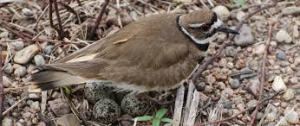 I recently found nest with four eggs in it is right on top of a gravel parking area near one of the ranch houses. The nest has survived a front loader coming and going filling in potholes from recent rains. The operator noticed the momma killdeer protecting the nest. He took care not to run over them and even asked us to watch out for it. A few days later, a worker arrived with heavy machinery to fertilize the yards. The driver saw the nest and momma and actually stopped and built a little rock ring around the eggs so no one would crush it. These workers are guys who I would not have guessed would have taken time or been interested in taking care of these vulnerable little eggs. But they did take care–a great deal of care to protect life in this very hard place. I hope the eggs survive all of upcoming festivities soon to happen around the ranch. I really can’t move the eggs for concern that they might be abandoned. So, I am left to hope life survives in this harsh, hard environment. Sometimes it does and sometimes it does not.
 vitalwholeness