How fun. David Freese, MVP of the the recent World Series, the slugger who hit that long arching ball that changed the direction of it all, made an appearance to his Alma Mater, the University of Missouri, at the Tigers game with Texas, November 12. There he was, a young man fresh to his acclaim, wearing his ball cap backwards and paling around with students. Since I was down on the sidelines on the Mizzou side of the field I shamelessly congratulated him and snuck a hand shake.

No, I didn’t say, “Good job, son.”

Notoriety is new enough to him that shaking all the hands available is thrilling. We’ll see in ten years.

I’ve just completed Stephen Carter’s new book, The Violence of Peace. Of course, the Yale prof is an intellectual of the first rank. But he is also rare. He balances his rock steady scholarship with a kind of reasonableness that is hard to dispute. I like him. I especially like the way he rattles my too easily acquired assumptions.

At the core of this project is a simple question: President Obama has presented a Just War Theory rationale for his policies and actions. So how do his actual choices and decisions stand up against his stated philosophy?

Answer: He does so partially, and in many cases not at all. And that is the case with most of his predecessors in the White House, certainly his most recent one.

Carter’s starting point is to describe the difference between presidential candidate Obama, running as a peace candidate, and President Obama, who has become a war president. There is a difference between the two, one frequently found in many other candidates-become-presidents. The abstract notions of governing before taking office are soon chastened with real world decisions.

In President Obama’s case, the Just War Theory is interpreted as conducting a war in self defense, and that self-defense may take the form of preemptive strikes upon enemies that are preparing to do harm. This is true of his predecessor. Though Obama did not begin armed action in either Iraq or Afghanistan, he has surpassed President Bush in his willingness to conduct preemptive drone attacks and assassinations on the home soil of enemies when not engaged in explicit battle, i.e., in their homes, in funeral processions.

This principle also applies to extreme interrogation, i.e., torture, and off shore rendition of “non-combatants” in the interest of avoiding harm inflicted by the enemy. All of this is explained according to same principle of self-defense in a preemptive mode. Though executing the presidential order banning torture (13491) actual practice has changed only in minor ways.

In Jus ad bellum – one discerns what realities justify commencement of armed action. According to public statements and action of President Obama this means that we may fight preventive wars that are not forced upon us, target individuals for assassination in countries with whom we are not formally at war, capture enemies on the battlefield and imprison them indefinitely beyond the reach of the American judicial system, and turn these captives over to other countries that will use torture.

None of these actions can stand close scrutiny with Just War Theory. Carter does not, however, criticize President Obama for taking the actions of a war president. He criticizes him for not squaring with his own stated philosophy.  When Obama runs in 2012 it will necessarily be as a war president.

Just War tradition asks first when it is appropriate to fight a war(Is it an action of last resort, etc.). It secondly asks how to conduct it (Is proportional force used, etc.). This is Jus in bello, Justice in war. To say it succinctly, the choices of President Obama have not been equivalent, but rather designed to win. Again, Carter does not criticize the President on moral basis, only in his failure to conform to Just War standards. Those are, after all, his own identified standards. There has not been total discrimination between militants and civilians. Killing the enemy is the highest objective.

One of the most incisive observations of Carter’s book is not tied to this sitting President, but rather to all Presidents – about which he knows much. And it is simple. Americans have always, and still do, hold a double standard in their perception of who are the good guys and the bad guys. Americans are viewed, in general, as always on the side of right. Therefore it is always appropriate to conduct whatever war of our choice because it is morally defensible in the end. The correlation to that is it is not right for our enemies to attack us on our own soil. Why? Well, because we are right! We may kill them in such ways – and torture them because, well, we are on the side of justice. But when enemies wish to do that to us they are evil and it is wrong, an outrage. Why? Because we are right.

This is an important book and should not be missed.

Syria or Bust (or may bust)

Posted: November 2, 2011 in Uncategorized
Tags: , ,

The human rights record is awful. Following through on the results of negotiations is not a strong suit. Syria’s opening fire on unarmed civilians is indicative of the brutality. Where can it go?

A thought: The Arab League is trying to broker a peace. If Assad turns away, his time is ended, his legitimacy tarnished. But will he? Who can guess. The boil point on the Arab street has already been reached. What the Arab League offers is a last chance, if there is one left.

Another thought: Let the West stay out and encourage the Arab League to sort through things with brothers and sisters. Theirs is an “honor” society in which conflict is ameliorated with certain rituals, ways that intermediary friends broker outcomes.

It’s like prisoner exchanges in the Middle East. This time-honored tradition includes an exchange of prisoners with an enemy. The number exchanged on each side is not really important. Sometimes one side will exchange fifty for one. It doesn’t seem fair or logical but it is. If you’ve got a lot of theirs, and they have an important one of yours, it’s worth it. That’s why it’s important to capture at least a few high value prisoners from the other side, for future exchanges. The trade is made and everyone wins.

When successful all parties are able to walk away saving face, with a few compromises and concessions. Let the Arab League broker it. They know the cultures of the parties involved. Keep the NATO planes on the ground. Nothing is simply regional anymore, but allow a regional solution to work. Don’t muck it up.

What if the United States, countries in the European union, Russia and Iran all said, “Let’s see if the Arab League’s proposal will be accepted. If it is, we’ll stand behind them.”

I mean, at this point, could it really hurt?

He had a cushy professorship at a leading university. After earning his Ph.D. at the University of Chicago – not unusual for the intellectual stormtroopers of the Catholic Church, the Jesuits – he had extensive experience working with poor communities. And then, as an earthquake, the news came to him in 1989: Six Jesuits, their housekeeper and daughter all executed by the military at the Catholic University in San Salvador. It was assumed that since they spoke on behalf of the poor and voiceless that they were revolutionary sympathizers. The orders came from the top. They were dragged out of their beds and shot execution style, including witnesses.

That slaughter became the decisive turning point of the Salvadoran civil war. And though only two of the many men responsible were charged with crimes, they were released in the amnesty agreement of 1992. What now? Who could possibly step up to bring academic and spiritual leadership in the aftermath of such an outrage?

There are not too many Jesuits who have a Ph.D. and are fluent in Spanish and have worked among the poor. That would be Fr. Dean Brackley, S.J. When his friends heard that he was considering it, they suggested that he was serving admirably right where he was. But God was calling, said Brackley. And so he headed to San Salvador, knees shaking. The military were still stationed around the university, ostensibly for security. It brings back the saying, “With friends like this, who needs enemies?”

For many years, in addition to teaching, Brackley led visitor tours of the site of the assassinations and the museum of the martyrs. He also served a small rural parish some 50 miles from the capital city. Often, at the close of one of the tours at the site of the martyrdom, Fr. Brackley would take guests to the eight bushes that were planted in honor and memory of the slain. The six were Jesuits, of course. Two, however, were the housekeeper and her daughter. They were were killed to eliminate witnesses. And Brackley would always introduce groups to the gardener who cares for the bushes even to this day, the husband and father of the slain mother and daughter.

Fr. Brackley died from pancreatic cancer on October 16 in San Salvador. He was 65.

We are back home from El Salvador now, feet on this soil and not that, but feet on the same planet, no other.

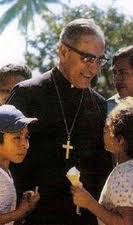
I share words from the late Archbishop Oscar Romero. True words ring with the clarity of their own truth:

It helps, now and then, to step back and take a long view.

The kingdom is not only beyond our efforts, it is even beyond our vision.
We accomplish in our lifetime only a tiny fraction of the magnificent enterprise that is God’s work.
Nothing we do is complete, which is a way of saying that the Kingdom always lies beyond us.
No statement says all that could be said.
No prayer fully expresses our faith.
No confession brings perfection.
No pastoral visit brings wholeness.
No program accomplishes the Church’s mission.
No set of goals and objectives includes everything.
This is what we are about.
We plant the seeds that one day will grow.
We water seeds already planted, knowing that they hold future promise.
We lay foundations that will need further development.
We provide yeast that produces far beyond our capabilities.
We cannot do everything, and there is a sense of liberation in realizing that.
This enables us to do something, and to do it very well.
It may be incomplete, but it is a beginning, a step along the way, an opportunity for the Lord’s grace to enter and do the rest.
We may never see the end results, but that is the difference between the master builder and the worker.
We are workers, not master builders; ministers, not messiahs.
We are prophets of a future not our own.

No commentary necessary

Notes from El Salvador V

Posted: October 28, 2011 in Uncategorized

Today we visited sacred sites, the places inhabited by memory and hope.

Of course, that means we visited the cathedral in San Salvador, the one in which Archbishop Romero presided. It was here that he preached for peace, for justice for the poor, for conversion of all to a way of life that befits Christians. In the dome over the altar there is painted a heavenly scene in which the host of heaven hovers over, to the left, the poor seated on the steps of a pueblo, and to the right, the peaceable kingdom, with all manner of elephants and lions and children. The symbolism is stunning; God is over all, including the most disenfranchised, and there is a peaceable kingdom on the way. This is pure Christian hope.

In the crypt of the church is the tomb of Romero, and the plain covering appears to be earthen, with four posts that resemble campasinos, the peasant people, and the single red bullet that is lodged in the place where his heart would be has broken the surface, creating cracks going in four directions, creating the shape of a cross – the bullet being at the center of the cross. The bishop’s crook lies unused, by his side.

We left the cathedral and went directly to the chapel of the hospital of divine providence, the place where Romero, in 1980, he was celebrating communion at the altar when a gunman fired one shot from outside the chapel through the open doors and struck Romero in the heart. We were silent in the presence of what the world does to prophets.

When Romero’s funeral took place at the Cathedral, the military fired upon the funeral procession, slaughtering scores of priests and people.

At the Catholic University we visited the location where, in 1989, the military laid siege to the residence of the Jesuits and killed six of them, including their housekeeper and her child. Their artifacts – clothing and possessions – were on display as sacred articles of remembrance. The motto that was appearing as graffiti in the streets – “Be a patriot, kill a priest” – had taken on its own macabre life.

It is estimated that over 9,000 peasants were slaughtered during the height of the civil war, over 120,000 people in total. Faithful Christians stood with the voiceless to give them a voice … and paid the price.

War is not new to the world stage. Nor is oppression and tyranny. Prophets have always been persecuted and killed for telling the truth, and still are. And each one of us is forced to answer the one, haunting question that cannot be avoided: “What would I die for? And would I have the courage to do so?”

Yes, we could catch the World Series in El Salvador. After showering off the grime of the day we could tune in and catch the game … with the commentators in Spanish. We got it anyway:)

Two excellent teams well matched, stretching to the max of their skill and strategy.

And yet, one prevails. It could have gone either way, without a doubt. So I offer consolations to Texas: Lo ciento. Que lastima. Really, I mean it from the heart. Ok, I don’t. Marivioso! Va Cardinales!

So there we are, all tied up 3-3. Like the rest of life the tale is yet to be told. But I’m looking for a red pennant with a Cardinal on it at the end. But what do I know? Pero creo que se

Notes from El Salvador IV

Posted: October 27, 2011 in Uncategorized

After working at the school in the morning, hauling all the dirt a person could ever want to haul, we shared a lunch and then a final conversation with Pastor Santos. It was a time to reflect on our Caminando Juntos, walking together, and share what Broadway and the Iglesia Salem, Salem Church, have learned with one another and to give an account of the hope that is within us.

We both shared our profound appreciation for the other, joy that God has brought us together, and hopefulness for our futures. One of the important links between our two congregations has been reaching out to those with disabilities – capacidades especiales. The mayor’s office and the municipality have been drawn into this ministry in significant ways, saying that the Salem Church is the first to reach out to the community in the way that it has. In addition, there is even talk about the formation of a school for those persons, something directly attributed to the efforts of the church – an inspiration to all.

As a part of this shared concern, we also explored how the church could be involved in a garden program for the disabled. Conversation also included a discussion of how the PET vehicle, manufactured in Columbia, could be of use for those without mobility in their legs.

The closing dedication of the school program included the traditional speeches of appreciation, attendance by community leaders, cultural songs and dances, and the family of Gabby – the young woman with disabilities whose family will soon have a new home.

It was such a pleasure to give little gifts as signs of our solidarity with our new brothers and sisters. They included books in Spanish, a Bible for Pastor Santos, a hand crafted communion bread plate made from native Missouri wood by an artist in Central Missouri, and some soccer balls for their favorite sport. The church has a budding team and we may surprise them with common jerseys or uniforms in the future.

Tomorrow we tour the capital city, visiting the historic sites especially familiar to us through the Salvadoran civil war – the chapel where Romero was murdered, the National Cathedral that includes Romero’s grave, and the site of the murder of the six Jesuits. We will visit the top of the beautiful volcano, Bocaron. Of course, we will visit the market place to see the work of the artisanos.

On Saturday we travel toward home, returning late that night. I arise the next morning to rejoin my own church family, as dear to God as those with whom I have most recently shared life. You see, somos todo juntos, we are all together, here, there, everywhere.

Notes from El Salvador III

Posted: October 26, 2011 in Uncategorized

While in El Salvador I’ve been reading Scot McKnight’s book, One.Life. Yes, there is a dot between the two words one and life. In short it’s about turning over your one life to the one kingdom dream of Jesus. That’s hard on several counts. For one we’d rather not. For two it’s not easy. But since we’ve only got one life we’d better figure out how, by grace, hook or crook.

In one chapter on pursuing justice – not a minor theme for the prophets or Jesus – he tells about the prophet Bono and the impact he has had on many, especially as it relates to not settling around issues for justice for the poor.  Bono has always had a problem, not with God, but with Christians, because all the words about love ring so hollow. He thinks there is a lot of pretending going on when it comes to the kingdom dream of Jesus, which we always water down to make it comfortable. A lot of times we bump against the faking, says Bono,and  “we have to overthrow the way of the world.” That’s pure Jesus stuff.

So when it comes to the prophetic vocation of the church (which many want to avoid at all cost because it challenges our ways, values and private little feel-good religion), McKnight takes us on a tour of prophet Jesus, strolling the Galilee. Then he translates the message and method down to what he calls a job description. This job description applies to everyone who dares to take on the prophetic calling, one of the three Ps of ministry (Prophet, Priest and Pastor). I have found this job description to be right on the mark, in American Christianity for sure, but I am certain in all forms and times:

Speak openly and clearly about what God is for.
Speak openly and clearly about what God is against.
God is with you.
Have courage because you will be needing to duck or die.

When you are following this job description and basing the content on the Jesus Dream it gets risky fast. I’m meeting some of these Christians here in El Salvador. They are just going about the business of being Christians and being the church. There’s not much time for the luxury of pettiness. It’s dangerous business being who they are and saying what they are saying. But when you have a wild, undomesticated, passionate God who doesn’t settle, and only one life, it’s not too surprising.