Last Saturday I joined with other interfaith clergy to staff a booth at our local Columbia, Missouri Pridefest. It was a large well-attended event. Our booth had a simple concept: We were offering blessings. The form was a kind of glitter paste we would apply to hands, foreheads or cheeks. Lots of people seized the opportunity.
Of course there were those who declined, maybe one-third of those passing by. Some may have been like me, not wanting to get glittered up. For most of the crowd that was not a problem. I suspect others carried grave suspicions about religion in general, so receiving a “blessing” from a religious stranger represented maximum threat. I’ll pass on this one.
Many others presented themselves with curiosity or even longing. All ages responded. They chose their color and where they wanted it applied. And then a pastor gave a simple blessing, something like, “May your life always be filled with peace and joy; you are loved; you are a child of God.” That was typically followed by big smiles and gestures of appreciation. Some were moved to tears. Without having the luxury of long conversations I can imagine why.
For some who had no religious background to speak of this was intuitive, the interior longing for transcendence that many of us have in native ways. They know there are sacred things out there that are mediated by people, events, and experiences. This was one, and if they risked it, they found something, perhaps the tiniest affirmation. It meant a great deal to some. They closed their eyes and soaked it up.
For a smaller number this was a reaffirmation of something they had misplaced or lost, a memory from childhood. Some said explicitly that they hadn’t had touch with church since they had come out or been rejected by a church. One woman sobbed. Her partner said that she was a preacher’s daughter and had lost it all. And now she was given this little gift of love and faith.
Though I still wonder how to reach to the margins to those who have been forgotten or rejected by society and have my doubts about how well mainstream churches can reach out, there is something here. We have to go to them not the other way around. Love has to be the real currency. And probably those within their own community need to do the reaching. It’s an open question. There are so many unsafe churches out there and the LGBTQ community is rightly cautious. Many churches say “welcome to all” but when people enter they discover the opposite under a thick coat of religious varnish.
My favorite response came from a man who said that he really needed a blessing. He was struggling with depression and couldn’t lift up and out. He said that he grew up a very fundamentalist Christian and simply couldn’t stand the rigid and judgemental way of faith. When we said that love is the answer and that we fully accept those in the LGTBQ community he asked, “So you love Jesus? And you also love us unconditionally?” When we answered yes he said, “Amazing! So you can love Jesus and not be an a%$hole?”
That gave us a laugh. But it also told a truth. He and many others equate the two, Christians with a%$holes. That couldn’t more sobering right now, considering what Christians are doing and how. But that gives us our charge. We have to demonstrate that it ain’t necessarily so. I love Jesus. And I really don’t want to be, well, you know.
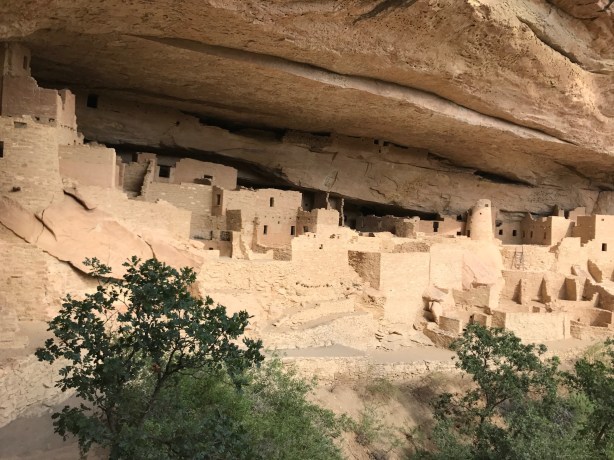 Mesa Verde in southwestern Colorado is a world treasure, one of the mother ships of the great Pueblo network of the Southwestern United States. The ancestors of the present-day Pueblo Indians were hunter-gatherers who migrated from the far north long before the time of Jesus. The earliest settlements were simple encampments as they remained fairly nomadic, following the seasons. In time, by 500 CE, permanent pit homes were located near verdant agricultural lands. Many of these dwellings were located in what became large centers of tribal life in Chaco Canyon and Mesa Verde. They thrived with an intricate and balanced social system of life and eventually transitioned from living on top of the mesas to living below in cliff/cave arrangements with greater shelter and protection. What we see today as the ruins of the cliff dwellers in places like Puye Cliffs in New Mexico is the very latest chapter of their long development.
 Every so often you are privileged to witness shifts in history as they occur. That was true for me as I sat in the General Assembly of the Christian Church (Disciples of Christ) on Sunday evening, July 9.
 vitalwholeness