
When a person attends a documentary film festival with the breadth of True/False it is 1) impossible to catch all the films, and 2) hard to rank them. They are hard to rank because they all deal with different subjects and contain very different backgrounds. But some do stand out. One did for me this year.

Island of Hungry Ghosts is the portrait of Christmas Island – off the coast of Australia – and the interweaving liminalities inside its coastline. The island itself has only recently been inhabited by humans, for only a century or so. Its very location lends itself to liminal status. But what happens there makes it even more so and director Gabrielle Brady will not let us miss it.

The migration of the red crabs is a phenomenon which is embraced and recognized by the whole island. Humans watch and even assist the great passage  of the crabs from land to sea and the laying of eggs. As the crabs continue their cyclical trek other things are happening. They bring a luster of timelessness to unfolding and cyclical creation. They have been here before us and will most likely be here after us.

The Chinese continue to assist the ghosts of their ancestors who never received a proper burial. The spirits are lost, caught in-between, souls that never received a proper send off. Many of the past immigrants came alone, leaving family behind, and became more or less indentured slaves, an involuntary permanent liminality from which they could not pass. Today their descendants strive to assist them on their way with prayers, rituals and chants.

Therapist Poh Lin Lee moved to the island to assist in providing counsel to the traumatized. Her clients are international immigrants to Australia who have been separated from their families and moved from one “dark” detention to center to another, Christmas island being one of them. She struggles to provide help as she watches the trauma inflicted by a cruel detention tear her clients down faster than she can help them heal. And eventually she comes to the conclusion that she can no longer be complicit in a system that does this to people and uses social workers and therapists to create the illusion that they are humane when they are not.

Crabs, unsettled spirits, and detainees. In transit. Stuck. Longing to be set free. Waiting to depart and arrive, to be connected – to the sea, to the place of the ancestors, to family and home wherever home can be. And we move with them in one way or another, if not through our own parallel experiences, then in the recesses of the heart, the place where we are most honest and lucid, the most conscious part of us where we know, deep down, that nothing is forever, everything changes, and the island hosts the fleeting and the forever at the same time.

The Whale Caller

Posted: February 22, 2019 in Uncategorized
Tags: ,

Whale Caller CoverI was recently reading an anthology of liminality in literature from South Africa (Beyond the Threshold: Explorations of Liminality in Literature) and one of the authors lifted up the novella by Zakes Mda entitled The Whale Caller. Mda now splits his time between Johannesburg, South Africa, and Athens, Ohio where he is a professor of creative writing at Ohio University.
The Whale Caller positions its characters and plot at the edge of every conceivable boundary. The main character, who only goes by The Whale Caller, is in love with a great Southern whale, Sharisha, and he dances and plays his kelp horn for her at the tip of the peninsula. In addition, The Whale Caller has a woman friend who is the town drunk, Saluni, and they maintain an on-again, off-again relationship of misfits on the edge of passion and madness. One of their problems is the great jealousy of Saluni toward the whale of her mate’s affection.

The story takes place at the boundary of the land and the sea, a space between human and sea creatures. It also takes place at a cultural threshold as The Whale Caller and Saluni are both positioned in the margins of their society. And the wisdom of the Whale Caller often surpasses the consumerism of so-called successful society, challenging our assumptions about what is and is not the good life.

Elegant in its simplicity, The Whale Caller creates clarity through the very edges it inhabits. And for those who are curious about whales, music and their orgasms, this book is for you. Except perhaps for the ending. Which I shan’t spoil.

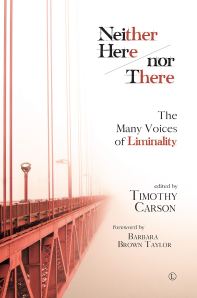
Neither Here nor There - Cover ImageI am pleased to announce that the new anthology of liminality, Neither Here nor There: The Many Voices of Liminality, is now available for pre-order! This anthology of sixteen international authors has been in process for three years and has finally come into fruition. As the editor I chose all the contributors, edited their work,  and penned the Introduction, First Chapter and Conclusion. Barbara Brown Taylor has written a stunning Foreword.

Liminality is the in-between state of being, the transitional domain, between the known of ordinary life and the unknown of the future. That ambiguous state includes great disruption as well as the potential of deep transformation.

From Barbara Brown Taylor’s Foreword:

“You are holding a wondrous book in your hands, full of startling stories about people who accept the risks of engaging liminal space … I can ignore these liminal gifts as easily as anyone but, like the other authors in this book, I am convinced that they deserve my best attention, both for myself and for the life of the world. In all the ways that matter, they are the truest parts.”

And Brian McLaren’s endorsement:

“Timothy Carson has brought together an amazing array of diverse writers of uncommon skill to transport readers to a place they may never have been before, a space between familiar spaces and beyond the dualist mind.”

Please share the good news with all those who may not only find this book personally intriguing but also a helpful tool for study groups and classes.

I am pleased to announce that the new The Liminality Project web site has gone LIVE! We are in our infancy but already moving toward posting regular blogs, articles, and videos, interviews. Go find a go-to liminality bibliography and primer. And feel free to share with your friends.

Thank you!

TheLiminalityProject.org

The Bird Feeder

Posted: February 12, 2019 in Uncategorized

Just outside our rear windows sits the bird bath which during this time of year serves a much more important purpose, that of the bird feeder. With all the ice and cold it appears we are the only cafe open. We have been serving up a rich mix of seed that appeals to a broad range of beaks. And, as it turns out, a menu that is suitable to the deer and squirrels, too, who make a point of finishing it all off before daybreak every single night.

Today there are two colors around the feeder, blue and red. The Blue jays are the bully tribe, and they couldn’t care less who eats and who does not. No one taught them how to share. Which is why ten of them can surround the feeder at the same time, gorging themselves, and a blanket of Red Cardinals cover the ground below, waiting for crumbs from the table. They are polite birds, Cardinals are, and you can see what that’s got them. Only the squirrel is more patient and evidently pretty much ignored. He sits at the base of the feeder like a furry lump of clay, chomping whatever he scrapes up in his delicate hands.

Just when I think the Jays will never get their fill, abandon their turf, and allow the Cardinals to belly up, another unexpected guest arrives. He is dining alone. His arrival is unceremonious. He dives, lands and stares down the blue gang with his impressive red head. And they scatter like a bunch of sissies. The Woodpecker takes his stand, king of the mountain, the only one on top. He eats at his leisure. Whenever a flash of blue draws near he simply takes one step in their direction and they are gone as fast as they came. This is his. Now the carpet below is a mixture of red and blue. And the one squirrel.

Everything is relative, of course, and when one group seems like they are dominant and will never, ever go away, sometimes all it takes is a new kid in town to clear the decks. That is amazing when you consider that the showdown is less about how many and more about who it is that shows up. This is where I could sing sweetly about the power of one. However true that may be, I will restrain myself. The pack, the herd, the tribe usually does prevail. Except for a few remarkable exceptions. Woodpeckers do come. At least for a while.

And I suppose that’s the rest of the story. The impressive Red Headed Woodpecker eventually ate his fill and flew away. When he did the Blue Jays returned to their former glory, the Cardinals once again policing the ground below. The systems get disrupted for a little while, but not much more than that. The call of survival is that strong. Which is why I doubt this little episode with the Woodpecker has led the Jays into some new moral conversion. Jays are going to be Jays. And if you want them to scram you need a handy Woodpecker.

In good time the squirrel ran up on deck and scuttled the Jays. And some Cardinals joined him. Coalitions are sometimes the only way to get something done. One tribe of birds and a mammal against another tribe of birds. The Jays seemed to get a little bored with it anyway because they’d probably had enough anyway.

Birds feed their young but not other kinds of birds. Mammals take care of their own, but usually not other types of mammals, though sometimes they do. The human variety of mammal can be just as territorial as a Jay, calculating as a coalition, and patient as Cardinals to survive. They cultivated an ability to depend on one another through division of labor and protection and food gathering early on. And then somewhere in the mists of their story some of them found some higher gene of compassion. They ended up saying strange, non-tribal things like, “Love your neighbor as yourself” and even “Love your enemy.” Which of course runs counter to most anything you might see at my bird feeder.

Just because a creature is human that doesn’t mean it is much more down the compassion path than Jays, Cardinals, Woodpeckers or Squirrels. The human creature can be just as base. And even more deliberately cruel, really. But ever so often you find some of those two legged creatures who transcend bird feeder society and become something more, something else. And that’s pretty much miraculous, all things considered. I mean, when you think about it, somebody actually went to a store, bought bird seed, and put it out for some other species not his own.

For now this causes me to consider how my tribe is relating to every other tribe, human and non-human, what to do with sharing resources, how to balance competition with cooperation, and, in the highest places, how to make choices that seem to transcend any rational reason for doing them in the first place. There are things that make the two legged creatures what they were meant to be, at least when they are at their best. And even though there is no natural reason to do so, there are other reasons, the ones that make life rich, beautiful and even worth the effort.


The Shrinking World

Posted: February 10, 2019 in Uncategorized

Let’s be clear, lot’s of things cause the world to shrink: new discoveries that make us smaller than we thought we were, a change in status where we are less connected than before, the ability to ring up anyone anywhere in the world and chat in real time like I did this week. Pretty small, really.

This came to me this week in dramatic form: When you get sick, like I was, your world shrinks quickly.

I know this professionally from being at the bedside of so many sick folks through my life. Suddenly outside concerns, world events, the things that used to get people all riled up melt away like butter left on the stove top. They just aren’t important anymore.

Now plenty of things are still important, but they are generally the things near at hand: Can I breathe? Am I able to walk, take care of myself, live without pain? Does my food have taste any more? Is my closest circle of friends still present (not the folks on the periphery)?

If your condition is chronic and goes on forever then it wears your pencil down to a nub. It’s hard for the world not to shrink to the outlines of your own body. That’s what you worry about 95% of the time. It’s a spiritual challenge to overcome that and move toward the bigness that has nothing to do with the material world around you as much as the galaxies of space within your own mind. Of course, that includes drawing near to death, the great passage. Lots of traveling to do.

Though my recent illness was highly annoying I knew that it would be temporary. A week is a week and I can get through another day knowing relief is on the way sometime soon. My world can be as small as it needs to be for a while. But what about those for whom the future portends more of the same, no end to … this? My heart goes out to them today.

If, as some of the spiritual masters have said, illness reminds us of our mortality and every time we get sick that flashes through some passage way our subconscious selves, then I’m reminded. Now to living on the other side of that, living with the reminder that we’re not forever but that each day is precious, because it really is.

Nadia Bolz-Weber has written what I think is one of the most eloquent descriptions of the variegated nature of sex I’ve ever read:

“Sex can be procreative, a way of creating new life. It can be intimate, a way for love to be expressed between partners. It can be revelatory, a way in which we discover ourselves and another. It can be boring, mind-blowing, or regrettable. It can be a beautiful aspect of human flourishing, and it can be a humiliating aspect of human degradation. It can be the safest place we can go or the most dangerous thing we can do. It can be obligation or joy. It can be deadly. It can be life.” (The Christian Century, Feb 2019)

Some things last

Posted: January 27, 2019 in Uncategorized

Just received a “thank you” from a church in Texas where I was instrumental in bringing a shelter program for the homeless into the church building itself – this is its 10th anniversary. Some good things last.

I remember how many good people got behind that effort to make it a success. And at the same time a very small group resisted with cries that the sky would fall if we did. A small group can be very noisy. We can never allow strident voices to detour us from doing the right thing.

Take heart. Be courageous. The right will prevail – if not today, then tomorrow.

In the Arena

Posted: January 25, 2019 in Uncategorized

Just watched the remarkable series The Roosevelts. If there is a quote from Teddy that says what needs to be said on most days:

“It is not the critic who counts; not the man who points out how the strong man stumbles, or where the doer of deeds could have done them better. The credit belongs to the man who is actually in the arena, whose face is marred by dust and sweat and blood; who strives valiantly; who errs, who comes short again and again, because there is no effort without error and shortcoming; but who does actually strive to do the deeds; who knows great enthusiasms, the great devotions; who spends himself in a worthy cause; who at the best knows in the end the triumph of high achievement, and who at the worst, if he fails, at least fails while daring greatly, so that his place shall never be with those cold and timid souls who neither know victory nor defeat.”


This is the letter I sent to the Principal of Covington Catholic High School, Park Hills, Kentucky, after their students mocked an Elder from an American Indian Tribe in Washington, D.C. Since that time both the school and the Covington Roman Catholic Diocese has issued an apology: “We extend our deepest apologies to Mr Phillips,” the statement read. “This behavior is opposed to the Church’s teachings on the dignity and respect of the human person.”

Dear Principal Rowe,
Catholics (and all Christians) from across the country and life of the church were shocked by recent actions on the part of your students involving the free exercise of speech by a Native American tribal elder. The combined behavior of disrespecting an elder, discounting the religion and values of another culture, and wearing uniform MAGA swag – hats and shirts – and chanting “build that wall” is a disgrace to all of us.
Surely you of all people know that none of this is consistent with Catholic moral teaching and practice. The values of a MAGA rally are not equivalent to Catholic values. None of this is taught in the catechism. It is not the way of Jesus or the great examples of the faith. And Pope Francis would be heart broken by this.
Where did we go wrong? Where is the moral instruction of the parents? Where is the teaching of the Priests and the Religious? Where were the teachers and school officials? Did they witness this? Did they endorse or enable this? Who provided the students with matching MAGA hats and shirts?
In a time in which the credibility of the Church has been stretched to the breaking point this incident has smeared the public witness of the Church and Catholic education one more time.
The rest of the nation and Church is waiting to see what you will do.
Respectfully,
Tim Carson