Tonight, the small Christian community in which I participate observed a hybrid service, a blending of Maundy Thursday and Good Friday. We sang Passion hymns, received the offering of special music, read responsive prayers, shared the Lord’s Supper, and heard the Passion story from Luke’s Gospel. A multi-sensory service, we tied red and black ribbons on a cross covered with chicken wire. And of course, our Pastor shared a brief meditation.

She made a provocative choice, one I appreciate not only for the courage it took to make it at all but the connections it made for the gathered body. She summarized portions of James Cone’s now classic book, The Cross and the Lynching Tree. Cone paralleled the Roman state-sponsored terror of mass crucifixions with the state-tolerated plague of lynchings in white supremacist America. Both used violence and threats of violence to control the masses.

Every soul in the church came face to face with the ways that the cross of suffering continues to show up everywhere, and what’s more, the image of lynching turns around and back toward our Lord: Jesus had a public lynching.

The cross does continue to show up and God’s people are hauled up upon it today. Elie Wiesel’s haunting recounting of the hanging of a young man in a concentration camp, legs kicking, struggling for life, includes muted questions from those forced to watch:

“Where is God now? Where is God now?”

From the same crowd comes an answer: “There – there on that gallows.”

God is always on the gallows just as Jesus was. God hangs by a noose, swinging from a lynching tree. Because wherever suffering is present, there is God. Wherever the weak and vulnerable are exploited and abused, there is God. Wherever the state uses violence as a form of control, there is God. Wherever humanity is so broken that only pure, unconditional, self-giving love can possibly set us free from ourselves, there is God.

At the end of the service we followed the cross in silent procession outside to the front lawn of the church and posted it in the ground. Immediately across the street from the church are bars, restaurants and hotels, and they were full of Friday night revelers. We forget that Christians in our present American culture comprise an extreme minority. On Good Friday that percentage is even smaller. The people across the street paused to look up at the strange assemblage. They wordlessly considered the ribbon decked cross and people standing around it. What could this public witness possibly mean, this spectacle?

Soon enough they returned to their fun, and like the people walking near Jesus’ cross in his time, became distracted with more pressing and interesting matters.


Open, Empty Hands

Posted: April 18, 2019 in Uncategorized
Tags:

In Nate Klug’s article in the April edition of Image journal, “Open, Empty Hands,” he tells James Merrill’s story in his volume Water Street, a story that ends with a poem. The story is about settling down in a new house in a small Connecticut village and the poem, “A Tenancy,” describes the arrival of a welcome committee of friends to bless the new arrival.

In a a distinct, unusual ritual, three visitors file past the new tenant, and we read

One has brought violets in a pot;
The second, wine; the best,
His open, empty hand.

Perhaps it is unavoidable to conjure Magi bringing gifts to the stall. Or wine to the ceremonial dedication of a new house, every house, every room, even the upper room, the last meal. Wherever the gifts are delivered and by whom, the same story informs every story, that setting the table unfolds with the beauty of hospitality, rituals of turning, and even more, and even an open hand, for God’s sake.

The first two I grasp quickly, almost instinctively: flowers and wine. Incensing the room, touching with beauty, pouring out life and toasting it at the same time.

But then there is the hand, open as it is. Passing through the threshold, resting on the table, gesturing, patting, beckoning.

Who noticed the hand, open, when so much else was going on? And even later, when wounded rather than wounding. And open and limp, finally.

Then, unexpectedly raised. In blessing.

A doorway. Surprising guests. Gifts. Table.

An open hand. Open. Open still.

I was pleased to recently attend another presentation of the now classic stage play Our Town written by Thornton Wilder. As you know, the sparseness of this play makes it rich. And the running commentary by the Stage Manager actually interprets the normality of life in its bigger view. There are portions of the three act play that always bring me to tears, mostly in the closing act that pulls no punches in bringing the stark reality of mortality and eternity to the fore.

The Stage Manager warns us early on that however intrigued we might be with day-to-day life in Grover’s Corners and refrains of love and marriage, more somber themes are on the way. He wasn’t kidding. Up to the cemetery we go where the dead are “weaned away from the world” step by step.

The living can’t grasp the meaning of life until it’s gone and they sure can’t grasp eternity, not fully, though, as the Stage Manger says, “everybody in their bones knows that something is eternal.”

But it is Emily, dead too early, who captures the longing for life unobserved and missed when she looks back one last time. Her monologue is the nut of the play, and one sentence stands out more than any other:

“Good-by, Good-by, world. Good-by, Grover’s Corners. Mama and Papa. Good-bye to clocks ticking. and Mama’s sunflowers. And food and coffee. And new-ironed dresses and hot baths and sleeping and waking up. Oh, earth, you’re too wonderful for anybody to realize you. Do any human beings ever realize life while they live it? – every, every minute?

And we lean in and listen to the answer of the Stage Manager, our resident philosopher: “No. The saints and poets, maybe—they do some.”

After Emily returns and takes her place in the company of those who have crossed over, darkness falls over Grover’s Corners and the Stage Manager helps us, one more time, to see how the ordinary turns under the aspect of eternity. After noting the time, the way we finite creatures understand time, he speaks to us and says,  “Hm…Eleven o’clock in Grover’s Corners…You get a good rest, too. Good night.”

Do we get a good night’s rest? The saints and poets, maybe.

Is this an Easter story? Part of it? Or larger than it?

Think about that as you watch the close of Act 3 in the Lincoln Center production with actress Penelope Ann Miller.


Night Train

Posted: April 11, 2019 in Uncategorized
Tags: ,

The rumble always precedes the whistle. That low gravely sound is the one that first rouses me from sleep. It comes from across the river, somewhere behind the tree line. The engine sound is accompanied by the mechanical grinding of steel upon steel, wheel upon track, and a deep vibration that reverberates through the earth.

The whistle always comes next, alerting every creature to clear the tracks, that something big is drawing near. Perhaps it whistles for a deer. Or an owl. And on most nights for nobody. It may be blown for no other reason than the engineer is bored or wanting to break up the monotony.

Years ago, before I was born, the train ran on our side of the river. But now it moves through the night in the distance, something I can only hear. I realize now that I provide my own visuals for this unseen thing. Long ago in another town my family lived not too far from the tracks. As children we watched the locomotives and boxcars move slowly through town. Friends always asked how we could stand the noise. “What noise?” we asked with perfect honesty. We hardly noticed anymore.

My family also told stories about my grandfather, one of those boys who ran away from home and straight to the trains. There was the hobo who saved his life when he was riding in a dangerous place and ordered him to get out at the last moment. And gramps actually served as a telegrapher who was located back in the caboose.  They ate bar food in the towns where they stopped to fill their water tank. What a life, I thought to my young self. Imagine, living and working on a train.  And of course there were the movies and great scenes of  trains, high drama, crime and epic gun battles. Trains.

When it comes to providing the video for this reoccurring, middle of the night movie, I have no lack of raw material that can be retrieved from the archives. What I cannot see with my own eyes in my dimly-lit bedroom, I borrow from the boxcar of the past. The night train keeps doing its part, providing the audio track, every sound that is necessary, and I waltz with the steamy ghost for mile after dreamy mile, rocking to a lullaby that still wheezes through the night spaces.

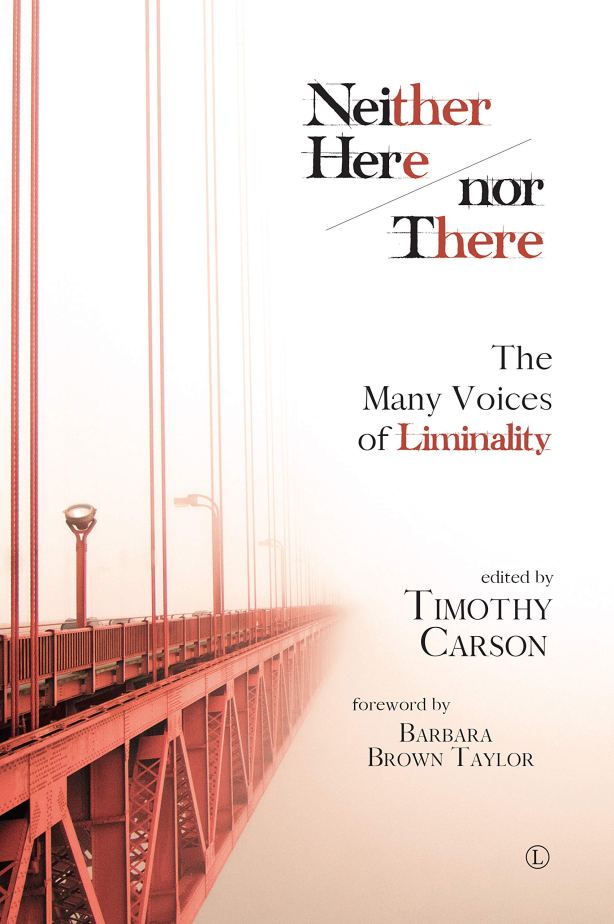
Neither Here nor There - Cover ImageYes, you can enter the Amazon contest to win a FREE copy of Neither Here nor There: The Many Voices of Liminality. By entering you put yourself in line to be the 1200th contestant and win the free copy! No strings, no special offer, no nothing. Just a free book for the winner.

Click this link and enter and then wait to see!

Launch Party on St Paddy’s

Posted: March 18, 2019 in Uncategorized

A huge crowd descended on the General Store in Rocheport, Missouri on St Paddy’s Day for the book launch of Neither Here nor There: The Many Voices of Liminality (now on Amazon). Irish music, libations, food and fun shaped the gathering – as did the presentation of the book, which has now entered the world!


The slaughter of worshipers in their houses of worship is nothing unique to New Zealand. The United States sets the pace on that peculiar atrocity. In the Middle East it is a favorite tactic among Muslims to inflict pain by bombing or shooting up their rival’s mosque. For sociopaths, there must be some perverse sport in shooting down people as they pray. Especially if you have branded their religion as false, a menace, or a blight on the planet.

This morning our pastor provided a brilliant analogy. When the shooter in Christchurch, New Zealand, crashed into the Mosque and slaughtered its worshipers it was like a hurricane hitting shore. Its peculiar evil hit with particular and immediate effect. But it didn’t start that way. No, long before the hurricane breached land it had been forming out over the ocean as a storm system. The system is what made the hurricane what it was.

The system that formed over the chaos of the deep was a deadly combination of just the right elements – heat, moisture, wind, ocean currents, colliding fronts. And for New Zealand as well as for anywhere else, the system that first formed over the ocean included white supremacy, fear, hatred of the other, an ideology that includes the idea that others have less value, and powerful influences that travel like viruses. That storm system brewed and developed long before striking land.  But when it did it came with terrible force.

What we face today are the powers and principalities of this world, forces that consolidate and show themselves with a very particular hatred and violence. When they do, we must be willing to bind up the wounds of all those afflicted. But beyond repairing the damage we all must speak to, address, and drain the storm systems of their accumulating power.  That is the prophetic task. Which means that there is much, much more to do than simply gazing passively toward the horizon and saying, “I think we’re in for another big one.”

You’re Next

Posted: March 17, 2019 in Uncategorized

I once had a work colleague who took extreme relish in disparaging my predecessor. He showed no little contempt in the way he regarded him. At the time I was tempted to think, “Well, that was that guy, but I’m different. He’ll like and respect me.” No, such was not the case. I got the same treatment as he undermined everything I was doing.

What is the case is that the people who discount and defame the ones who preceded you will do the same thing to you. And then to the person who comes after you. It’s a pattern. They are the problem.

I remember during graduate school serving as an intern in a large church not too far from the seminary. A small little man – let’s call him Bob – told stories of how his father destroyed the minister during his time. Bob laughed as he told it. And then Bob went about trying to do the same to my supervisor, a well-respected and long-serving person who Bob would not be qualified to untie the thong of his sandals. It’s even generational.

So think twice: When you hear language and watch behavior that tears down the people who came before you, know that there is probably more at work than meets the eye. Don’t get paranoid, but don’t be vain or proud, imagining that such things cannot happen to you. What you can do is never, never hop on the criticism bandwagon to tear down the one who preceded you. Don’t do it.

Because you’re next.

Einstein's FieldThough Albert Einstein was certainly not religious in any traditional or doctrinaire way, not subscribing to notions of God from classical theism, he nevertheless had a vivid appreciation for the great mystery at the heart of all things. Whether one believes in “God” has to do with the kind of God being described. If God is described in one way I may have no choice but to be an atheist. But if described in another way I may have already believed for the longest time.

One evening in Berlin as Einstein and his wife attended a dinner party one of the guests stated that a belief in God was impossible. To that Einstein replied

“Try and penetrate with our limited means the secrets of nature and you will find that, behind all the discernible laws and connections, there remains something subtle, intangible and inexplicable. Veneration for this force beyond anything that we can comprehend is my religion. To that extent I am, in fact, religious.”

(Charles Kessler, ed., The Diaries of Count Harry Kessler, NY: Grove Press, 2002, p. 322)

ash-wednesday-6For forty years in a row I have observed the Christian day of Ash Wednesday. I created a black paste made from the burned palms from the previous Holy Week and olive oil and smeared it on hundreds of foreheads and hands in the sign of the cross. I received and wore them myself. We recited words from the Psalms that encouraged repentance and assured forgiveness. The bells of mortality were sounded as well as the chimes of brokenness, sin and separation. Ash Wednesday is unvarnished truth-telling. Even practicing Christians avoid it like the plague. If you want to build a crowd don’t expect to do it on Ash Wednesday, the first day of the season of Lent. Unless you are a Catholic and Ash Wednesday is one of your “days of obligation” expect a few, not many.

I have personally treasured Ash Wednesday and promoted it wherever I happened to be serving. But this year – not needing to promote anything or participate in anything I don’t choose – I’m passing. I’m opting out not because I don’t think it is a helpful Christian observance any more, not because I am giving up it up for Lent. In fact, I may very well resume the practice next year. But today I am staying home for other reasons.

First, it’s good to not do something that is presented as necessary for living the Christian life. This is not just rebellion, shaking a clenched fist at the system. No, it is a reminder: The validity of your life, your faith, your destiny does not ride on rituals. So don’t do them ever so often just to make sure you haven’t formed some false reliance. Even though I don’t receive the ashes today God and I will move along swimmingly. I will meditate on my mortality, repent and make amends and turn around in the direction I should be going at other times, just not this day. Ash Wednesday was created for humanity, not humanity for Ash Wednesday.

Second, not participating in the Christian high holy days once in a while also reminds us that their scheduling is arbitrary. In the main I actually think there is something valuable to dramatizing the Christian tradition in a narrative, a sequence, seasons layered one upon another to tell a grand story. At the same time we have to remember that the church year has also been chopped up into seasons primarily to set Christian observances over the pagan ones that preceded them. So Christmas upstages the winter solstice and Easter the spring equinox. And that’s just a sample of holy days designed to cover up pagan ones. The list is long. The whole church year is a contrivance. Not a bad one, but a contrivance none the less. Sometimes it is important to welcome the coming of spring and nature’s rebirth after winter without overlaying it with a season like Lent that is all about introspection and marching to Jerusalem and the cross. You can march to Jerusalem some other time.

If it were up to me I would redesign the whole thing. But twenty centuries of tradition always wins that debate – even if the church is in a long, spiraling decline. By all means, let’s keep doing the traditions and practicing the rituals in the same ways even if they no longer work!

If I had the chief’s conch shell and had the authority to sound a new beginning it might look something like this:

We don’t have public worship every Sunday. Instead, people attend weekly home meals, speak of their lives, talk about God. Make it multi-generational. Always share the Lord’s table whenever we gather. In fact, the actual meal is the Lord’s Table and everyone is invited to participate. We all engage in service that heals the world around us. Some of that we do on our own and some of that we do together.

We baptize one another when the time is right – not just at certain times of the year – but whenever people feel the call, no matter what age they are. Mentors and loving friends lead people in practicing the Christian life.

We plan four “festival” celebrations a year, conveniently oriented to the seasons, if indeed the place in which you live has seasons. Abandon the common lectionary and choose our own texts and themes that match. Employ every resource and artistic medium available:

  • In the Winter keep the “Festival of Incarnation” where it is, Christmas, a season of light in the darkness. Incarnation works well here. If you want to lead up to it with a season of anticipation like Advent, go ahead. But do that in home groups with the lighting of the Advent candles at each gathering. In fact, make that the substance of your home gatherings.
  • In the Spring have a “Festival of Creation.” Talk about the unfolding Christian life. Tell all the parables of Jesus. Talk about spiritual formation. The relationship to the natural world. Assume spiritual disciplines. Make a growth plan. Talk about original grace, the goodness of creation. The mind/body/spirit unity and connection to every created being.
  • In the Summer have a “Festival of Resurrection.” Host a Holy Week retreat/pilgrimage and tell the story of Jesus’ prophetic actions, his critique of the religious and political system of his day, his suffering, trial, farewell and martyr’s sacrifice of love. Walk the people of God through the tomb on the way to a life in which God’s love always triumphs. Build a campfire, smear the soot on foreheads and remind ourselves that everything dies. And everything lives.
  • In the Fall have a “Festival of Harvest” in which we focus on the fruit of the Christian life – mission, service, compassion, social action, prophetic presence. An in-gathering of the spirit. Gather the generations of the church together and celebrate maturation and realization. Let it be a homecoming. Give thanks.

That’s it. Keep it simple. Host four common festival gatherings a year, everyone together. Live most of shared Christian life on a week-to-week basis around tables in homes. Celebrate the mission that is happening in the world individually and collectively. Discard all the secondary things. Design a community of faith for the 21st century not the 19th century. Embrace the freedom. Breathe the oxygen.

So, no ashes for me this year. I will pray for those for whom this will be deeply moving. But I will be meditating on melting snow and the way hardened hearts melt as well. I will contemplate the invisible new birth that is slumbering just under that white, taunt surface, poised and waiting to launch hope into a world sorely in need of it.