Archive for the ‘Uncategorized’ Category

(The following article ran as an editorial in the July 5th edition of Columbia Faith and Values)

To share life with neighbors in a pluralistic cultural and religious neighborhood requires respect, a continual quest for understanding and acceptance of not only similarities but divergences. We form unity by identifying the common golden thread that weaves through all of our narratives, symbols and communities.  And we honor one another not by erasing distinctiveness but rather by … click here to read full article …

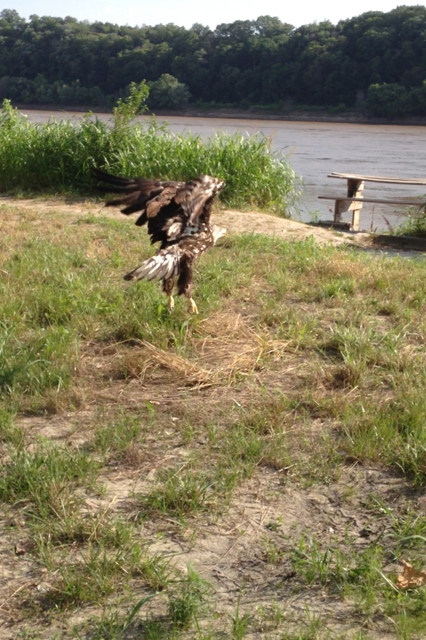
Fly, Birdie, Fly!

Posted: July 3, 2013 in Uncategorized
Tags:

Justice“Justice” – a young male bald eagle – was released back into the wild on July 1 after a four-month convalescence. As volunteers of the Raptor Rehabilitation Project of the University of Missouri looked on, Justice took wing from his re-entry point, the Eagle Bluffs conservation area just outside of Columbia on the Missouri river. Fly, Birdie, Fly!

The Raptor Rehab Center provides sanctuary to injured birds of prey protected under federal law such as owls, hawks, vultures, eagles, and falcons.

The result of not renewing the student loan interest rate levels is in effect doubling them – for those who began at one level and now have another. With a great increase in those choosing to pursue a college education 2007-2012 (coinciding with the economic downturn) the generation most affected will be our rising bubble, the largest in decades, the Millennials. This is precisely the demographic of young people we most want to empower to pursue education and bring the fruit of it to our republic. Instead of providing encouragement and practical support, we are penalizing them.

The move is not only stupid but duplicitous; we engage in a classic game of bait and switch. We entice you with one interest rate and offer you an increased one once you have acquired the debt. We also make it harder for the up and coming generation to finance an education, the price tag of which is dramatically rising year by year.

Our government is already yielding a handsome sum from the interest gained from student loans. It is not a crisis for the government but we are making it one for our most precious resource – the youth and young adults of our country. This reveals a conspicuous lack of vision. We will pay for it in the end, our meager savings reflected in less capacity among those who should be emerging as the greatest resource this country has ever realized.

Our congress flunked the required course, Virtue and Intelligence 101. They should be required to take it over and at least get a C. And if they won’t we should find others who do evidence moral fiber and vision superior to their own.

As I was re-reading Bruce Lipton’s The Biology of Belief I zeroed in on his chapter on Growth and Protection. The simple, condensed summary of this portion of his book is this: We are designed for both growth and protection but they don’t usually don’t coexist well at the same time. In fact, they often compete with one another for center stage.

We have several blessed mechanisms developed over millions of years to protect ourselves and our species. One is the fight or flight response which mobilizes the whole body to protect or flee from threats. When this response is activated against threat – like a tiger prowling around your tent – adrenals pop into high gear, blood flows to the limbs and all other functions are put on hold: immune system, digestion, reproduction, higher cognitive functioning. The frontal cortex of the brain involved in higher reasoning actually takes a snooze as the rear portions of the brain – earlier in evolutionary development and responsive for reflexive response – jump into high gear.

Imagine this: Your community is going about its happy, fruitful existence – working, attending class, exercising, eating supper, having sex, praying, doing something compassionate, when the tornado siren sounds. Suddenly all these common, growthful, flourishing activities cease. None of them will matter if you get whisked away to Oz. So the survival instinct makes a decision and all the blood rushes to the storm shelter, the mechanism of survival.

Any of us can do that for a short time. We can suspend everything else for a while. But if this becomes protracted and continues without ceasing, then the survival instinct, the impulse to protect, shuts down growth and flourishing. They can’t co-exist forever without undermining the other. If we stay in the storm shelter of protection for too long we will neglect other healthy functions like nutrition, learning, emotional flourishing, reproduction, compassion, and spirituality. The drive to survive will undermine the drive to grow.

That’s what happens in our bodies if we are dominated by fear. The good stress that mobilizes protection becomes bad stress that undermines health: our immune system, the function of our visceral organs, relational health. If we are placed in a position of constant defending our overall health is compromised.

Likewise, if a society is in a constant siege mentality, always defending against real or imagined enemies, in a perpetual war against something, bracing against the next attack, remaining hypervigilant – it drains off all the blood from the organs that make for higher functioning, creativity and flourishing. Those who want to control the populace (and make sure they remain unthinking) keep them in a state of fear, mobilizing for the next attack, arming against all slings and arrows of outrageous fortune. The answer to every situation becomes more defense against more threat. If that message is believed – and it is because people are afraid – they will sacrifice all other functions that contribute to growth in order to make sure that protections are in place; realities like education, health care, personal freedoms, creativity, diversity, and spiritual wisdom are all sacrificed at the altar of fight or flight.

We who serve in the church business know that to be doubly true. Churches preoccupied with survival can’t grow; all their energies are drained off to the storm shelter. People who want to stop churches from growing (especially in ways they don’t want them to) instigate siege and attack so energy is drained away from growth to protecting.

A storm shelter is a very important thing – a blessing for protection. But we are not meant to stay there forever. In fact, there is a direct correlation between the amount of energy we put toward protecting ourselves and the diminishing of all other higher functions. In our personal lives it will make us sick, powerless and without moral compass. In our social life the moral nerve and social contract will become diminished, greedy, self-centered and tattered. And if Maslow was right, and I think he was, an obsession with constant protection of self or tribe will inevitably keep us from attaining to the higher states of personhood and spiritual life.

The Columbia Faith and Values Network provided very nice coverage for our Friendship Dinner for the Muslim Community on Sunday, June 23. Go read the whole story here.

When you open a dinner to all comers, cast a broad net over an identified audience, that means you must expect a broad spectrum of response. That was most certainly the case at a recent “you all come” dinner for the Muslim community in Columbia.

One of our honored guests was an exceedingly aged man from Russia, one who made a point of showing – with proof of documentation – that he was a chess champion, held a PhD in philosophy from a prestigious university in Moscow and was a professor. After explaining all this that audience expressed their appreciation with generous applause.

Our brother, however, had suffered a stroke and I suspect had some form of dementia as well. So at periodic intervals during the evening, sometimes right in the midst of discussion of questions by speaker or audience, he would rise, totter to the front and provide another rendition of what he had already shared. People were polite. And maybe a bit amused.

By about the fifth interruption he struggled to explain that the stroke had taken his words, especially his English ones. But he told a story from his father. He told us how his father, a pious Muslim, always insisted that their family read both the Koran and the Bible. Why? Because, he said, there is one God, one earth and one human family.

This capsule of truth was worth the wait, the interruptions and our occasional embarrassment for him. Some of the very best things in the world are not tidy, organized and planned. They often come as a mixed package, mixed blessings, as we say. The good comes with the bad and vice versa. And, like 49ers panning for gold, we sift through buckets of sand to obtain but an ounce of gold dust. It sometimes wears us out. But it’s worth it in the end.

The Phillips 66 gas station was on the right side of the road and as I glanced through my windshield I noted a contrast, a moving figure, dressed in white, just beneath the large red and white sign. The man was scrubbing the rear window of his car with the long handled scrubber, which is, in itself, unremarkable. I do that, have done that. Many do. What seemed jarring was his apparel; he was dressed in a long ankle length monk’s habit.

I’ve seen plenty of monks in their contexts, their monastic or even educational settings. Benedictine and Trappist orders wear white. When I have moved among them in their own contexts nothing seems unusual. It was the contrast of a monk at the pump that stood out. Why?

You could say that he was just something normal out of place. That might have been it. Anything normal out of place catches our eye. But it felt like more.

It had to do with his scrubbing the window. I’ve seen monks work before so it wasn’t just physical labor. That’s normal for them, prayer and work.

As he reached far over and drew the wiper toward him I was struck by a collision of antiquity with modernity, a smash up between our image of holy orders and practicality. Perhaps we think most often of the monk in prayer, in his cell or sanctuary, and making cheese, fruitcakes or sherry on the monastery grounds. But here, for whatever reason, the white robe darted in and around the gas pump, reached over the car, side stepped the grease on the driveway and otherwise covered a man who, whatever his spiritual inclination, needed to go somewhere.

Perhaps he was traveling to give a guest lecture or retreat at another monastery or school. A diocesan congregation may have engaged his service for teaching or administering the sacraments. Was he visiting a sick family member? Or was this monk returning from a command performance in a religion class at the university, entertaining the curiosity of students who see him as an oddity?

Whatever the reason for his trip to the gas station, the white robed monk did what most of us do on the way to somewhere else; we stop and get what we need to go on. We fill the tank and clean the windows. And maybe that was it. In the most ordinary of things, daily and mundane things, a person who lived for not so ordinary and mundane things was doing them, too. If the man in white represented some kind of symbol to me, which is most likely the case, then his gas station visit reminded me that something mysterious still haunts a world that’s not looking for it, prowling around pumps and streets and commerce. The ordinary had been invaded and for at least a moment I saw the slightest glimmer of it through the window, under a road sign where I wasn’t expecting it.

That is how it most often comes to us, I think, when we’re not thinking about it, the least likely subject against a too familiar background, God against gas.

I passed by, leaving him in the rear view mirror, scrubbing the bugs off the glass. Was he praying for the life of the bug he took? Or cursing under his breath? Or grunting and firming up his talk for which he was late? It probably doesn’t matter, the state of his mind at the time. For whatever reason or circumstance the walking symbol made its entrance, its visitation. Remember, it said. Wake up. What you’re looking for is right here, right beneath your feet.

This past Spring two study groups in the congregation read and discussed Brian McLaren’s Why Did Jesus, Moses, the Buddha and Mohammed Cross the Road? The gist of the book is that Christians need to redefine themselves as strong and benevolent (not hostile) toward those of other faiths. At the end of our read we asked ourselves what step we might take to be that presence of love in a multi-faith world. Our answer was to host the local Muslim community for a meal and evening of story telling around their next observance, Ramadan.

This coming Sunday night, June 23, 6:30 p.m., we will gather in our fellowship hall to receive our interfaith guests and extend hospitality. After breaking bread and introductions we will invite them to share their own stories of Ramadan and what it means to them.

Peacemaking takes many forms and reaches in many directions. But one thing is for sure, peacemakers are blessed when they are actually doing it, making peace. It is something active, an action in the world that defies assumptions of the culture and society in which we live. And  unless someone takes the first step and then the second … we will never cross a road together in peace, shalom, salem, paz or pax.

Over a plate of eggs and potatoes my table mates of the morning service club led our conversation toward a consideration of the inspiring memorial at the site of the bombing of the Murrah federal building in Oklahoma City. I knew just what they were describing since I’ve been there, but it was fresh for them after a recent visit.

After some time I simply made a statement: “Since Timothy McVeigh was an American, self-described revolutionary and Christian, that means that all Christians are terrorists.” He was a lapsed Catholic with agnostic leanings. Then I shut up and waited.

These guys are all in their seventies and have been around. They get it immediately. “Yes,” said one as he munched his bacon. “The logic clearly follows.” His friends agreed with a wink and a smile.

They didn’t even need to mention the words Muslim and terrorist in the same sentence.

As a part of a week of retreat I fasted from television, radio and most work-related email or texts. For the better part of each day I was “unplugged.” I’ve done it before and the impact is usually the same.

First comes withdrawal which is simply the mind letting go of its familiarity with the external data stream and its own adapted inner noise to match. It took half a day for the mind to quiet. The outer silence, when received as a gift and practice, drives itself inward until it become the new normal. Relapse is easy. And habits die slow. Is it a conditioned reflex we have acquired to reach for the phone to check for messages?

Once we quiet and start listening again we can hear the sound of our own consciousness, the singular strike of each word of the prayer or reading, the motion of each creature swooping through space. We can attend again or better.

Then there is the natural rhythm of the day, guided by the rising and setting of the sun, framed by darkness and the quieting of nature’s activity. Even the nocturnals do their business under the auspicious of silence.

Time passes quickly or slowly or not at all. Day flows into night and back again. Breathing is noticed and then not. And somehow the world got along just fine during my absence. Oh, it’s not that I don’t have anything yet to do or that my presence might be desired or needed; it is. But the world doesn’t depend on us as much as we think. And the deep drink of spirit that refreshes fills us with what we need to re-enter the data stream, manic world that fools itself into thinking that the faster and louder it moves the more importance it holds.