Archive for the ‘Uncategorized’ Category

“Moral Inversion” is the way that evil deflects truth-telling so that it will not be exposed.  It does so by claiming that up is down, white is black, true is untrue and untrue is true. Most often evil distracts by blaming others.  Recently in events and language surrounding Charlottesville evil deflected attention from the cancer of the KKK, Nazis and White Supremists by charging that the crowd protesting that evil was really the problem. “Poor, poor white supremists – how persecuted they are!” Moral inversion is also accomplished by creating false equivalencies: “There are really two sides to this issue, good and bad are on both sides. You’ve got Hitler and his truth and Ghandi and his. It’s all a matter of how you view it.”

The corrective to attempts at moral inversion is direct truth telling by trusted eye witnesses. In Charlottesville clergy gathered to provide flesh and blood presence and witness, a faithful opposition to the subculture of hate and racism in our society. One of our Disciples of Christ ministers, Jeff Moore of Webster Groves Christian Church in St. Louis, was there and one of those witnesses. I share his eye witness, first person account at the fateful rally:

“Dear Sisters and Brothers in Christ, By now you have heard news and seen images of the chaos in Charlottesville as white supremacists brought their hatred and violence to threaten the people there. I was present, along with many interfaith clergy, students, and concerned citizens, and saw first hand the ways in which armed neo nazis and neo fascists attempted to intimidate people of color, lgbtqi people, and the entire city.

The good news is that the people of Charlottesville were not intimidated, and, as we clergy sang and chanted as we protected people and held the street – “love has already won.” We clergy were present to provide a prayerful witness against this hatred and to speak and demonstrate God’s love for all. We were also on hand to aid first responders and help calm and move the crowd as more than a dozen people were injured and one woman died as the result of a hate-filled hit and run into a crowd. Two people also lost their lives in a helicopter crash late Saturday afternoon.

I saw hundreds of people stand for love and peace – offering food, water, medical care, and supportive presence. As disciples of Jesus Christ, we are called to call out and resist injustice, and to love courageously and compassionately because God infinitely loves us and all people. We must continue to speak and act for the dignity and liberation of all those who have been targeted by racist, homophobic, fear-filled evil. What happens in Charlottesville, and in all places, matters to us as people of faith because, as Martin Luther King, Jr. has said, “Injustice anywhere is a threat to justice everywhere.”

Please continue to keep the people of Charlottesville in your thoughts and prayers as they care for one another and continue to actively resist those who would spread hate and violence.”

Jesus and White Supremacy

Posted: August 13, 2017 in Uncategorized

It’s Sunday, and of the remaining practicing Christians, a rapidly diminishing company, many will be in their houses of worship this morning, praying, singing, preaching, communing. On the surface of these many different traditions within the Christian household, even with the differences, you see much of the same thing going on. On the surface.

When it comes to how these many stripes of Christians relate the faith to personal lives and our social situations there are large culverts that separate them. They may all love Jesus but the Jesus they love is portrayed in surprisingly different ways. And the derived moral sense from this portrayal of Jesus is also very different.

So if you happen to be a Christian this is a conversation for you. If you’re not maybe you can tune in to understand why it is that people who supposedly bear the same name – Christian – look and act so radically different.

Let’s go for the low-hanging fruit first. Many just use the faith label while not seriously considering the content of the faith. They have a worldview to which they are already disposed and find religious sounding mottos to endorse it. This has created some of the worst behavior throughout history. We see it today among the Christian identity movements like the KKK and Neo-Nazis. They have nothing to do with Chrisitanity. They delude themselves.

But those are the easy ones. No one outside of their recycling echo chamber of hate buys it. The hard ones are the least observable. You will know them by their fruit and how they address recent events in Virginia and elsewhere shows their true colors. You will discover it in worship. Will they ignore the hatred and bigotry? Will they somehow rationalize the behavior and make excuses? Will they denounce such speech and actions on the one hand but continue to practice it in a thousand other ways at the same time?  And the big one: Do they endorse and support political figures, legislation and policies that continue systematic discrimination?

My Christian friends of many kinds:

Jesus was not a white supremacist.  He was not even white. And he was not Christian. He was a Jewish peasant living in the midst of a brutal occupation. He found and proclaimed God in the midst of all that. He was killed for denouncing religious hypocrisy and governmental oppression. We love him for it. And we fear what following him will require of us.

What it requires of us today is clearly opposing all that which is not the way of love, everything that is unjust and fueled by hatred. What it requires is putting our lives – our security, reputations and comfort – on the line. This of course means that we have to draw a distinction between the way of Jesus and the cultural values that we breath in like the air around us. The distortion of our hearts and minds – what we Christians have called sin – keeps us from reflecting the divine life and speaking of it. Today and every day we will either take a stand for the radical way of Jesus or not.

Taking this stand means being very clear about what is and is not the way of Jesus. Our voice is important. And faithful teaching and preaching and shepherding will help people know what is and is not the path. This will take lots of courage. We will need to encourage and pray for one another. We can’t do it alone and yet each one must do it alone, make the moral decision alone.

Where do we stand? I hope our answer will be that we stand with the one who made our lives oh so much better but also more dangerous.

Can you imagine Jesus participating in anything like the hatred we witnessed in Virginia yesterday?  Or in hatred and violence of the centuries? Of course not.

Denounce it, good Christians. Don’t participate in it yourselves.  Dare to pronounce a reign and kingdom of God that includes an entirely different vision. If we will we will not end up a part of the popular masses of Christians who make Jesus into an icon but don’t follow him. Refuse to do that. If we will our reward will be found in a conscience and heart at rest. Remember that after the cross comes resurrection. And it may take a cross.


If you mean it, Mr. President

Posted: August 12, 2017 in Uncategorized

if you mean what you say about bigotry, hate and violence in Virgina, Mr. President, then dismiss Steve Bannon immediately. He and others like him represent and create the source of these problems.

While you are at it declare that racism is not welcome in our country in any form. Denounce it. Especially among elected leaders.

Do not court global leaders who exemplify those same vices.

And then cease referring to violation taking place “on many sides.” There is only one side of the evil underbelly of our nation. Denounce it. Do not reinforce it. And do not welcome them into your camp.

That is, Mr. President, if you mean what you say.

Moved not Disappeared

Posted: August 12, 2017 in Uncategorized

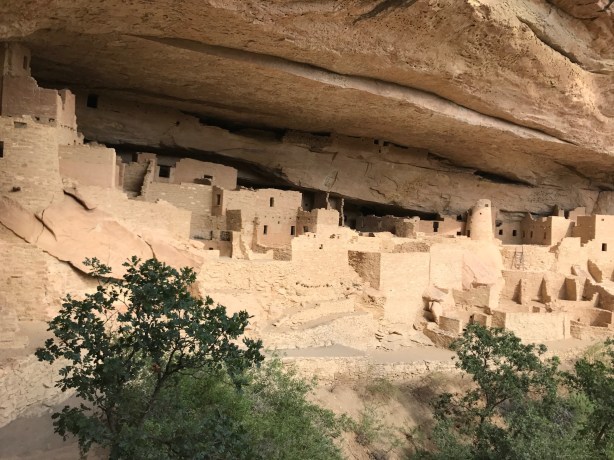
imageMesa Verde in southwestern Colorado is a world treasure, one of the mother ships of the great Pueblo network of the Southwestern United States. The ancestors of the present-day Pueblo Indians were hunter-gatherers who migrated from the far north long before the time of Jesus. The earliest settlements were simple encampments as they remained fairly nomadic, following the seasons. In time, by 500 CE, permanent pit homes were located near verdant agricultural lands. Many of these dwellings were located in what became large centers of tribal life in Chaco Canyon and Mesa Verde. They thrived with an intricate and balanced social system of life and eventually transitioned from living on top of the mesas to living below in cliff/cave arrangements with greater shelter and protection. What we see today as the ruins of the cliff dwellers in places like Puye Cliffs in New Mexico is the very latest chapter of their long development.

Sometime during the 1200s the inhabitants of these great cliff-dwelling societies vanished from their centuries-old homes. Unlike the parallel civilizations in Mezo-America and the peoples of the Andes in Latin America, the Pueblos were not marked by any conflagration, violence or conquests by invaders. They left because they could no longer live there and survive. But they didn’t disappear from the face of the earth; they migrated. They moved southward and formed or joined what are now the great pueblos which are scattered the length of New Mexico, Utah and Arizona. The story of the great migration from Mesa Verde is carried in the stories and dances of those present-day Pueblo cultures. That is why they hold Mesa Verda and Chaco as the figurative “mother ships” of their cultures, the first ancestors.

Any student of world history knows the rising and falling of civilizations for a variety of reasons. Warfare, conquest, and internal strife play obvious and important parts. A lesser cited but equally important cause is changes in the natural environment. From the end of the dinosaurs to ghost towns that were abandoned because the mines played out, civilizations are either wiped out or relocated.

In the case of Mesa Verde the best guess is that a deep drought that lasted as much as two decades decimated the crops and precipitated far-reaching famine. Like the Biblical story of Joseph and his brothers leaving Israel for Egypt in the time of drought, so the ancestors of the Pueblos packed up and left their homes in the cliffs forever behind.

If there is a cautionary tale for us today it comes in several layers.

The first and obvious truth is that nothing lasts forever. Civilizations rise and fall, some enjoying much longer and more resilient dynasties than others. But they all end or at least change form.

The ones that do  experience continuity are the ones that adapt with the changing circumstances. This often means transferring from one physical location to another. It can mean adapting the place we already are. We may face that in the future. It is possible that like the cliff-dwellers we look back from the future and tell stories of where and how we used to live.

A changing environment and climate is a definitive game changer. People have flocked to the South and Southwest of the United States thanks to air conditioning. But what happens when water sources dry up or our desertscapes become even more uninhabitable? They may actually be migrating back north. Please don’t build a wall, Canada.

The way that we are different than the cliff-dwellers is that we do not only experience the change of our environment in passive ways, simply living with or dying with what the natural world deals.  The cliff-dwellers’ whole way of life may have been changed by cyclical climate change, but they didn’t contribute to it. We now have the terrible power to do just that. Through vast environmental degradation, the destruction of water, land and air, we can create an unsustainable environment. We can hasten the end of our civilization as we know it. And our reach is so deep and far that the impact is not only local, but global. Damage our atmosphere by continuing to belch out carbon emissions and you do it to everyone. That is exactly why the Paris accords are so important; we are only as strong as the weakest national link.

One more thing the Puebo cliff-dwellers did not have at their disposal was atomic weapons. People are under the impression that the outcome of a nuclear conflagration would only be lots of dead people all at once. That would surely happen, but what’s more is the irreparable damage to the environments that support life. When the destruction is that vast there is nowhere to which you can migrate to create a future. That is why principled and informed people are so very concerned when nations posture, rattle swords and threaten the worst.

People of faith carry certain convictions about stewarding the world that we pass through but do not own. We have convictions about living as bountifully and peacefully as possible with one another. We have convictions about the goodness of nature and the goodness of humanity that, at its best, is created in the image of its creator.

At the same time we also know that everything is passing, even us, even the planets that orbit a star that may eventually obliterate them. Some things abide and some things pass away. The sound of the wind blowing through the now vacant kivas and pueblos of Mesa Verde remind us that what we see now is not forever even as we sense that the creating and sustaining power of the universe is.


Be determined, have a plan, expect the best, enter the wonder.

https://drive.google.com/open?id=0B0yHljE-Ej21WjZKOHlzT1o3N0U

The United States has been moving toward universal health care coverage for all its citizens for almost fifty years now. It has occurred in stops and starts with different kinds of initiatives, but it has been on the way. Who could draw a contrast more sharply between a President Richard Nixon and First Lady Hillary Clinton? Yet in their time on the political stage they both advocated for some form of universal coverage. In the case of Clinton, her failed initiatives were resisted by Republicans who labeled such efforts as “socialized medicine.” Their alternative vision in the 1990s was something along what we have today, a hybrid of public/private coverage.

While the most progressive edge of the Democratic Party always supported a central payer option – “Medicare for All” – Republicans balanced that with insurance industry led private solutions. A hybrid plan of public/private coverage is in fact what then Governor Mitt Romney designed for his state of Massacusetts. It was so successful that Romney’s plan became one of the major templates for the Affordable Care Act, what Republicans quickly attached to the President’s name – Obamacare.

During the development/hearing phase of the Affordable Care Act, the Romney plan provided a most helpful template. In addition, Republicans added well over a hundred adopted amendments to the plan, leaning it toward the private sector.  And yet when the vote was taken not one Republican voted for it. Their hybrid model had come into being, but for the sake of political statement, they had to oppose it – and spend seven years attempting to repeal it, all the while attempting to undermine and sabotage it so it would fail. But opposition is not the same as governing.

With the Republican ascendancy to control the Administration and both houses of Congress they found themselves in a very peculiar situation. The plan they were politically charged to dismantle was the very thing they would have presented as their own plan, the Romney solution.  So when it came to actually presenting an alternative to Obamacare they had none, that is, none that would be acceptable.  With vast ideological divisions in their own party they could not settle on a plan that was acceptable to their leadership, much less an American public that has warmed to the idea that all citizens should have real, not fake access to health care.  Republican Governors and Senators heard from their constituencies. Medicaid expansion was wildly popular. The Republican plan was doomed to failure.

Ironically, Obamacare was always seen as a compromise plan for many Democrats who still held to a vision of central-payer, universal coverage, a la Canada or the United Kingdom. That position is actually gaining strength again. Ironically, Obamacare – the Romney template – was something like what the Republican Party would have developed itself.

With the failure of the Republican effort to repeal and replace comes a moment when the GOP and DEMs could collaborate on strengthening our system.  Because of the need to win and prevail it is unlikely to happen. But one thing has already happened, directly and indirectly, beyond party and ideology: Americans have already come to believe that access to quality health care is a right of citizenship, not  something to be enjoyed by the privileged who can afford it. That change – more significant than any bill in congress – will most likely tell the future story of real access to health care in our country, whatever form it takes.

imageEvery so often you are privileged to witness shifts in history as they occur. That was true for me as I sat in the General Assembly of the Christian Church (Disciples of Christ) on Sunday evening, July 9.

Rev. Teresa Hord Evans was elected as the General Minister and President of the Christian Church (Disciples of Christ). This is a renewable six year term. She follows Rev. Dr. Sharon Watkins who completed a twelve year term.

Teresa is a graduate of Harvard and the University of Chicago Divinity School where she later served as Dean of Students. She is the first African American woman to serve in the highest post of the church, a first among all Christian denominations in the United States and Canada. She takes her place as a pace-setter alongside Sharon Watkins, who was the first female head of communion among the many Christian denominations.

What a deep drink from the well of sanity and sanctity! I’m here with friends, gathering with the tribe of the Christian Church (Disciples of Christ) at the General Assembly in Indianapolis. With what is swirling in the world at present it is satisfying and inspiring to reconnect with a wholly different story and affirmation of what life really means and the terms of engagement for this time.  Much of this is simply restating the core values of faith, justice and deep community.

Sharon Watkins has just finished a twelve year term of service as our General Minister and President.  She has been a steady and inspired presence at her post. Many of us remember when she was the preacher at the Innagural worship service in the National Cathedral for President Obama.  Sharon was the first female “Head of Communion” in the nation – now joined by several other women in other denominations who occupy the highest post. One of the most powerful tributes I heard given to Sharon was that she made the fact of a woman serving in the church at this level “normal.” Yes she did. So much so that our next GMP will also be a woman and an African American woman at that.  We  will pass the baton to Rev Teresa Hord Owens at the close of the Assembly.

When the national/international tribe of church gathers it is always a time for high festival celebration. That includes the best and brightest worship and that was certainly true for the opening night of the Assembly. It was refreshing to hear that unity is not real unity unless it is unity shaped by justice. In a time when that message is mostly absent from national discourse we were heartened to remember who we are and who we are meant to be.

In addition to countless reunions with colleagues and church folk from across the years the Assembly is a magnificent gathering of the whole church in all its diversity. In local congregations we often lose track of our remarkable ethnic and geographic richness. Our brothers and sisters who live and minister in many varied contexts do so in ways we cannot, and that is the point. Together we are a potent force for the activity of the Spirit in a universal kind of way. Our ecumenical and international relationships are rich. Our reach into every aspect of society is broad. We are not alone.

This morning we worship at Central Christian Church and hear William Barber bring the word. He has been a voice for faithful engagement for justice in our time. We can’t hear that message too much.

Return and Repair

Posted: July 1, 2017 in Uncategorized

As the young woman walked down the stairs into the basement she noticed that it was the same as always, yet not the same as always. Sitting beneath the small window at the workbench, was her grandfather, bent over his work. She smelled the mixing fragrances of oil, wood shavings, gasoline and grass clippings. It was just like always except for one thing; her grandfather died years ago.

Standing beside the bench she could hear his raspy breathing. He spoke without lifting his eyes from his work. “I’ve been waiting for you to come.”

She stood silently, waiting. “Years ago I went to the shop and found a wooden chain, one I had carved from one piece of pine, broken, one link cracked. I never asked and you never told.”

After what seemed like an eternity she cleared her throat. “Yes, Grampa, I was playing and using the chain as a whip and it broke. I put it up and never told anyone.” She held her breath, anticipating the worst.

“You are not to worry about breaking it,” he said as he continued to sand. “That broken link represents a terrible loss you would endure in your life. Do you know which one?”

The young woman nodded yes.

At that Grandfather turned away from the bench and handed her the wooden chain with the link repaired. “Sometimes time heals, but not always. The most important healer is love because it is timeless. And that’s why you came back.”

She carried the wooden chain carefully up the stairs, walked to the living room and placed it on the mantle right beside the urn with the ashes in it.

They were perfect side by side.

Sometimes the issue du jour is living in your own back yard. That is the case with the recent Supreme Court case of Trinity Lutheran Church in Columbia, Missouri. The issue was whether that congregation was eligible to receive funds for the development of a playground through the Department of Conservation if it satisfied all application requirements. It had in fact satisfied the requirements but was denied anyway because Missouri’s Constitution denies state funding for religious organizations. The high court ruled in the church’s favor saying that it goes too far when public funds are denied for a cause as secular as a playground.

Even as a pastor and one who frequently comes down on the side protections of religious freedom, I have problems with the ruling. I’m glad the church is getting its rubberized playground surface. I am, however, unconvinced by the high court’s ruling.

The Constitutional question, of course, has to do with the First Amendment and its “non establishment” clause and “free exercise” clause. Government shall not establish any one religious organization nor shall it prohibit the free practice of any religious organization. The founders, in particular Thomas Jefferson, elucidated the principle behind the amendment as being one of separation between church and state. That is, they shall not be too intermingled – either positively or negatively.

The put this in context the Supreme Court has ruled in the past that government money might not be used to specifically fund scholarships for religious training. That would be direct government support of a religiously sectarian effort. Church playgrounds, though, have now fallen into another category, classed along with other community organizations with public facilities.

Missouri Attorney General Josh Hawley and Governor Eric Greitens applauded the decision. They, like a majority of the high court, fall on the side of what they would call religious liberty and against unfair treatment of churches simply because they are religious organizations.

Here is why I have problems with this and it is both a Constitutional argument and a theological one.

The free exercise clause prohibits any effort to block any form of religious expression. This was a corrective that the founders found essential as they experienced the opposite in the countries of their origins. Too often minority religions were persecuted mightily. In the case of a state church, non-authorized religions were seen as as illegal and immoral for state and church. Our founders knew they must protect religious freedom from religious tyranny.

Free exercise, however, is not absolute. Other laws may supersede this. In the case of the Branch Davidians, for example, laws about child endangerment superseded free exercise of religion; just because this is part of your religious practice that does not mean that it is acceptable according to other laws of the land. Free exercise is not absolute.

And here is where the problem begins. The Trinity Lutheran Church playground case was not about persecution, mass discrimination or the suppression of free exercise. None of that was in play. The case was not primarily about the free exercise clause – thought arguments presented it in that way. Rather, it was about the non-establishment clause.

Should state money, government money, be used to support any religious organization? The answer based on past rulings tends to be that exceptions may be made for government money channeled to churches if the uses of that money are designated for a community non-religious good, like the distribution of food, clothing and other resources. And they extended that reasoning to things like playgrounds.

Lots of kids from the neighborhood could use it, they said. But that is not really the core issue. This is the church’s playground used primarily for its congregation and its programs. Would we say at my congregation that everything in the church is religious and created with religious intent except the playground? We would not. We would never say that the playground is separate, that it’s secular. No, it is seen as part and parcel of our entire church’s mission and ministry.

I would say that by using government money to support a church in the development of a playground they are indeed violating the non-establishment clause and the principle of separation of church and state. You see, it’s not really about a playground – that’s just the presenting issue. This judgement is biased and tilting toward something else.

For all the “school choice” people who welcome government support of religious schools this is a convenient step in that direction. As a matter of fact that position is now being articulated by our Secretary of Education, Betsy Devos, who wants more money directed to school vouchers for religious schools. And that is how a judgement about a church playground is about more than a church playground.

I think we should be expecting more and more disregard of the non-establishment clause of the First Amendment. What we will see instead is more language about the free-exercise clause, hyperbole on steroids. Keeping the balance of those two is important but that balance is being diluted with this recent Supreme Court judgement on the Trinity Lutheran Church Playground.

Oh, I would be derelict not to mention the greatest irony of the moment: All of this is being brought to you compliments of the same people who are most often in the “states rights” camp. They don’t want some runaway federalism forced down on the states. Except they don’t seem to mind disregarding Missouri State Constitution when it draws a line in the sand between church, state and funding. But in this case, when it suits their purposes, I suppose it’s just fine to ignore it.